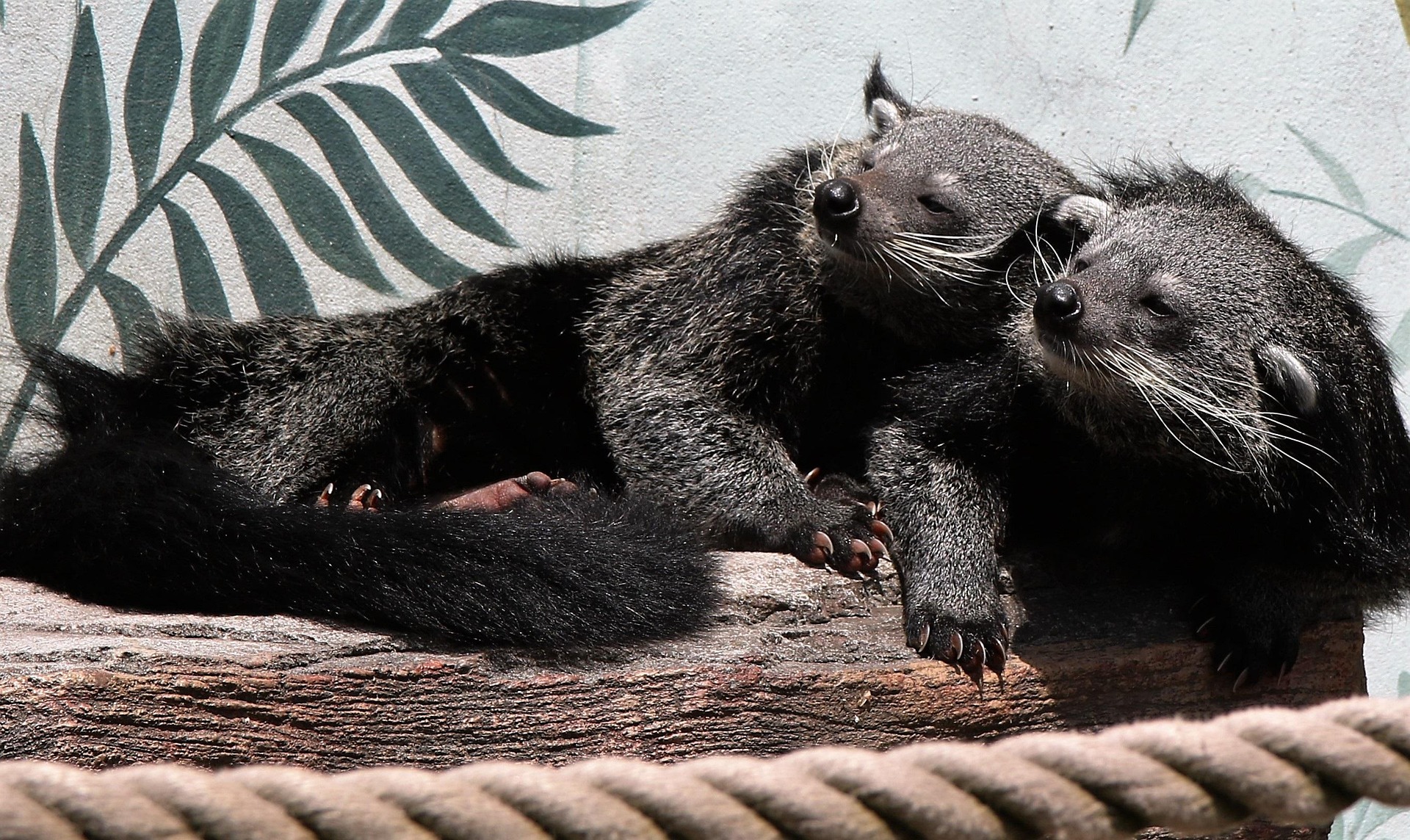
What kind of animal is the Binturong? We will explain its characteristics, ecology, and habitat. It is a member of the civet family that mainly lives in Southeast Asia, and at first glance it looks similar to a cat. It has a unique body odor. This animal is designated as an endangered species and is in urgent need of protection.


- What is Binturong? Basic Stats
- What are the roots and origins of the binturong?
- Habitat
- What are its characteristics? What kind of creature is it?
- What is its ecology?
- About Molting
- About Their Vocalizations
- Seasonal Activity
- About Baby Binturongs
- Is the binturong an endangered species?
- Can you keep a binturong as a pet?
- Zoos Housing Binturongs (Japan & Worldwide)
- Recommended articles
What is Binturong? Basic Stats
Binturong is a carnivorous animal classified in the Mammalia, Carnivora, Civetidae, Binturong genus. This species alone constitutes the Binturong genus. Its scientific name is Arctictis binturong, or Bear cat or Binturong in English. It is also known as Bear cat or Binturong.
| Japanese(和名) | ビントロング |
| English(英名) | Bear cat、Binturong |
| scientific name(学名) | Arctictis binturong |
| classification(分類) | Mammalia、 Carnivora、 Viverridae、binturong 哺乳綱、食肉目、ジャコウネコ科、ビントロング属 |
| IUCN Status(保全状況) | VULNERABLE~ |
| Length(体長) | 60-90cm |
| Weight(体重) | 9-15kg |
About classification
The classification has the following subspecies. This is a quote from Wikipedia.
- Arctictis binturong binturong (Raffles, 1821)
- Arctictis binturong albifrons (Cuvier, 1822)
- Arctictis binturong kerkhoveni Sody, 1936
- Arctictis binturong mengalensis Wang & Li, 1987
- Arctictis binturong penicillata Temminck, 1835
- Arctictis binturong whitei Allen, 1910
Binturong Taxonomy
- 界(Kingdom): 動物界 (Animalia)
- 門(Phylum): 脊索動物門 (Chordata)
- 綱(Class): 哺乳綱 (Mammalia)
- 目(Order): 食肉目 (Carnivora)
- 科(Family): ジャコウネコ科 (Viverridae)
- 属(Genus): パラドクスルス属 (Paradoxurus)
- 種(Species): ビントロング (Paradoxurus hermaphroditus)
What are the roots and origins of the binturong?
The binturong is an animal belonging to the Viverridae (civet) family, originating in the tropical forests of Southeast Asia.
Scientific name: Arctictis binturong
Classification: Order Carnivora → Family Viverridae → Genus Arctictis
Distribution: Northeast India, Bangladesh, Myanmar, Thailand, the Malay Peninsula, Indonesia, etc.
Habitat: Tropical rainforests and forests
🌏 How did it evolve?
The binturong belongs to the civet family (Viverridae), not the cat family (Felidae).
Broadly speaking, its evolutionary path is thought to be:
Ancient carnivore ancestor
↓
Civet lineage
↓
Binturong ancestor
↓
Adaptation to arboreal (tree-dwelling) life
↓
Modern binturong
A particularly distinctive feature is its long tail.
Unusual among carnivores, the binturong possesses a prehensile tail—capable of wrapping around branches to support its body. This is a crucial adaptation for its life in the trees.
🐻 Why is it called a “Bearcat”?
Its appearance consists of:
A bear-like body + a cat-like face
…which is why it is sometimes called a “Bearcat” in English.
However, it is neither a bear nor a cat.
Phylogenetically, it actually belongs to a group closely related to mongooses and civets.
Habitat
It is known to be distributed quite widely in Southeast Asia, including India, Indonesia, Cambodia, Thailand, Nepal, and the Philippines.
- Main Habitat
Region:
India, Sri Lanka
Southeast Asia (Thailand, Malaysia, Indonesia, Philippines, Vietnam, etc.)
Parts of New Guinea and the Solomon Islands
Environment: Tropical rainforests, secondary forests, mangrove forests, and forests near agricultural land
- Habitat Characteristics
Adapted to arboreal life, they base their activities in tree branches and tree cavities.
Nocturnal, resting in tree cavities or on trees during the day.
May appear near human habitats, feeding on fruit in orchards and agricultural fields.
- Ecological Points
Highly Adaptable: They can live not only in primary forests but also in secondary forests and agricultural fields that have been cultivated by humans.
Territory: Each individual has its own territory and moves around at night in search of food.
Preferentially near water sources: They often appear near water sources to forage for fruit and small animals.

What are its characteristics? What kind of creature is it?
Its whole body is covered with long, coarse hair, but its head is covered with short hair and its ears are small and rounded. It has six incisors on the top and bottom, two canines on the top and bottom, eight premolars on the top and bottom, six to eight molars on the bottom, and two to four molars on the top. It is a mysterious animal with a unique scent like almonds or popcorn, and has a body odor. It uses its long tail to balance itself and can move around by grasping tree branches. It is an animal that basically lives in trees. It lives alone or in small groups. It is nocturnal and rests during the day.
- Physical Characteristics
Size: Medium (approximately 50-70 cm body length, approximately 45-60 cm tail length)
Weight: Approximately 2.5-5 kg
Coat Color: Brown to dark brown; some individuals may have dark stripes or spots on their backs.
Tail: Long and bushy, adapted for climbing and balancing.
Face/Ears: Pointed face, round ears, large eyes (adapted for nocturnal behavior).
- Behavior/Personality
Nocturnal: Rests in tree holes or in trees during the day and becomes active at night.
Arboreal Life: Specializes in navigating trees and forages for nuts and small animals.
Omnivorous: Eats fruits, nuts, small mammals, bird eggs, insects, etc.
Highly Alert: Sensitive to humans and predators, and will flee to the trees if it senses danger.
- Sociality/Personality
They are generally solitary.
They do not form groups except during breeding season and live within their own territories.
They are highly intelligent and show ingenuity in their foraging and nest-building behavior.
What is its ecology?
Binturongs live by eating fruits, insects, birds, small mammals, earthworms, etc. It reproduces viviparously. It can breed all year round. It has a gestation period of three months and gives birth to one to three pups. Its lifespan is 15 to 20 years.
- Living Environment and Behavior
Habitat: Tropical rainforests, secondary forests, mangrove forests, and near agricultural land
Arboreal: Resting in tree hollows or on branches during the day
Nocturnal: Active and foraging in the evening and at night
Territory: Usually solitary territories, not forming groups except during breeding season
- Diet
Omnivorous: Fruits, nuts, small mammals, bird eggs, insects, etc.
Foraging Behavior: Locates nuts by smell and hunts in trees or on the ground
Adaptability: May forage in human farmland and orchards
- Breeding
Estrous Period: Breeds approximately once a year, depending on the region and climate
Gestation Period: Approximately 2-3 months
Birth: Gives birth to 1-4 pups
Raising: Mothers protect their young in tree hollows and teach them how to forage
- Sociality and Behavior
They are generally solitary creatures.
They are highly cautious and avoid humans and predators.
They are highly intelligent and have ingenious methods for finding food and building nests.
Do they have any natural enemies?
The natural enemies of the binturong are tigers, leopards, clouded leopards and dholes.

About Molting
Binturongs do not undergo the type of seasonal molting that involves a massive change in their coat.
🍂 Molting Characteristics
They shed and replace their fur gradually throughout the year.
They do not typically exhibit distinct, major “spring” or “autumn” molts.
In captivity, the amount of shedding can vary depending on factors such as temperature, humidity, daylight hours, and nutritional status.
They possess long, coarse guard hairs and a soft undercoat, making them well-adapted to forest environments.
🌴 Why is there no major seasonal molt?
The binturong’s primary habitat is the tropical and subtropical forests of Southeast Asia.
Unlike animals from temperate zones,
Winter → Thick winter coat
Spring → Transition from winter to summer coat
…they do not need to undergo such drastic changes in their fur.
About Their Vocalizations
Although their appearance might suggest otherwise, binturongs are animals capable of a wide variety of vocalizations.
“Kuk-kuk-kuk” / “Ku-ku-ku”: Sounds sometimes made when excited or in a good mood.
“Hah-hah” breathing sounds: Observed during moments of excitement or tension.
Low growls: Produced when on alert or to signal discomfort.
Higher-pitched calls: Sometimes emitted when startled or during communication.
Young binturongs may make sounds to call out to their parents.
🔊 Key Characteristic
Binturong vocalizations range widely, from sounds resembling a cat’s meow to those sounding like a bird.
They are particularly well-known for a “ku-ku-ku” sound—resembling a chuckle—made when they are in a good mood. In English-speaking regions, this specific vocalization is often described as a “chuckle.”
Additionally, as binturongs are nocturnal, vocal communication plays an important role during the night.
Seasonal Activity
Since binturongs inhabit the tropical and subtropical forests of Southeast Asia, they do not exhibit the dramatic seasonal changes seen in animals from temperate zones. However, their activity levels do fluctuate based on the rainy and dry seasons, as well as breeding cycles and food availability.
Seasonal Activity Overview
🌸 Spring: Primarily active at night. They move through the tree canopy searching for fruit and small animals. Breeding-related behaviors are also observed.
☀️ Summer: Active at night while avoiding the heat. Fruit consumption increases when fruit is abundant.
🍂 Autumn: Move through the forest in search of fruit and other food. Foraging activity is primarily nocturnal.
❄️ Winter: As there is no harsh winter in tropical regions, they generally remain active as usual. Their activity is influenced more by food availability and rainfall than by temperature.
🌧️ “Rainy vs. Dry Season” Matters More Than the Four Seasons
For binturongs, the cycle of rainy and dry seasons is more significant than the four seasons found in Japan:
Rainy Season → Increase in plants and fruit → Changes in foraging conditions
Dry Season → Shifts in food and water distribution → Changes in movement patterns
Additionally, as binturongs are nocturnal and arboreal, their general routine involves resting during the day and being active from evening through the night throughout the year.
About Baby Binturongs
Baby binturongs (Paradoxurus hermaphroditus) differ in physique and behavior from adult binturongs, and they grow up dependent on their mother and a safe place.
- Physical Characteristics
Body Length and Weight: Approximately 20-25 cm in length and 150-250 g in weight immediately after birth.
Fur Color: Soft and light brown at birth, changing to dark brown or blackish brown as they grow.
Tail: Becomes bushy and long as they grow, but is short and soft during juvenile development.
Eyes and Ears: Their large eyes and round ears, adapted for nocturnal behavior, are well developed even immediately after birth.
- Behavior and Personality
Dependent on their Mother
They spend time with their mother in tree holes or burrows.
They learn how to forage and climb trees while nursing.
Play and Learning
Climbing branches and playing with their mother and siblings.
They practice searching for prey and fruit, preparing for independent living.
- Ecological Points
Nursing Period: They are breastfed for the first 2-3 months.
Weaning: They begin eating fruit, insects, and small animals at around 3-4 months of age.
Independence: They leave their mothers at 6 months to 1 year of age and begin living independently.
Learn Vigilance: They learn to avoid danger and navigate in trees by observing their mothers’ behavior.
Is the binturong an endangered species?
The binturong is used for food and medicine, so its numbers are declining due to overfishing. The population is declining due to habitat destruction and hunting, and it is listed in Appendix III of the Convention on International Trade in Endangered Species of Wild Fauna and Flora (CITES), and is designated as an endangered species.
- International Union for Conservation of Nature (IUCN) Assessment
The IUCN Red List classifies this species as “Least Concern (LC).”
Due to its wide distribution and relatively stable population, the risk of extinction is considered low.
- Why it’s not endangered
Distributed widely from Southeast Asia to India, Sri Lanka, and New Guinea.
Arboreal and omnivorous, it is highly adaptable and can survive in farmland and secondary forests.
It has limited natural predators, so its survival rate in the wild is relatively high.
- Caution
Deforestation and development: Logging of tropical rainforests can cause localized habitat loss.
Capture for pets and food: Human activities have had an impact in some areas.
Populations remain stable in protected areas and areas where conservation efforts are underway.
Can you keep a binturong as a pet?
The binturong is designated as an endangered species, so it is difficult to keep as a pet. We recommend viewing it at a zoo or other place. Visit the general information page of the zoo and participate in an event. Visit the zoo’s page and check out the overview from the site map.
- Legal and Regulatory Considerations
Binturongs may be protected as wild animals in some countries.
Capturing and raising them without permission is likely illegal.
In Japan, they may be listed under Appendix II of the Convention on International Trade in Endangered Species of Wild Fauna and Flora (CITES), requiring permission for import and breeding.
- Ecology and Breeding Environment
They are adapted to arboreal life and require ample space for movement.
They are nocturnal, resting during the day and becoming active at night.
They are omnivorous and have a diverse diet.
Fruits, nuts, small mammals, bird eggs, insects, etc.
Recreating their natural diet is extremely difficult.
They are solitary and territorial.
They do not live in groups and are prone to stress in shared spaces.
- Suitable Breeding Locations
Zoos and research facilities with ample exercise areas and arboreal facilities are essential.
Professional staff are required to manage their feeding, health, and behavior.
Zoos Housing Binturongs (Japan & Worldwide)
According to the latest information, a significant number of zoos in Japan house binturongs. However, as individual animals are frequently transferred between facilities, this information is subject to change.
🇯🇵 Japan
Binturongs are confirmed to be housed at 21 facilities, including zoos and safari parks.
Regional Zoos & Facilities: Iwate (Iwate Safari Park); Tochigi (Nasu Animal Kingdom, Nasu Safari Park); Gunma (Gunma Safari Park); Chiba (Ichihara Elephant Kingdom & Sayuri World); Nagano (Nagano City Chausuyama Zoo); Shizuoka (Izu Shaboten Zoo Park); Aichi (Higashiyama Zoo and Botanical Gardens); Hyogo (Kobe Oji Zoo, Kobe Animal Kingdom, Himeji Central Park); Yamaguchi (Akiyoshidai Safari Land, Shunan City Tokuyama Zoo); Ehime (Ehime Prefectural Tobe Zoo); Kochi (Kochi Prefectural Noichi Zoological Park); Fukuoka (Fukuoka City Zoo); Kumamoto (Kumamoto City Zoological and Botanical Gardens, Aso Cuddly Dominion); Kagoshima (Kagoshima City Hirakawa Zoological Park); Okinawa (Neo Park Okinawa, Okinawa Zoo & Museum).
Facilities such as Kochi Prefectural Noichi Zoological Park and Higashiyama Zoo and Botanical Gardens are particularly notable for their ongoing binturong husbandry programs.
🌍 Worldwide
Binturongs are kept at a wide range of facilities internationally. Examples include:
🇺🇸 Bronx Zoo (USA)
🇩🇪 Tierpark Berlin, Dortmund Zoo (Germany)
🇨🇿 Ostrava Zoo, Olomouc Zoo (Czech Republic)
🇬🇧 Edinburgh Zoo, Port Lympne Wild Animal Park, Colchester Zoo (UK)
🇳🇱 Royal Burgers’ Zoo, Artis (Netherlands)
🇦🇺 Melbourne Zoo (Australia)
🇹🇭 Chiang Mai Zoo, Chiang Mai Night Safari, etc. (Thailand)
🇷🇺 Moscow Zoo breeding facility (Russia)
🇮🇱 Hai Park (Israel)
Globally, the binturong is an important species subject to breeding and conservation efforts in zoos.
Recommended articles
コメント