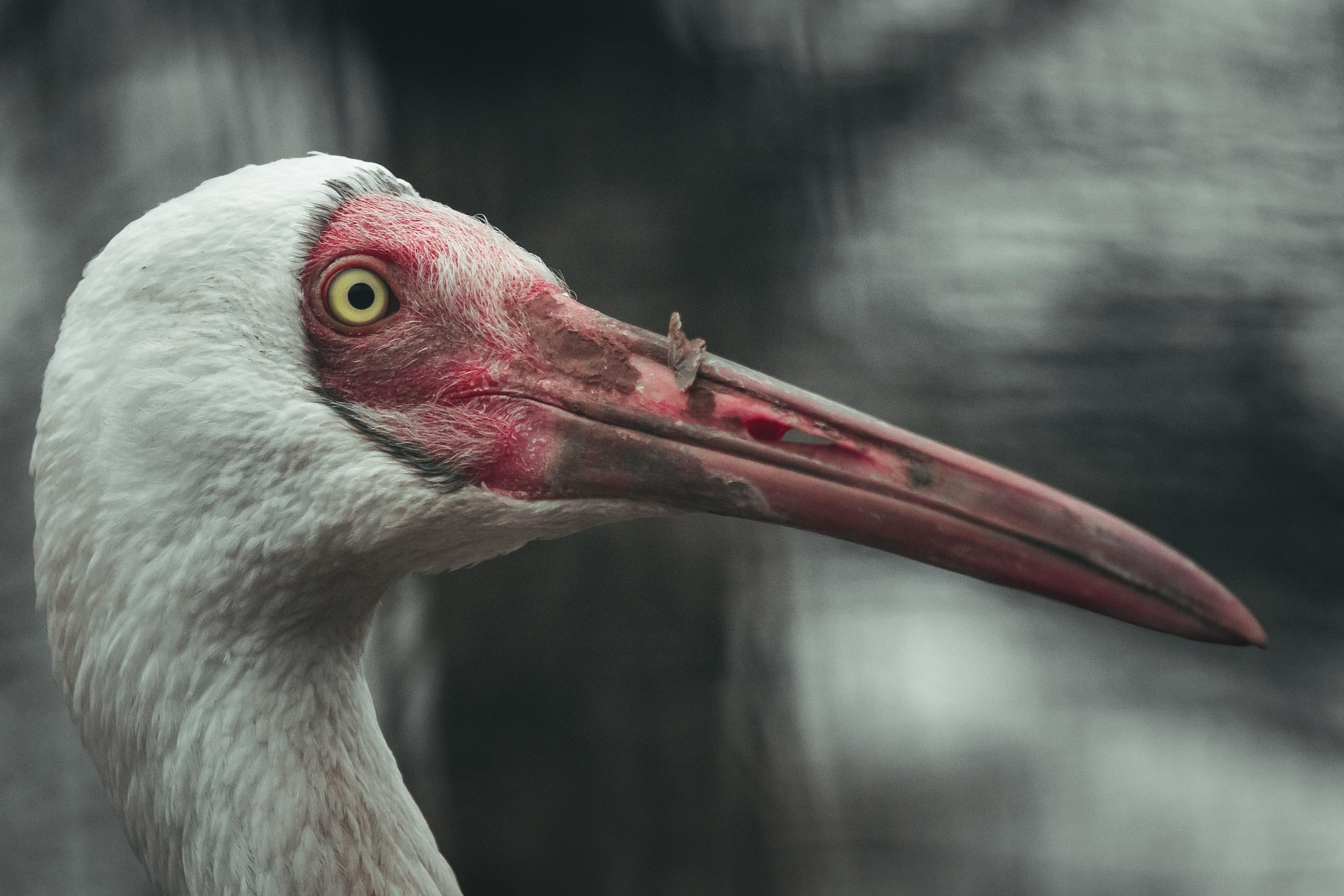
What kind of bird is the Siberian Crane? We will explain its characteristics, ecology, and habitat. As you can tell from the English name, this bird is distributed in Russia and other places, and its habitat extends as far as India. However, it is a bird designated as an endangered species.


- What is a Siberian Crane? Basic Stats
- What are the roots and origins of the Siberian Crane?
- Habitat
- What are its characteristics? What kind of creature is it?
- What is its ecology?
- About Siberian Crane Chicks
- Are Siberian Cranes an endangered species?
- Can Siberian Cranes be kept as pets?
- Zoos Housing the Species (Japan & Worldwide)
- Recommended articles
What is a Siberian Crane? Basic Stats
The Siberian crane is a bird classified in the Gruidae family, Grus genus, and Grus order. Its English name is Siberian crane, and its scientific name is Grus leucogeranus. Its body length is about 140cm, its weight is 4-5kg, and its wingspan is 230cm. The list of information is as follows.
| Japanese(和名) | ソデグロヅル |
| English(英名) | Siberian crane |
| scientific name(学名) | Grus leucogeranus |
| classification(分類) | Aves、 Gruiformes、 Gruidae、Grus 鳥綱、ツル目、ツル科、ツル属 |
| IUCN Status(保全状況) | CRITICALLY ENDANGERED |
| Length(体長) | 120~140cm |
| Weight(体重) | 4-5kg |
Taxonomic position (taxonomy)
| 階級 | 分類 |
|---|---|
| ドメイン | 真核生物 (Eukaryota) |
| 界 | 動物界 (Animalia) |
| 門 | 脊索動物門 (Chordata) |
| 綱 | 鳥綱 (Aves) |
| 目 | ツル目 (Gruiformes) |
| 科 | ツル科 (Gruidae) |
| 属 | ツル属 (Grus) |
| 種 | Grus monacha |
What are the roots and origins of the Siberian Crane?
The Siberian Crane (Leucogeranus leucogeranus) is a highly distinctive crane species belonging to the family Gruidae; it is considered to represent a lineage that diverged quite early within the family. It is currently the only extant species in the genus Leucogeranus.
Tracing back to the crane ancestor
Within the class Aves, the Siberian Crane is positioned in the following lineage:
Aves (Birds)
↓
Gruiformes (Cranes and allies)
↓
Gruidae (Cranes)
↓
Gruinae (Typical cranes)
↓
Leucogeranus (Siberian Crane genus)
↓
Siberian Crane
There are currently 15 known species in the family Gruidae, which are broadly divided into two subfamilies:
Balearicinae (Crowned cranes)
Gruinae (Typical cranes)
Genetic studies suggest that the crowned cranes (Balearicinae) represent the earliest diverging lineage among extant cranes, with the Gruinae subfamily diverging subsequently.
The Siberian Crane: An “ancient branch” among cranes
This is a particularly interesting aspect when considering the origins of the Siberian Crane.
DNA-based phylogenetic analysis indicates that, within the subfamily Gruinae,
the Siberian Crane (Leucogeranus) is the lineage that diverged earliest from all other extant cranes.
Visually, the relationship looks like this:
┌─ Siberian Crane
Gruinae ───────┤
│
└─ Other cranes
├─ Demoiselle cranes
├─ Wattled Crane
├─ Hooded Crane
├─ White-naped Crane
├─ Red-crowned Crane
└─ Others
In other words, the Siberian Crane belongs to a lineage that began its own independent evolutionary path at a very early stage among modern cranes.
When did it diverge?
Molecular phylogenetic analysis estimates that the Leucogeranus lineage (Siberian Crane) diverged from the rest of the subfamily Gruinae during the Late Miocene.
In contrast, the common ancestor of the subfamily Gruinae itself may date back to the Middle Miocene. Research combining fossil records and DNA data suggests that the lineage leading to modern cranes diverged during this period.
Broadly speaking, the sequence of events is as follows:
Middle Miocene
↓
Evolution of the Gruinae ancestor
↓
Late Miocene
↓
Divergence of the Siberian Crane lineage from other cranes
↓
Subsequent evolution
↓
Extant Siberian Crane
Note: It is difficult to pinpoint exactly how many millions of years ago the Siberian Crane itself emerged based solely on fossils; the timeline above is primarily inferred from molecular phylogenetic studies.
What makes the Siberian Crane unique?
The Siberian Crane is highly distinctive compared to other cranes.
Its combination of a pure white body, black wingtips, and a red face is truly unique.
Another distinguishing feature is the absence of the complex tracheal coiling found in many other crane species. Skeletal studies have also confirmed that the Siberian Crane possesses characteristics that differ from those of other cranes.
For this reason, the Siberian Crane is not merely a “white crane”; it represents a distinct lineage that is crucial to understanding the evolutionary history of cranes.
Habitat
Siberian Cranes are found in Afghanistan, Iran, India, China, Pakistan, and Russia. They often hibernate in the winter, so they are often at the top of social news content. You can see photos and videos of them on internet pages.
- Geographic Distribution
Breeding Grounds
Eastern Russia (Primorye, around Sakhalin)
North Korea, northeastern China
Breeds in wetlands, riverside areas, and moist grasslands
Wintering Grounds
Japan (including flooding in Kagoshima Prefecture), South Korea, and southern China
Wintering in rice paddies, wetlands, and shallow lakes
- Habitat Characteristics
Prefers wetlands, rice paddies, and shallow lakes
Wintering in areas with abundant food (seeds, plant buds, and aquatic life)
Breeding Grounds
Nests near moist grasslands and marshes
Nests in ground nests in wetlands and moist grasslands
Often forms flocks in open areas, rarely living in trees
- Migration
Typical Migratory Bird
Migrates long distances (thousands of kilometers) between breeding and wintering grounds
Among the cranes in East Asia, Japan has the highest concentration of wintering grounds
- Importance of habitat conditions
Wetlands and rice paddies are essential
They also use artificially preserved rice paddies and tidal flats in their wintering grounds
Conserving diminishing wetlands and rice paddies is key to their survival

What are its characteristics? What kind of creature is it?
The Siberian Crane has no feathers on its face, red skin, and white plumage. Its iris is yellow or pale yellow, and its beak is thick and long. The Siberian Crane is a migratory bird that breeds in Russia and Siberia, and migrates to southern China and India in winter. It lives in shallow marshes, reed fields, and the shores of lakes with thickets.
- Physical Characteristics
Physique
Medium-sized crane
Body length: Approximately 110–120 cm
Weight: Approximately 2.7–3.6 kg (same weight for males and females)
Covered entirely in gray feathers
Head and Neck
The head is black, with white “sleeve”-like patterns on the face and neck.
The neck is long and gray, and the body is slim.
The beak is gray and slender, suitable for feeding.
Legs and Wings
Long legs, adapted for walking and feeding on the ground.
Large wings allow for flight and long-distance migration as a migratory bird.
- Behavior & Ecology
Diet
Omnivorous, but primarily herbivorous
Seeds, aquatic plant shoots, and roots
Also consume small aquatic invertebrates (insects, earthworms, etc.)
Often feeds in rice paddies and wetlands
Social
Winters and feeds in groups outside of the breeding season
May form large groups during migration
During the breeding season, they travel in pairs and have territories
Call
High-pitched, clear call of “kyo, kyo”
Used for communication and warning
- Breeding
Nests are built on the ground
Simple nests made of piles of fallen leaves and grass in wetlands or grasslands
Egg size: 1-3
Both parents incubate the eggs and protect the chicks
Chicks leave the nest and become independent within a few weeks
- Special Features
Their name comes from the black pattern on their heads and white “sleeves.”
As a medium-sized, flight-capable crane, they possess stable, long-distance flight capabilities among migratory birds.
They are characterized by their reliance on wetlands and rice paddies, playing an important role in ecosystems.
What is its ecology?
The Siberian Crane is an omnivore with a strong tendency to eat plants, and lives on plant buds, roots, fruits, seeds, insects, fish, and frogs. It is an oviparous breeding method. It lays 1-2 eggs at a time, and the incubation period is 27-29 days. It is said that the life span of wild Siberian cranes is 60 years.
- Habitat Relationship
Wetland-Dependent Migratory Bird
Breeding season: They live in humid grasslands and wetlands in eastern Russia, North Korea, and northeastern China.
Wintering season: They live in rice paddies, tidal flats, and shallow waters in Japan (including Izumi, Kagoshima), Korea, and southern China.
They nest on the ground, so they require open wetlands and grasslands.
Waterside areas are important for feeding and ensuring the safety of their chicks.
- Diet
They are omnivorous, but primarily plant-based.
Seeds, grains, and aquatic plant shoots and roots.
They also consume insects, earthworms, and small aquatic invertebrates.
They forage while walking in rice paddies and wetlands.
In wintering areas, they also utilize human-grown land (rice residue).
- Migration
A Typical Migratory Bird
They travel thousands of kilometers between breeding and wintering grounds.
They arrive in Japan around October each year and return to their breeding grounds around March.
They form flocks during migration and rest in wetlands and rice paddies during their migration.
- Social Behavior
Hibernates in groups outside of the breeding season.
During the breeding season, pairs maintain territories.
They call “kyo, kyo” with a high, clear voice.
Used during breeding and when alert.
Although they have limited flying ability, their stable flight skills are adapted for long-distance migration.
- Breeding and Chick Rearing
Nests are built on the ground.
Simple nests made of piles of fallen leaves and grass in wetlands or grasslands.
Egg Size: 1-3.
Both parents incubate the eggs and protect the chicks.
The chicks leave the nest within a few weeks and learn to forage under their parents.
Do they have any natural enemies?
The Siberian Crane has no particular natural enemies.

About Siberian Crane Chicks
This article provides a detailed overview of Siberian Crane (Grus monacha) chicks.
- Egg Laying and Hatching
Egg Number: 1–3 per brood
Nest Location: Built in marshes or grasses on the ground
Simple nests made of piles of fallen leaves and grass
Egg Color and Size: Light green to blue-green, approximately 7–8 cm
Hatching Time: Approximately 27–30 days
- Chick Appearance
Their feathers are pale brown to dark brown with stripes, providing a camouflage coloring that blends in with their surroundings.
Their heads and necks are not yet black, and the characteristic adult coloring is underdeveloped.
Their legs and wings are small, they are incapable of flight, and they walk cautiously.
- Chick Behavior
Both parents (especially the male) protect the chicks.
Before fledging, they live near the nest, hiding from predators.
They learn to forage under the guidance of their parents.
During the early breeding season, they learn to feed by walking with their parents in shallow marshes.
- Growth and Independence
Initially, they depend on the nest and their parents.
The stripes on their feathers gradually disappear, turning their body gray.
The black on their heads and the white sleeves on their necks develop over several months.
They become independent about 2-3 months after hatching, and they also practice flying with their parents for migration.
- Key Points for Survival
Young birds are vulnerable to birds of prey and introduced predators (dogs and cats).
Since they nest on the ground, hiding places and parental protection are key to their survival.
In their wintering grounds, they learn to forage safely within the flock.
Are Siberian Cranes an endangered species?
Siberian Cranes are designated as an endangered species (Red List). There are only a small number of Siberian Cranes worldwide, and development and other factors are causing a further decline in their population.
- IUCN Red List Classification
Classification: Vulnerable (VU)
This means that wild populations are declining and are at risk of future extinction.
- Population and Distribution
Distributed primarily in East Asia
Breeding areas: Eastern Russia, North Korea, and northeastern China
Wintering areas: Japan (including Izumi, Kagoshima Prefecture), South Korea, and southern China
The global population is estimated to be around 10,000 birds.
Flocks of several hundred birds have been observed in wintering areas.
- Major Threats
Decrease in wetlands and rice paddies
Habitat loss due to agricultural development, reclamation, and urbanization
Anthropogenic impacts on wintering areas
Inadequate management of feeding areas and risk of damage from pesticides
Climate change
Changes in migration routes and wetland environments affect survival
Predation and human activity
Young birds and eggs are vulnerable to predation
Illegal capture is rare, but has an impact
- Conservation Status
In Japan, the Izumi crane migration site has been designated a natural monument and is protected.
Habitats are also secured in protected areas in South Korea and China.
Internationally, the species is listed under Appendix II of the CITES Convention, and international trade is restricted.
Wetland conservation and management of feeding grounds in wintering areas are key to conservation.
Can Siberian Cranes be kept as pets?
As Siberian Cranes are an endangered species, it is extremely difficult to keep them as pets. Information is provided at events held at the zoo, so check the site map on their website to see the data, content and activities. Research is also progressing on this animal.
- Current Status of Captivity
They are primarily kept in zoos, research facilities, and conservation facilities.
Wild collection is strictly restricted, and private capture is illegal.
They are rarely kept as pets.
- Legal Restrictions
Protected as an Endangered Species
Listed in Appendix II of CITES (Convention on International Trade in Endangered Species of Wild Fauna and Flora), international trade requires a permit.
Private captivity is virtually impossible under the law in Japan, South Korea, and China.
Capturing and keeping wild specimens is illegal.
- Breeding Environment Requirements
Breeding Facility
A large area is required (space to walk around on the ground)
Recreate wetlands and shallow water areas
Provide water sources, moist soil, and grassland
Long-distance flight is difficult, but a large area to support flight is desirable
Diet
Omnivorous, but primarily plant-based
Aquatic plants, grains, and seeds
Supplementary insects and small aquatic organisms are also provided
A well-balanced diet that mimics feeding habits in wintering grounds is essential
Sociality
Must be kept in pairs during the breeding season
A large area that can mimic flocking behavior during wintering is desirable
- Breeding
Breeding in captivity is possible
Since nests are built on the ground, a wetland or grassland must be recreated
Pair rearing simulates the brooding behavior of both males and females
Zoos Housing the Species (Japan & Worldwide)
The Siberian Crane is a rare species of crane currently kept in zoos around the world. In Japan, they can be found at several zoos. JAZA (Japanese Association of Zoos and Aquariums) maintains a search system for animals kept in domestic facilities.
🇯🇵 Japan
The main facilities currently known to house the species are as follows:
- Yagiyama Zoological Park (Sendai City, Miyagi Prefecture): Past history of keeping the species
- Tama Zoological Park (Hino City, Tokyo): Currently housing and exhibiting
- Tennoji Zoo (Osaka City, Osaka Prefecture): Past history of keeping the species
- Hirakawa Zoological Park (Kagoshima City, Kagoshima Prefecture): Currently housing
Past JAZA data lists these four facilities as domestic keepers of the species.
Tama Zoological Park, in particular, is actively engaged in breeding Siberian Cranes. In March 2025, the cranes were moved from quarantine facilities to the Siberian Crane enclosure, and public exhibition resumed in April. The park aims to breed three pairs, and egg-laying was confirmed in May 2025.
Additionally, Tama Zoological Park achieved Japan’s first successful breeding via artificial insemination and hand-rearing in 1996, making it a crucial facility for the husbandry and breeding of Siberian Cranes in the country.
Hirakawa Zoological Park states on its official website that it houses one male and one female.
🌎 Worldwide
Overseas, there are records of the species being kept in a greater number of facilities than in Japan.
Europe
Tierpark Berlin (Germany)
Cologne Zoological Garden (Germany)
Weltvogelpark Walsrode (Germany)
Tallinn Zoo (Estonia)
Pairi Daiza (Belgium)
Zoopark Chomutov (Czech Republic)
“Zootierliste” lists facilities across Europe, including four in Germany, one in Estonia, and three in France.
Russia
Moscow Zoo
Moscow Zoo Breeding Facility
Yaroslavl Zoo
Novosibirsk Zoo
Roev Ruchey Zoo
Kaliningrad Zoo
Ivanovo Zoo
Limpopo Zoo
Wildlife Park DoDo
…and others have records of housing the species. China
Beijing Zoo
Dalian Forest Zoo
Changchun Park of Animals and Plants
Beifang Forest Zoo
…are among the recorded locations.
Central Asia
There are also records of them being kept at Tashkent Zoo (Uzbekistan).
🐦 Facilities of Particular Note
If your goal is to see Siberian cranes, Tama Zoological Park and Hirakawa Zoological Park are particularly noteworthy facilities in Japan.
The Siberian crane is a rare species classified as CR (Critically Endangered) by the IUCN, and captive breeding plays an important role in its conservation.
*Note: As the status of animals in zoos changes due to transfers, breeding, or deaths, it is necessary to distinguish between facilities that have kept them in the past and those currently exhibiting them. JAZA also notes that search results for captive animals may include individuals that are not currently on display.
Recommended articles
コメント