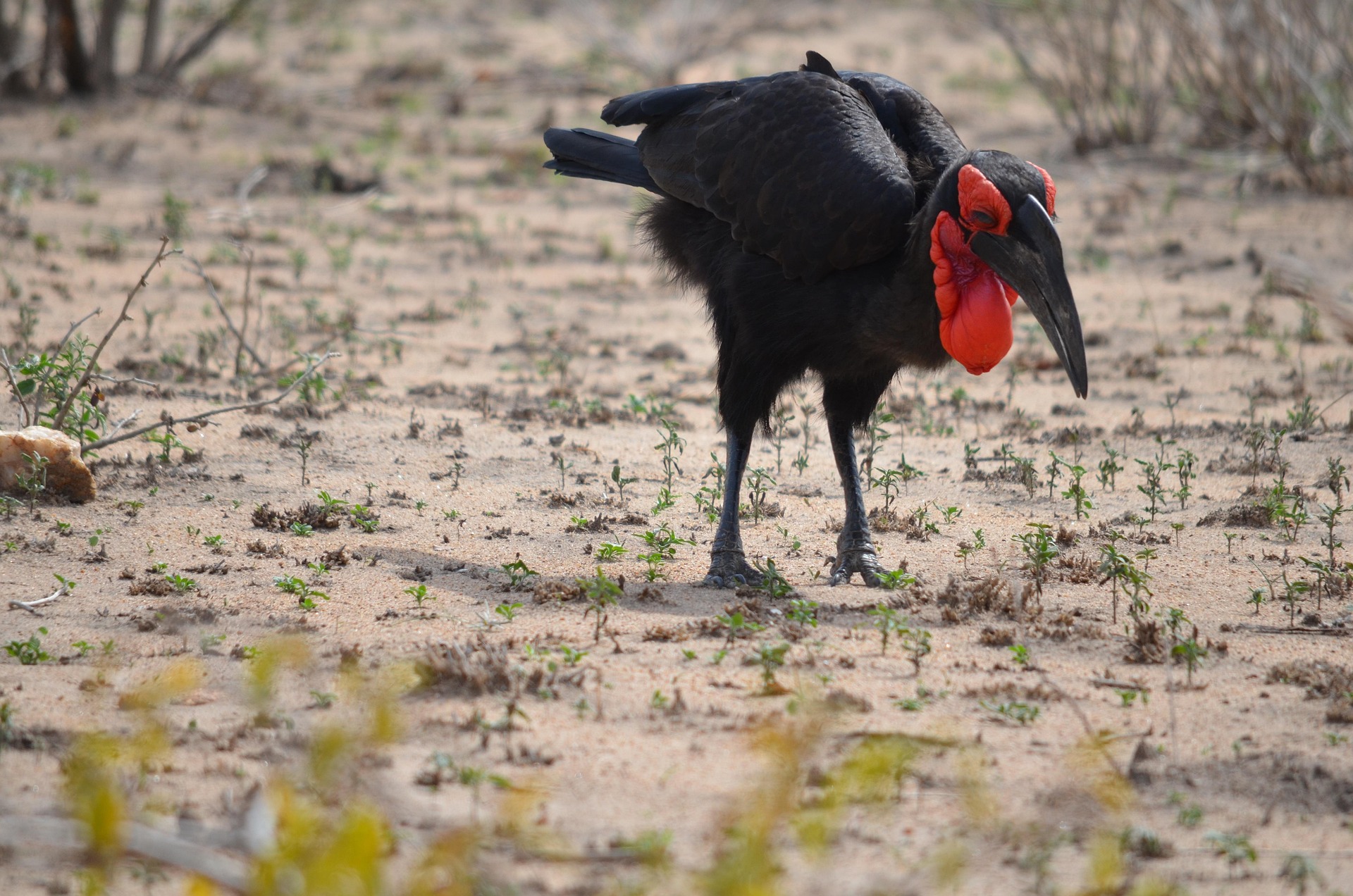
What kind of bird is the Southern Ground Hornbill? We will explain its characteristics, ecology, and habitat. The Southern Ground Hornbill is one of the largest species in the order Hornbill. It is a bird that can be seen widely in Africa, but it is actually an endangered species.


- What is the Southern Ground Hornbill? Basic Stats
- What are the roots and origins of the Southern Ground Hornbill?
- Habitat
- What are its characteristics? What does it look like?
- What is its ecology?
- About Southern Ground Hornbill Chicks
- Is the Southern Ground Hornbill an endangered species?
- Can Southern Ground Hornbills be kept as pets?
- Zoos Housing the Species (Japan & Worldwide)
- Recommended articles
What is the Southern Ground Hornbill? Basic Stats
The southern ground hornbill is a bird classified in the order Bucconidae, family Bucorvidae, and genus Bucorvus. Its scientific name is Bucorvus leadbeateri, its English name is Southern ground-hornbill, and its kanji is 南地犀鳥. Its body length is 90-130cm, its weight is 4-5kg, and its wingspan is 120-180cm.
| Japanese(和名) | ミナミジサイチョウ |
| English(英名) | Southern ground-hornbill |
| scientific name(学名) | Bucorvus leadbeateri |
| classification(分類) | Aves、 Bucerotiformes、 Bucorvidae、Bucorvus 鳥綱、サイチョウ目、ジサイチョウ科、ジサイチョウ属 |
| IUCN Status(保全状況) | VULNERABLE |
| Length(体長) | 90~130cm |
| Weight(体重) | 4-5kg |
Taxonomic position (taxonomy)
| 階級 | 分類 |
|---|---|
| ドメイン | 真核生物 (Eukaryota) |
| 界 | 動物界 (Animalia) |
| 門 | 脊索動物門 (Chordata) |
| 綱 | 鳥綱 (Aves) |
| 目 | ダチョウ目 (Casuariiformes) |
| 科 | ミナミジサイチョウ科 (Casuariidae) |
| 属 | ジサイチョウ属 (Casuarius) |
| 種 | Casuarius casuarius |
What are the roots and origins of the Southern Ground Hornbill?
The Southern Ground Hornbill (Bucorvus leadbeateri) is a large bird inhabiting the African savanna; taxonomically, it belongs to the family Bucorvidae and the genus Bucorvus. There are only two extant species in the genus Bucorvus: the Southern Ground Hornbill and the Northern Ground Hornbill.
- It actually diverged from “typical hornbills” quite early on
The most distinctive feature of the Southern Ground Hornbill is that it belongs to a lineage that diverged very early within the hornbill group.
Broadly speaking, the current phylogenetic relationships are as follows:
Birds
↓
Coraciiformes-Bucerotiformes lineage
↓
Order Bucerotiformes
↓
├─ Ground hornbills (Bucorvus)
│ ├─ Northern Ground Hornbill
│ └─ Southern Ground Hornbill
│
└─ Other hornbills
├─ Large hornbills (e.g., Great Hornbill)
├─ Small hornbills (e.g., Dwarf Hornbill)
└─ Others
DNA-based phylogenetic analysis indicates that Bucorvus (the ground hornbill genus) is the lineage that diverged earliest from other extant hornbills. In other words, the Southern Ground Hornbill is not simply a “typical hornbill that took to living on the ground”; rather, it is a group that has followed its own evolutionary path since a very early stage in hornbill evolution.
- When did their ancestors appear?
Regarding the fossil record of ground hornbills, an early ground hornbill species named Bucorvus brailloni has been discovered in Morocco, dating back to the Middle Miocene (approximately 16 to 10 million years ago).
This fossil is considered to represent a primitive type closely related to the extant Bucorvus genus, indicating that the ground hornbill lineage was already in existence by at least the Miocene epoch. Additionally, an extinct ground-hornbill species known as Euroceros bulgaricus, which lived during the Late Miocene epoch (approximately 7 million years ago), has been identified in Bulgaria.
Interestingly, fossils of these ancient ground-hornbills have been discovered not only in present-day Africa but also in North Africa and Europe.
- “Terrestrial Life” as a Key Evolutionary Point
The Southern Ground-hornbill has a lifestyle that differs significantly from that of typical hornbills.
Many hornbills:
live in trees,
feed on fruit, and
breed using tree hollows.
In contrast, the Southern Ground-hornbill:
leads an almost entirely terrestrial life,
roams across savannas and grasslands,
preys on insects, small reptiles, and amphibians, and
forages while walking on the ground.
Consequently, its legs are structured for walking long distances. Conservation plans by the South African government also highlight its limb structure—adapted for walking—as a distinguishing feature compared to many other hornbills.
- Why Did They Become So Large?
The Southern Ground-hornbill is one of the largest extant hornbill species.
Adults reach a total length of approximately 90–100 cm, and males can weigh over 6 kg.
This size is considered an adaptation to a lifestyle distinct from that of arboreal hornbills—specifically,
“growing large to walk on the ground and forage for animal-based food in the savanna.”
Furthermore, while they are capable of flight, their lives center on walking and terrestrial foraging rather than flying.
- When Did the Southern and Northern Ground-hornbills Diverge?
The extant genus Bucorvus (ground-hornbills) comprises two species:
the Southern Ground-hornbill (Bucorvus leadbeateri) and
the Northern Ground-hornbill (Bucorvus abyssinicus). Genomic studies estimate that these two species diverged from a common ancestor approximately 2.52 million years ago—spanning the transition from the late Pliocene to the early Pleistocene.
While this divergence appears to have occurred relatively recently, the history of the ground-hornbill lineage itself traces back to the Miocene, meaning the group as a whole possesses a very long evolutionary history.
Habitat
The southern ground hornbill is found across the African continent south of the Sahara Desert, and can be seen widely in countries such as Congo, Kenya, Namibia, and Uganda.
- Geographic Distribution
Northeastern Australia (Queensland)
Inhabits coastal and montane tropical rainforests
Southern to western New Guinea
Lowland and humid tropical rainforests of New Guinea
Depends on tropical rainforests, particularly those with high humidity and abundant fruit and small animals
- Habitat Characteristics
Mainly dense jungles and lowland and montane tropical rainforests
Prefers humid, wooded environments
Rarely found in open grasslands or dry areas
Builds nests on the ground, often surrounded by trees and shrubs
Relationship with Water
Prefers proximity to water, streams, and wetlands
Often found near fruit cultivation and water sources within forests
- Movement and Distribution Characteristics
Non-migratory (flightless, unable to travel long distances)
Move locally within forests when food and water are scarce
Habitat is relatively limited, but depends on areas with fruit and water sources
- The Importance of Habitat Conditions
Heavily dependent on tropical rainforest fruit resources
Because they nest on the ground, a dense forest understory is essential for their safety
Populations decline sharply when habitat is reduced due to deforestation or land development.

What are its characteristics? What does it look like?
The Southern Ground Hornbill is black in color and has a large red throat pouch. It is one of the largest species in the order Hornbills, and is a resident bird that lives throughout the year in its distribution area. The Southern Ground Hornbill is found in forests and savannas, and in the highlands of eastern Africa, it lives at an altitude of about 3,000 meters. Its slightly curved beak is black and has a protrusion at the top of the base.
- Physical Characteristics
Physique
Large flightless bird (non-flighting)
Body Length: Approximately 150–180 cm
Weight: Males 50–55 kg, Females 58–70 kg (Females are larger)
Back and wings covered with stiff black feathers
Head and Neck
Neck and head are bright blue
Red wattles (wads of skin) hang from the throat
Herring horns (horny horns) are located on the top of the head, which are used to grab tree branches and intimidate.
Eyes are brown and sharp-looking.
Feet and Claws
Long, thick legs and sharp claws (especially the claws on the second toe, which are long and weapon-like).
Mainly walks on land, with a maximum running speed of approximately 50 km/h.
Uses claws for defense and territorial disputes.
- Behavior & Ecology
Diet
Omnivorous
Fruit is their staple food (mainly rainforest fruits)
Also eats small animals, insects, leaves, and flowers
Forages while walking on the forest floor
Social
Generally solitary
Highly territorial, with females establishing territories during the breeding season
Their call is a low, resonant “rumble” sound used for long-distance communication within the forest
Reproduction & Chicks
They build nests on the ground and lay 1-5 eggs
Both parents are generally males who raise their chicks (a rare bird breeding habit)
Chicks become independent within a few months of birth
- Special Characteristics
Flightless, but capable of high-speed running
Their most distinctive feature is their horny parietal projections (skulls)
They have few predators in the wild because they can defend themselves with kicks and claws in dangerous situations
They rely on dense forests and play an important role as fruit dispersers
What is its ecology?
The Southern Ground Hornbill is mainly active on the ground, and forages on the ground, eating insects, terrestrial snails, amphibians, and reptiles. It breeds from September to December and is monogamous. It builds its nest in a high tree hole or a rock hole in a cliff, and lays 3 to 7 eggs. Both males and females reach sexual maturity in 4 to 6 years, and it is said that it can live for nearly 70 years.
- Habitat
Dependence on Rainforest
Dense forests in northeastern Australia and southern New Guinea
Live in moist lowland to mountain forests
Prefers proximity to water sources
Riversides, swamps, and areas where rainwater accumulates
Mainly terrestrial; unable to fly
- Diet
Omnivorous
Mainly fruits (mainly rainforest fruits)
Also consume leaves, flowers, insects, and small animals
Eats whole fruit seeds, making it important as a seed disperser in the forest
Forages while walking on the ground
- Behavior
Movement/Behavior
Usually solitary
Movement through the forest by walking or running (capable of running at high speeds)
Move locally when food or water sources are scarce
Social
Generally solitary except during breeding season
Long-distance communication using a low-pitched “buzzing” call
Uses antlers and claws for intimidation and courtship
- Breeding and Chick Rearing
Nests on the ground (no tree nests)
Egg size: 1-5
The male is responsible for raising the chicks (a rare bird breeding habit)
Chicks become independent after a few months, but initially live under the male’s protection
Breeding Season
Breeding during the rainy season
Breeding during times of abundant food increases the survival rate of chicks
Do they have any natural enemies?
The Southern Ground Hornbill is a predator, so it has almost no external enemies.

About Southern Ground Hornbill Chicks
This article provides a detailed overview of Southern Ground Hornbill (Casuarius casuarius) chicks.
- Egg Laying and Hatching
Egg Number: 1–5 per brood
Nest Location: Simple nest built on the forest floor
Simple nest consisting of fallen leaves and branches on the ground
Egg Size: Approximately 8–9 cm, pale green or blue-green in color
Incubation Time: Approximately 50 days
- Chick Appearance
Feathers have brown or reddish-brown stripes.
These stripes serve as camouflage, helping them hide in the forest understory.
Their heads and horn protrusions (antlers) are not yet developed.
Their legs are small, limiting their running ability.
- Chick Behavior
Males are responsible for raising the chicks.
After hatching, chicks spend several months under the male’s protection.
They learn to forage while traveling through the forest with their parents.
At first, they cannot fly, so hiding from predators is key to their survival.
- Growth and Independence
They cannot make their first flight (since ground hornbills are flightless).
As they grow, their stripes fade, revealing the adult’s black feathers and vibrant blue-red head and neck coloring.
They become independent approximately 6-12 months after hatching.
Until they reach adulthood, they learn to navigate and find food under the male’s protection.
- Survival Tips
Chicks are highly vulnerable to predators.
They are targeted by snakes, crocodiles, small mammals, and birds of prey.
Because they nest on the ground, hiding places around the nest and the male’s protection determine their survival rate.
Finding food is also important, and they learn to spot fruit and small animals from their parents.
Is the Southern Ground Hornbill an endangered species?
The Southern Ground Hornbill is designated as an endangered species (Red List). The habitat and population continues to decline due to habitat destruction, being caught up in poison bait used to exterminate other animals, and being exterminated as a pest bird. Southern Ground Hornbills have a low reproductive rate and often take a long time to grow, which is why their population is not increasing.
- IUCN Red List Classification
Classification: Endangered (EN: Endangered)
This indicates that wild populations are declining and there is a high risk of extinction in the future.
- Population and Distribution
Distributed primarily in northeastern Australia (Queensland) and southern and western New Guinea
Distribution is limited to tropical rainforests, with localized population declines.
In Australia, the wild population is estimated at only a few thousand birds.
- Major Threats
Habitat Destruction
Habitat loss due to tropical rainforest deforestation and agricultural and road development.
Traffic Accidents
Because they live on the ground, many individuals are hit by cars on roads.
Invasive Species and Predators
Cats, dogs, and wild boars prey on chicks and eggs.
Pet Trade
Due to their rarity, there is a risk of smuggling and capture (local restrictions apply).
- Conservation Status
In Australia, the species is legally protected, and wild collection is prohibited.
Habitat conservation is being carried out in nature reserves and national parks.
Breeding programs are also being conducted, with attempts to raise chicks and introduce them.
Can Southern Ground Hornbills be kept as pets?
As Southern Ground Hornbills are an endangered species, it is extremely difficult to keep them as pets. Look up information about zoos and other places and see them at events. Images are posted on online pages and can be viewed.
- Current Status of Captivity
There are examples of captivity in zoos and conservation facilities around the world.
Wild collection is strictly restricted, and captive specimens are primarily bred in conservation facilities or breeding programs.
Keeping them as pets is extremely rare.
- Legal Restrictions
The Southern Ground Hornbill is listed as an Endangered Species (EN).
It is listed in Appendix I of the Convention on International Trade in Endangered Species of Wild Fauna and Flora (CITES), and international trade is generally prohibited.
In Japan and Australia, private captivity is either prohibited by law or requires strict permission.
- Breeding Environment Requirements
Breeding Facility
A large area is required (ensuring sufficient space for running and safe movement).
A rainforest-like environment must be recreated.
Humidity control, water, and jungle undergrowth.
Substrate must be natural, with soil, grass, fallen leaves, etc.
Diet
Omnivorous, but primarily fruit.
Supplementary vegetables, small animals, and insects are also provided.
A well-balanced diet simulating forest fruits is essential.
Safety Management
Large, aggressive, and capable of kicking with sharp claws.
Dangerous to humans, so specialized care is required.
- Breeding
Captive breeding is carried out in conservation facilities and zoos.
Males raise chicks, so a paired breeding environment is required.
Recreating wild breeding behavior requires a large facility and appropriate stimulation.
- Breeding Difficulty
Extremely difficult: Large size, aggressiveness, specialized diet, and a reproduced breeding environment are required.
Private breeding is almost impossible.
Only zoos, conservation facilities, and research facilities can breed them.

Zoos Housing the Species (Japan & Worldwide)
The Southern Ground Hornbill (Bucorvus leadbeateri) is currently kept in zoos both in Japan and abroad. In Japan, specifically, the species can be found at several facilities and is listed in the animal inventory data of JAZA (Japanese Association of Zoos and Aquariums).
🇯🇵 Japan
Key facilities where the species is currently kept:
| Zoo | Prefecture | Current Status |
|---|---|---|
| Yokohama Zoological Gardens “Zoorasia” | Kanagawa | Kept & Exhibited |
| Saitama Children’s Zoo | Saitama | Kept & Exhibited |
| Himeji City Zoo | Hyogo | Kept & Exhibited |
Notably, Himeji City Zoo lists the Southern Ground Hornbill in its official animal inventory (as of March 2026).
The species is also confirmed to be kept at Yokohama Zoological Gardens “Zoorasia” and Saitama Children’s Zoo.
🌎 Worldwide
The species is kept in significantly more zoos overseas than in Japan.
Current data from Zootierliste lists numerous facilities in Europe alone.
🇩🇪 Germany
Representative facilities:
Zoo Berlin
Zoo Augsburg
Zoo Duisburg
Zoo Hannover
Kölner Zoo
Zoo Krefeld
Zoo Schwerin
Weltvogelpark Walsrode
Vogelpark Marlow
Tier- und Freizeitpark Thüle
Zoo Neuwied
Westküstenpark St. Peter-Ording
Zootierliste lists 12 facilities in Germany alone.
🇧🇪 Belgium
Parc Animalier de Bouillon
Pakawi Park
🇩🇰 Denmark
Ree Park Safari
🇺🇸 United States
The species is also kept in the United States; notably, the Dallas Zoo is actively engaged in breeding and conservation efforts.
A 2026 AZA article highlights the Dallas Zoo’s work in establishing a multi-generational family group and its efforts in the hand-rearing of chicks.
Recommended articles
コメント