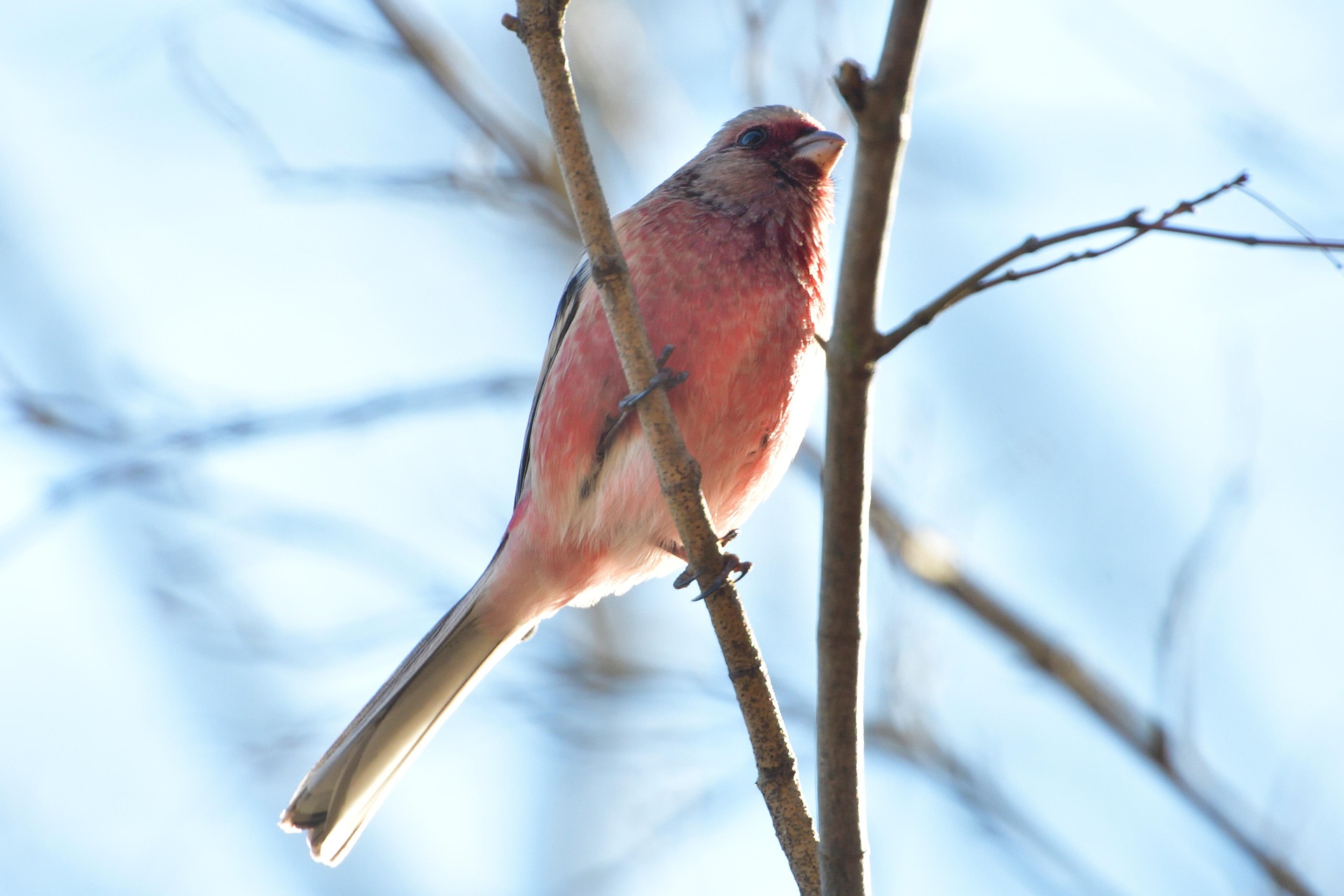
What kind of bird is the Beni-Matsuko? We will explain its characteristics, ecology, and habitat. It is a sparrow-sized bird that can be found in Russia, the Korean peninsula, China, and Japan. As you can imagine from the name Beni, it is a very eye-catching bird with an overall red color.


- What is the Red Grosbeak? Basic Stats
- What are the roots and origins of the Long-tailed Rosefinch?
- Habitat
- What are its characteristics? What kind of creature is it?
- What is its ecology?
- About Red Francois Chicks
- Is the Red Grosbeak an endangered species?
- Can the Red Grosbeak be kept as a pet?
- Captivity in Zoos (Japan & Worldwide)
- Recommended articles
What is the Red Grosbeak? Basic Stats
The Long-tailed Rosefinch is a bird of the order Passeriformes, family Fringillidae, and genus Uragus. Its kanji is 紅紗子, 鳥厥雀, and its English name is Long-tailed Rosefinch, and its scientific name is Uragus sibiricus. Its total length is 14-15cm, its wingspan is 20-21cm, and its weight is 14-18g. The list of information is as follows.
| Japanese(和名) | ベニマシコ |
| English(英名) | Long-tailed Rosefinch |
| scientific name(学名) | Uragus sibiricus |
| classification(分類) | Aves、 Passeriformes、 Fringillidae、Uragus 鳥綱、スズメ目、アトリ科、ベニマシコ属 |
| IUCN Status(保全状況) | LEAST CONCERN |
| Length(体長) | 14~15cm |
| Weight(体重) | 14~18g |
Taxonomy (phylogenetic classification)
The red finch is classified as follows:
| 階級 | 分類 |
|---|---|
| 界 | 動物界 (Animalia) |
| 門 | 脊索動物門 (Chordata) |
| 綱 | 鳥綱 (Aves) |
| 目 | スズメ目 (Passeriformes) |
| 科 | アトリ科 (Fringillidae) |
| 属 | カルポダクス属 (Carpodacus) |
| 種 | ベニマシコ (Carpodacus erythrinus) |
What are the roots and origins of the Long-tailed Rosefinch?
The Long-tailed Rosefinch is a small bird belonging to the finch family (Fringillidae); under current classification, it is known as Carpodacus sibiricus. Although it was previously classified as Uragus sibiricus within the genus Uragus, DNA-based phylogenetic studies now support classifying it within the genus Carpodacus—the group comprising the “rosefinches”—rather than in a separate Uragus genus.
🌏 1. Broader origins: “Southwest China to the Himalayas”
This is a particularly fascinating aspect.
Molecular phylogenetic and historical biogeographic studies examining the entire Carpodacus genus (the “rosefinches”) estimate that they evolved from an origin point in the region spanning southwest China to the Himalayas approximately 14 million years ago (14 Ma).
The current Carpodacus genus is distributed across Eurasia; however, since 19 of its 25 species are concentrated in the China-Himalaya region, it is highly likely that this area served as the evolutionary center for these rosefinches.
To visualize the process:
Approx. 14 million years ago
Southwest China to the Himalayas
↓
Ancestors of the rosefinches
↓
Dispersal and evolution to various regions
↓
Expansion into North, Central, and East Asia
↓
Emergence of the Long-tailed Rosefinch lineage
This is the general progression.
🧬 2. The Long-tailed Rosefinch: A rosefinch that expanded northward
The Long-tailed Rosefinch occupies a habitat range that differs somewhat from its relatives in the Carpodacus genus.
Its distribution is centered in areas such as:
🇷🇺 Russia (Siberia)
🇲🇳 Mongolia
🇨🇳 Northern China
🇰🇷 Korean Peninsula
🇯🇵 Japan
In Japan, the Long-tailed Rosefinch primarily arrives as a winter visitor.
In other words, while ancestral Carpodacus species were spreading outward from the southwest China-Himalaya region, the lineage of the Long-tailed Rosefinch can be viewed as the group that expanded into and adapted to Northeast Asia.
🧬 3. What are its close relatives?
On the phylogenetic tree, groups relatively closely related to the Long-tailed Rosefinch (Carpodacus sibiricus) include:
Pallas’s Rosefinch (Carpodacus roseus)
Streaked Rosefinch (Carpodacus rubicilloides)
Great Rosefinch (Carpodacus rubicilla)
Spot-winged Rosefinch (Carpodacus rodopeplus)
Phylogenetic estimates based on “BirdTree” suggest that the lineage leading to the Long-tailed Rosefinch (C. sibiricus) diverged from the common ancestor shared with Pallas’s Rosefinch (C. roseus) approximately 6.7 million years ago.
Therefore, a rough evolutionary history can be outlined as follows:
Approximately 14 million years ago
→ Establishment of the major Carpodacus lineage
Around 7 million years ago
→ Divergence between the Long-tailed Rosefinch lineage and the lineage including Pallas’s Rosefinch
However, these dates are derived from phylogenetic estimation models; they do not represent definitive figures pinpointing exactly when the Long-tailed Rosefinch species emerged.
🇯🇵 4. Where do the Long-tailed Rosefinches in Japan come from?
The Long-tailed Rosefinches seen in Japan are individuals that breed in northern regions and migrate south for the winter.
According to the Check-list of Japanese Birds, the species inhabits areas such as Hokkaido, while being classified as a winter visitor in Honshu and regions further south.
In other words, rather than viewing the Japanese archipelago as the evolutionary center of the Long-tailed Rosefinch, it is more accurate to regard it as one of the overwintering grounds utilized by the species’ lineage, which is distributed across East Asia.
Habitat
The scarlet finches inhabit Japan, China, Kazakhstan, North Korea, South Korea, and Russia, and in Japan they breed as summer birds in Hokkaido and the Shimokita Peninsula of Aomori Prefecture before migrating south in the winter.
- Habitat in Japan
Migratory birds in winter: Kyushu, southern Honshu, Shikoku, etc.
Habitat:
Shrublands along rivers and forest edges
Grasslands and shrub thickets
Can also be seen in shrubbery around parks and fields
Flock behavior:
In winter, they forage in flocks of several to several dozen birds in shrubs and bushes
- Global distribution
Breeds in northern Eurasia (Siberia, North Asia)
Migrates south to southern China, northern India, and Japan in winter
Prefers open environments such as forest edges, grasslands, and shrublands
- Habitat characteristics
Shrub thickets are important:
They feed on fruits and seeds, so bushes allow them to forage safely
They also provide cover for hiding from raptors and predators
Adapted to open environments:
Can be seen in parks and fields near human settlements
- Interesting Points
Females are often difficult to spot among bushes and shrubs due to their highly protective coloration.
Males stand out even in winter thanks to their red coloring, making them easy to spot in a flock.

What are its characteristics? What kind of creature is it?
It is a very small bird, only the size of a sparrow. Its body is reddish all over, with a bright red underside and an even redder summer plumage. Unlike males, females have a calm coloring and stripes all over. Their wings and tail feathers are dark and blackish, with two white stripes on their wings. They make a chirping sound. They live in grasslands, marshes, and coastal scrub forests.
- Body Size
Body Length: Approximately 14-16cm
Wingspan: Approximately 22-24cm
Body Type: Small and rounded, easily perched on branches and bushes
- Body Color and Appearance
Male:
Head, chest, and back are bright red.
Belly is slightly paler red to brown.
Wings are brownish-brown, with the color of the feather edges prominent in flight.
Female:
Overall brownish-brown, dull camouflage.
Spotted, making it difficult to stand out in bushes.
Beak: Short and conical, adapted for cracking seeds.
Legs and Feet: Structured for perching on the ground or branches.
- Behavioral and Ecological Characteristics
Feeding:
Pecks seeds, fruit, and small insects
Mainly forages on the ground or in shrubs
Flight:
Specializes in short, straight-line flights
Often travels in flocks, moving from branch to branch
Call:
Light chirp “chiri-chiri…”
Used for flock communication and vigilance
- Sociality
Often forms flocks in winter, ranging in size from a few to several dozen birds
Rests and forages in bushes and shrubs
Can be seen in parks and fields near human settlements
What is its ecology?
The Japanese bush warbler feeds on insects and seeds. It is monogamous and oviparous. Its nests are made of dead grass, bark, and fine roots, and it lays about three eggs at a time. The eggs hatch in about two weeks, and it is said that it lives for about five to ten years.
- Habitat
Prefers shrub and bush thickets:
Riversides, forest edges, and grassy thickets
Places where they can safely forage for fruit and seeds
Migratory to Japan as a winter bird:
Wintering from Kyushu to southern Honshu
Spread in flocks in shrubs and bushes during the winter
- Behavior
Foraging:
Pecks fruit, seeds, and small insects
Mainly forages on the ground and in shrubs
Flight:
Specializes in short, straight flight
Often moves from bush to bush or branch to branch
Call:
Light chirp
Used for communication and vigilance within the flock
- Breeding
Breeding Grounds: Forest edges and grasslands from northern Siberia to northern East Asia
Nests: Built in grass on the ground
Eggs: 4-6, light brown with spots
Parent Care:
Females incubate and care for the chicks
Chicks begin foraging on the ground or in shrubs immediately after hatching
- Flocking Behavior
In winter, they form flocks of several to several dozen birds.
Rest and forage in bushes and shrubs.
In winter, they move between areas rich in fruit and seeds.
- Diet
Main Food:
Grass seeds, nuts, and fruit
Side Food:
Small insects, spiders, and other animal matter
Foraging Method:
Pecks on the ground and in shrubs
Eats safely in bushes
Does it have any natural enemies?
The Japanese bush warbler’s natural enemies are birds of prey such as crows and hawks.

About Red Francois Chicks
This article provides information about Red Francois Chicks (juveniles). Although they are small passerine birds, they become active on the ground and in shrubs immediately after hatching.
- Eggs and Hatching
Number of Eggs: 4-6
Egg Color: Light Brown with Small Spots
Incubation Period: Approximately 11-13 Days
Incubation: The female primarily incubates, while the male remains vigilant.
- Chick Appearance
Immediately After Hatching:
Feathers are covered with soft down.
Eyes are open, and they can follow their parents immediately after hatching.
Bak is small, and their adult coloring is still pale.
Developmental Process:
Full feather growth occurs within a few days.
They practice foraging by pecking on the ground and in shrubs.
- Life in and around the Nest
Nest Location:
In shrubs or bushes on forest edges or in grasslands.
They build simple nests out of grass and dead leaves collected on the ground.
Relationship with Parents:
Chicks forage under the supervision of their parents immediately after hatching.
They hide in bushes or shrubs when threatened.
- Growth and Independence
Flight Ability: Begins short-distance flights at 10-15 days of age
Foraging:
Chicks learn to peck at seeds and fruit
Small insects are also a supplementary diet
Independence:
Becomes independent from their parents at 3-4 weeks of age
Gain the strength and flight ability to participate in winter migration
Is the Red Grosbeak an endangered species?
The Red Grosbeak is classified as least concern and is not an endangered species. However, in Japan, it is on the Red List in Shiga and Saitama prefectures, and its population is on the decline.
- International Conservation Status (IUCN)
Scientific Name: Carpodacus erythrinus
IUCN Red List: LC (Least Concern)
Widely distributed worldwide, populations stable
Deteriorated by deforestation and habitat destruction in some areas, but the risk of extinction is low
- Status in Japan
In Japan, it migrates as a winter bird from Kyushu to southern Honshu
The population is relatively stable, and it is not listed as endangered on the Japanese Red List
Attention is required to environmental changes (decrease in forest edges and shrublands)
- Threats
Development and logging of forest edges and shrublands
Habitat loss due to farmland and urbanization
Natural predators (raptors) and cold winter environments
Can the Red Grosbeak be kept as a pet?
The Red Grosbeak is managed by the Ministry of the Environment under the Wildlife Protection and Management Act, and feeding it is prohibited.
- Wild Birds
The Japanese Francophone is a small, passerine bird that lives on forest edges and in shrublands.
It is sensitive to environmental changes and stress, and cannot maintain its health in a small cage.
- Difficulty of Raising
Factors: Reasons for Difficulty
Environment: It is difficult to recreate a natural environment, such as shrubs and bushes.
Diet: Fruits, seeds, small insects, etc. must be provided daily.
Stress: A small cage prevents preening and foraging, resulting in significant stress.
Breeding: Breeding habitats are forest edges and grasslands in the north (Siberia and North Asia), making nest building and raising chicks difficult at home. - Legal Restrictions
In Japan, the Japanese Francophone is subject to the Wild Bird and Animal Protection Act.
Capturing and raising it without permission is illegal.
Keeping is permitted only in research and conservation facilities with permission from the prefecture.
Captivity in Zoos (Japan & Worldwide)
🇯🇵 Japan
No facilities currently keeping or exhibiting this species have been identified.
However, there are records of captive individuals in Japan. At Kushiro City Zoo in Hokkaido, a necropsy and parasite study were conducted on a Long-tailed Rosefinch that died in 2018; the specimen remains preserved at the zoo. Note that this does not refer to a currently living exhibit animal.
Additionally, the Hokkaido University Museum houses a large collection of older Long-tailed Rosefinch specimens, though these are not part of a live exhibition.
🌍 Overseas
Multiple records of captivity exist overseas.
| Country | Facility | Status |
|---|---|---|
| 🇨🇿 Czech Republic | Zoo Plzeň | Captivity record exists |
| 🇷🇺 Russia | The Aviaries (Peterhof) | Captivity record exists |
| 🇷🇺 Russia | Moscow Zoo | Captivity record exists |
| 🇷🇺 Russia | Novosibirsk Zoo | Captivity record exists |
| 🇷🇺 Russia | Zheleznogorsk Zoosad | Captivity record exists |
| 🇷🇺 Russia | Vorobyi Birdpark | Captivity record exists |
| 🇷🇺 Russia | Limpopo Zoo (Nizhny Novgorod) | Captivity record exists |
| 🇺🇦 Ukraine | Kyiv Zoo | Captivity record exists |
These are listed in zoo databases under the name Long-tailed Rosefinch / Carpodacus sibiricus.
Furthermore, records for the subspecies Carpodacus sibiricus ussuriensis can be confirmed for Kyiv Zoo.
Regarding Zoo Plzeň, an actual captive individual is also featured in photographer Joel Sartore’s “Photo Ark” project.
Recommended articles

コメント