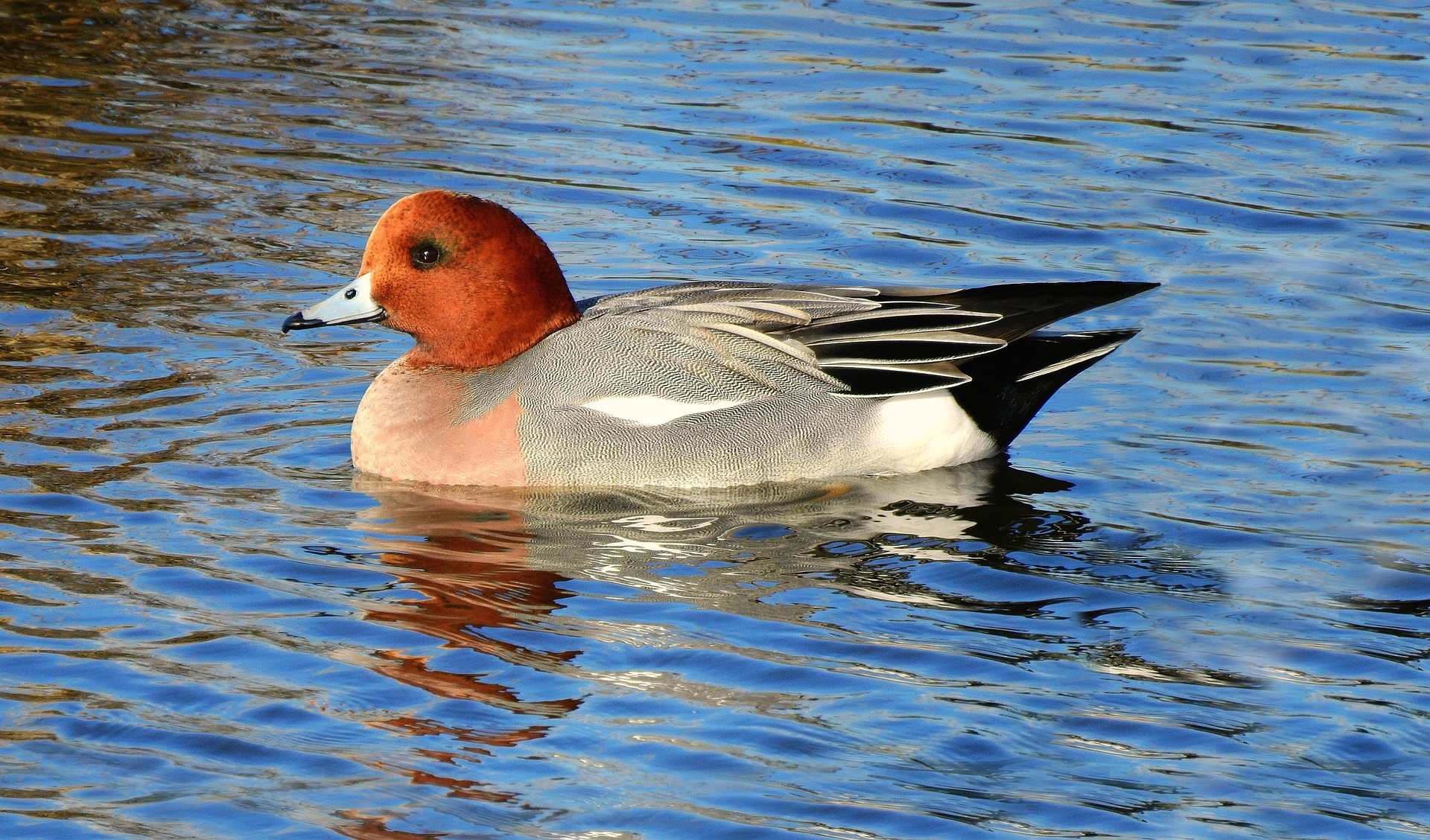
What kind of bird is a Wigeon? We will introduce and explain the characteristics, ecology, and habitat of this gray or brown bird that can be seen in Japan. When they fly, they can be seen in large flocks and act in groups. They can be seen mainly in Eurasia, and in winter they migrate to Europe, northern Africa, northern India, southern China, and the Korean Peninsula.


- What is Wigeon? Basic Stats
- What are the roots and origins of the Eurasian Wigeon?
- Habitat
- What are its characteristics? What kind of creature is it?
- What is their ecology?
- About Wigeon Baby
- Are Wigeons an endangered species?
- Can Wigeon be kept as a pet?
- Zoos Housing the Species (Japan & Worldwide)
- Recommended articles
What is Wigeon? Basic Stats
The Eurasian Wigeon is a species of bird that belongs to the Anatidae family and the Mallard genus. Its English name is Eurasian Wigeon, its scientific name is Mareca penelope, and its kanji is hitorikamo. Its total length is 42-53cm, its wingspan is 68-84cm, and its weight is 500-1100g. A list of information about it is as follows:
| Japanese(和名) | ヒドリガモ |
| English(英名) | Eurasian Wigeon |
| scientific name(学名) | Mareca penelope |
| classification(分類) | Aves、 Anseriformes、 Anatidae、Mareca 鳥綱、カモ目、カモ科、マガモ属 |
| IUCN Status(保全状況) | LEAST CONCERN |
| Length(体長) | 42~53cm |
| Weight(体重) | 500~1100g |
Taxonomy (phylogenetic classification)
Wigeons are classified as follows:
| 階級 | 分類 |
|---|---|
| 界 | 動物界 (Animalia) |
| 門 | 脊索動物門 (Chordata) |
| 綱 | 鳥綱 (Aves) |
| 目 | カモ目 (Anseriformes) |
| 科 | カモ科 (Anatidae) |
| 属 | カモ属 (Anas) |
| 種 | ヒドリガモ (Anas penelope) |
What are the roots and origins of the Eurasian Wigeon?
The Eurasian Wigeon is a duck species with the scientific name Mareca penelope. It is a type of duck frequently seen in Japan during the winter.
🌏 1. Its primary roots lie in “Eurasia”
As its name suggests, the Eurasian Wigeon is a duck that evolved and distributed itself primarily across the Eurasian continent.
Its current breeding range is vast, extending from Northern Europe, through Russia and Siberia, all the way to East Asia.
In other words, the Eurasian Wigeons found in Japan follow this migratory pattern:
Breed in northern Eurasia
↓
Migrate south in autumn
↓
Overwinter in East Asia, Japan, and other regions
For the Eurasian Wigeon, the Japanese archipelago is not the place of evolutionary origin, but rather a crucial overwintering ground. Research is also being conducted on the genetic connections between the East Asian population and those in Siberia and the Russian Far East.
🧬 2. Actually a lineage distinct from the Anas genus
This is a particularly interesting aspect of the Eurasian Wigeon’s evolutionary history.
Previously, the scientific name for the Eurasian Wigeon was:
Anas penelope
However, as DNA-based phylogenetic analysis advanced, it became clear that the traditional Anas genus did not form a cohesive group in terms of evolutionary lineage.
Consequently, the group containing the Eurasian Wigeon and others was split off into the current genus:
Mareca
The current classification is:
Order Anseriformes
↓
Family Anatidae
↓
Subfamily Anatinae
↓
Genus Mareca
↓
Eurasian Wigeon (Mareca penelope)
🧬 3. Closely related to the American Wigeon
A very close relative of the Eurasian Wigeon is the American Wigeon (Mareca americana), found in North America.
Phylogenetic analysis indicates that the Eurasian Wigeon and the American Wigeon belong to very closely related lineages.
Phylogenetic estimates based on “BirdTree” suggest that the two species diverged from a common ancestor approximately 1.2 million years ago. Broadly speaking, the divergence is thought to have occurred as follows:
Ancestor of early Mareca species
↓
Eurasian lineage ─ Eurasian Wigeon
↓
North American lineage ─ American Wigeon
However, the “1.2 million years ago” figure is an estimate derived from phylogenetic trees; it is not a date pinpointed by fossil evidence.
🦆 4. Relatives in the Mareca genus
In addition to the Eurasian Wigeon, the current Mareca genus includes species such as:
American Wigeon — Mareca americana
Chiloe Wigeon — Mareca sibilatrix
Falcated Duck — Mareca falcata (Note: distinct from the Anas group containing the Northern Pintail or Garganey)
Gadwall — Mareca strepera
Among these, the Eurasian Wigeon, American Wigeon, and Chiloe Wigeon form a distinct, closely related group known as the “wigeon group.”
🗺️ Overview of Eurasian Wigeon evolution and distribution
Ancestor of early duck species
⬇
Divergence into Mallard-like and Wigeon-like groups
⬇
Emergence of the Mareca lineage
⬇
Expansion of distribution to Eurasia, North America, South America, etc.
⬇
Development of the Eurasian Wigeon lineage in Eurasia
⬇
Expansion across Europe, Siberia, and East Asia
⬇
🇯🇵 Migration to Japan for overwintering
Viewing it in this sequence makes the process easier to understand.
Habitat
The Eurasian Wigeon breeds in the northern polar regions of the Eurasian continent and in Iceland, and migrates to Europe, northern Africa, India, China, the Korean Peninsula, Japan, etc. in the winter. It is also known that the breeding grounds of the closely related American Wigeon (Anas americana) are close to each other.
- Habitat in Japan
Wintering bird: Lakes, rivers, tidal flats, and coastal areas from Hokkaido to Kyushu
Typical habitats:
Lakes and ponds (freshwater)
Mid- to downstream rivers
Tidal flats and coastal shallows
Flocking:
Wintering in flocks of dozens to hundreds of birds
Gathering in safe areas of water or on shore
- Global distribution
Breeding in Europe and northern Asia
Wintering in Western Europe, the Mediterranean coast, northern Africa, and Southeast Asia
Wintering mainly in aquatic environments such as lakes, estuaries, and wetlands
- Habitat characteristics
Aquatic: Requires suitable water for swimming and foraging
Open water: Places where flocks can rest and forage
Acclimatized to human settlements:
Can be seen in waterways, ponds, and rivers near agricultural land

What are its characteristics? What kind of creature is it?
Wigeon feathers vary by sex (female and male). Males have reddish-brown heads and cream-colored crowns, while females are dark brown overall and have white underparts. The upper side of the body is gray with fine black spots and a black undertail. The beak is somewhat short, and both males and females are blue-gray with a black tip. They live in groups and prefer rivers, lakes, estuaries, inland bays, and coasts. Males make a whistling call, “Pewee.” Females make a low, muddy “Guu.”
- Physical Characteristics
Body Length: Approximately 44-51cm
Wingspan: 71-80cm
Body Color:
Male: Reddish-brown head, pale forehead, gray to white sides, black tail
Female: Overall brown and dull with many markings
Beak: Flat with a black tip, adapted for feeding by rubbing against mud and aquatic plants
Legs/Feet: Webbed, adapted for swimming and feeding on the surface
- Behavior and Ecology
Feeding:
Eats plant matter (aquatic plant sprouts and seeds) and small aquatic organisms on the surface
Rarely dives, pecking at the surface with its proboscis
Flight:
Capable of long-distance flight as a migratory bird
Often travels in flocks, sometimes forming a V-formation during flight
Calls:
Males produce a high-pitched, resonant “whoosh” sound
Used for flock communication and vigilance
- Sociality
They hibernate in flocks of dozens to hundreds of birds.
They migrate to various parts of Japan as winter birds.
They can also be seen in lakes and ponds near human settlements and in agricultural waterways.
- Appearance
The male’s bright reddish-brown head makes it stand out.
They are typically seen feeding on the water surface and swimming in groups.
Females have a more subdued body color, but are easy to spot in groups.
What is their ecology?
Wigeon feeds on aquatic plants such as seaweed, seaweed, and algae. They are oviparous. They are monogamous and nest in grasslands near water and lay 7-11 eggs. The eggs are incubated for about one month before the young are born. Their lifespan in the wild is thought to be about 15 to 20 years.
- Habitat
Aquatic:
Lakes, rivers, tidal flats, and coastal shallows
Migrate to various parts of Japan in winter and spend the winter in flocks
Prefers open water:
Safe places where flocks can rest and forage
- Behavior
Foraging:
Pecks at plant matter (aquatic plants, seeds) and small aquatic organisms on the water’s surface
Rarely dives, feeding while floating with their proboscises
Feeds while moving in flocks, following the currents and winds
Flight:
Capable of long-distance flight as a migratory bird
Often forms V-formations or undulating flight patterns in flocks
Calls:
Males produce a high-pitched, soaring “whoosh” sound
Used for flock communication and vigilance
- Breeding
Breeding Grounds: Freshwater lakes and marshes from Northern Europe to northern Siberia
Nests: Built on the ground from grass and feathers
Eggs: 7-9, pale brown with spots
Parental Care:
Female incubates, male keeps watch
Chicks move to water immediately after hatching and begin foraging under the supervision of their parents
- Migration/Migration
Migratory Birds:
Breed in the north in summer
Migrate south to warm regions, including Japan, from autumn to winter
Return north in spring
Flocking Behavior:
Form flocks of dozens to hundreds of birds in wintering grounds
- Diet
Mainly plant matter:
Aquatic plant sprouts, seeds, grains, etc.
Side Food:
Insects, crustaceans, small aquatic organisms
Feeding Methods:
Floating and pecking, attracting plants from the surface of the water, digging their proboscises into the mud
Do they have any natural enemies?
Hawks and crows are natural enemies of the Wigeon.

About Wigeon Baby
This article summarizes the young (chicks) of the Wigeon. Typical of ducks, they quickly adapt to life both on land and in water.
- Eggs and Hatching
Number of Eggs: 7-9
Egg Color: Light Brown with Small Spots
Incubation Period: Approximately 23-25 Days
Incubation: The female primarily incubates the eggs, while the male is responsible for guarding the surrounding area.
- Chick Appearance
Immediately After Hatching:
Feathers are covered with soft down.
Eyes are open and ready to move.
Bak is short and will later develop into its adult form.
Development Process:
Within a few days, feathers grow in and the chicks begin swimming on the surface or in shallow waters.
Even young birds have a strong foraging instinct, pecking at small aquatic creatures and plants on their own.
- Life in and around the Nest
Nest Location:
Marshes and grasslands from Northern Europe to Siberia.
They build simple nests on the ground out of grass and feathers.
Relationship with Parents:
Chicks move to water immediately after hatching.
They forage safely under the supervision of their parents.
They flee with their parents when danger approaches.
- Growth and Independence
Flight Ability: First flight at 40-50 days of age
Feeding:
Learn to feed on plants and small aquatic animals on the surface or in shallow waters
Independence:
Completely independent from parents at about 2 months of age
Makes migrations independently
Are Wigeons an endangered species?
Wigeons are classified as least concern, and are not endangered. They are kept in zoos and other facilities, and events are held, so look at guides and take part in them. There are also many photos and images on online pages that you can refer to. They are well-known birds. Research activities at sea on migratory birds are also underway.
- International Conservation Status (IUCN)
Scientific Name: Anas penelope
IUCN Red List: LC (Least Concern)
Widely distributed worldwide, with relatively stable populations
Although impacts from wetland loss and hunting have been observed in some areas, the species is at low risk of extinction.
- Status in Japan
Migratory bird throughout Japan (from Hokkaido to Kyushu)
Wintering in flocks in lakes, rivers, tidal flats, and coastal areas
The population is stable, and the species is not listed as endangered on Japan’s Red List.
- Threats
Reclamation and development of wetlands and tidal flats
Decrease in prey species due to pesticides and deteriorating water quality
Hunting along migratory routes and wintering grounds
However, because Wigeon ducks can adapt to lakes and farmlands near human settlements, the risk of extinction is low.
- Conservation Key Points
Conservation of aquatic environments such as tidal flats, wetlands, and lakes
International protection, including for migratory routes and wintering grounds, is desirable.
Can Wigeon be kept as a pet?
Wigeons are managed by the Ministry of the Environment under the Wildlife Protection and Management Act, and feeding them is prohibited.
- Wildlife Migratory Bird
Wigeons are migratory waterbirds that travel long distances.
They winter in Japan and breed in northern regions (Siberia and Northern Europe).
Crowded cages can lead to lack of exercise, stress, and health problems.
- Difficulty of Raising
Factors: Reasons for Difficulty
Environment: They require large bodies of water, such as lakes, rivers, and tidal flats, and aquatic environments.
Diet: They require daily provision of aquatic plant buds, seeds, and small aquatic organisms.
Migratory Instinct: Their desire to migrate during migration season makes caged breeding extremely stressful.
Breeding: Because they build ground nests in the north, breeding at home is nearly impossible.
- Legal Restrictions
In Japan, Wigeons are protected under the Wild Bird and Animal Protection Act.
Capturing and raising them without permission is illegal.
They can only be raised in special research and conservation facilities with prefectural permission.
Zoos Housing the Species (Japan & Worldwide)
The Eurasian Wigeon (Mareca penelope) is kept and exhibited in Japan.
Based on currently available information, the Inokashira Park Zoo in Tokyo explicitly lists the species in its current exhibits on its official website.
🇯🇵 Japan
Facility Status: Inokashira Park Zoo (Tokyo) ✅ Current exhibit confirmed. Other domestic facilities: No confirmed current exhibits at this time.
Inokashira Park Zoo displays the Eurasian Wigeon in its “Waterfowl” (Mizube no Toritachi) exhibit area. It is also listed as Mareca penelope in the zoo’s official animal encyclopedia.
🌍 Worldwide
There are more records of the species being kept in facilities overseas compared to Japan.
Examples of facilities confirmed to currently house the species:
🇧🇪 Zoo Planckendael (Belgium)
🇩🇰 Fiskeri- og Søfartsmuseet (Denmark)
🇩🇰 Aqua Ferskvands Akvarium & Dyrepark (Denmark)
🇩🇪 Zoo Augsburg (Germany)
🇩🇪 Tierpark Chemnitz (Germany)
🇩🇪 Tierpark Cottbus (Germany)
🇩🇪 Tierpark Hagenbeck (Germany)
🇩🇪 Vogelpark Eslarn (Germany)
These are listed under “Current Holdings” on Zootierliste.
However, the species has been kept in many more facilities in the past; for instance, there are records of it being housed at Copenhagen Zoo, Antwerp Zoo, and Pairi Daiza. These historical records should be distinguished from current holdings.
🇺🇸 Examples in North America
At Woodland Park Zoo (Seattle, USA), a Eurasian Wigeon was photographed in the “Wetlands Aviary” in February 2025.
Recommended articles


コメント