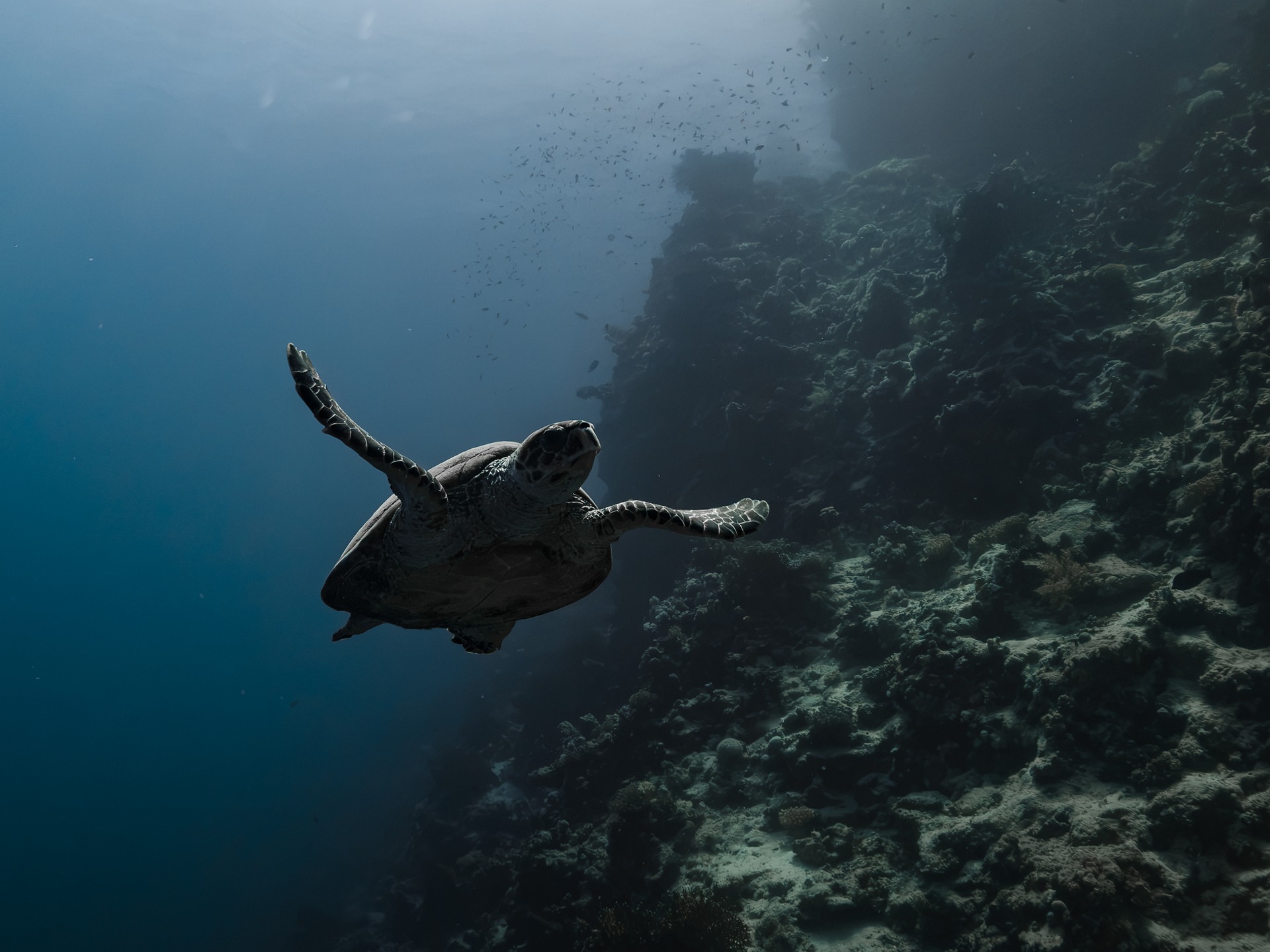
What kind of animal is the beautifully patterned Radiated Tortoise? We will explain its characteristics, personality, ecology, and habitat. It is a type of land turtle that is distributed in the southern part of Madagascar, and not many people may have seen a wild turtle. Unfortunately, it is designated as an endangered species.


- What is a Radiated Turtle? Basic Stats
- What are the roots and origins of the Radiated Tortoise?
- Habitat
- What are their characteristics? What kind of creature are they?
- What is their personality like?
- What is their ecology like?
- About Radiated Tortoise Hatchery
- Is the Radiated Turtle an Endangered Species?
- Can the Radiated Turtle be kept as a pet?
- Zoos Housing the Species (Japan & Worldwide)
- Recommended articles
What is a Radiated Turtle? Basic Stats
The Radiated Tortoise is a turtle classified in the order Testudins, family Testudinidae, genus Testudinidae. Its scientific name is Astrochelys radiata, and its English name is Radiated Tortoise. Its carapace length is 40cm and its weight is 13-16kg. The list of information is as follows.
| Japanese(和名) | ホウシャガメ 放射亀 |
| English(英名) | Radiated tortoise Sokake |
| scientific name(学名) | Geochelone elegans |
| classification(分類) | Reptilia、 Testudines、 Testudinidae、Butagur 爬虫綱、カメ目、リクガメ科、マダガスカルリクガメ属 |
| IUCN Status(保全状況) | CRITICALLY ENDANGERED |
| Length(体長) | 40cm |
| Weight(体重) | 13~16kg |
Classification of Radiated Tortoises
- 界(Kingdom): 動物界 (Animalia)
- 門(Phylum): 脊索動物門 (Chordata)
- 綱(Class): 爬虫綱 (Reptilia)
- 目(Order): カメ目 (Testudines)
- 科(Family): スッポン科 (Geoemydidae)
- 属(Genus): ホウシャガメ属 (Cuora)
- 種(Species): ホウシャガメ (Cuora amboinensis)
What are the roots and origins of the Radiated Tortoise?
The Radiated Tortoise (Astrochelys radiata) is a tortoise species native to southern Madagascar. It is currently endemic to the island and is classified within the family Testudinidae and the genus Astrochelys.
🐢 Where did their ancestors come from?
DNA analysis has revealed important information regarding the tortoises endemic to Madagascar, including the Radiated Tortoise.
These endemic Malagasy tortoises (such as Astrochelys and Pyxis) form a group that evolved from a common ancestor; this ancestor is believed to have crossed over to Madagascar from the direction of Africa.
Notably, a 2023 study involving ancient DNA and phylogenetic analysis estimated that the “Madagascar-Seychelles-Aldabra lineage”—which includes these Malagasy tortoises—diverged from other major tortoise lineages approximately 34.3 million years ago (at the end of the Eocene epoch).
In short, the broad evolutionary history is thought to be as follows:
Ancestor from the direction of Africa
↓
Migration to Madagascar
↓
Independent evolution on the island over a long period
↓
Differentiation into Astrochelys species (including the Radiated Tortoise and the Ploughshare Tortoise)
🌍 Unique evolution in Madagascar
Although Madagascar separated from the African continent very early on, the ancestors of species like the Radiated Tortoise are believed to have arrived on the island at a later time.
A 1999 mitochondrial DNA study suggested that the four tortoise species endemic to Madagascar likely originated from a single colonization event; there is also discussion regarding the possibility that their ancestors crossed the ocean to reach the island (via drifting or “rafting”).
This does not mean they simply walked across a land bridge when Madagascar was connected to the continent. Rather, the possibility that the ancestors of tortoises reached the island by drifting across the sea over a very long period becomes significant.
Habitat
The Radiated Tortoise is found in Madagascar.
- Distribution
Radiated tortoises are widely distributed, primarily in Southeast Asia. Specifically:
Southeast Asia
Indonesia (Java, Sumatra, the Moluccas, etc.)
Malaysia (Malay Peninsula, Borneo)
Thailand
Philippines
Cambodia, Vietnam, and parts of Laos
South Asia
India (Andaman Islands, etc.)
*Distributions may vary slightly depending on the subspecies.
- Habitat
Radiated tortoises prefer freshwater environments, but are also adapted to semi-aquatic and aquatic life.
Freshwater wetlands: swamps, ponds, and marshes
Stream and river coasts: shallow, relatively calm waters
Waterside forests and grasslands: moist forest floors and areas around mangrove forests
Artificial environments: They can also be found in irrigation channels and small rice paddies.
A distinctive feature is their ability to live both in water and on land, and they often bask on land.
- Ecological Key Points
They are nocturnal to crepuscular, often resting near water or in bushes during the day.
During droughts and dry seasons, they can hide in moist soil even in areas with reduced water sources.
They are omnivorous, feeding on aquatic plants, fruit, and small invertebrates.
What are their characteristics? What kind of creature are they?
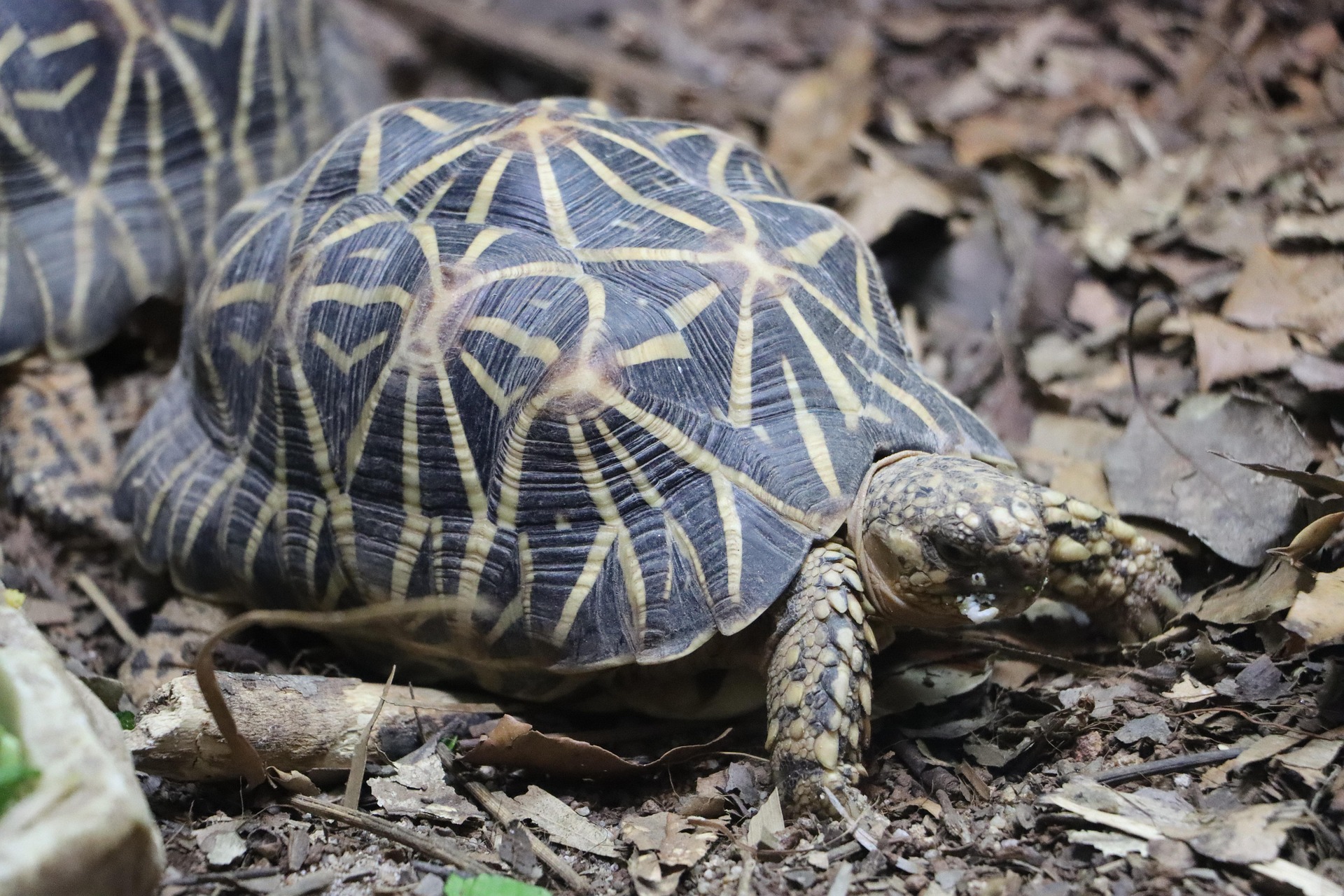
The Radiated Tortoise is a land turtle found in the southern part of Madagascar, and they never go into water. The carapace has a radial pattern of dark yellow lines, and the carapace is raised in a dome shape. Males are slightly larger than females, and their carapace is black or dark brown, while the primary carapace is yellow or orange. They live in flat grasslands.
- Appearance and Physical Characteristics
Carapace (Dorsal Shell)
Rounded, dome-shaped, with a carapace length of approximately 20-25 cm (rarely up to 30 cm).
The color is brown to dark brown, with pale yellow or orange spots on the edges and center of the carapace, giving it a jewel-like shine, hence the name.
The carapace is relatively hard and can be used for defense both in water and on land.
Plastron (Ventral Shell)
Yellow or pale orange, with patterns that vary from individual to individual.
Head
Small and round
Yellow or orange lines or spots on the head
Many individuals have patterns around the eyes and on the top of the head.
Limbs
Feet are somewhat broad and webbed
Easy to swim in water and walk steadily on land.
Tail
Relatively short
- Behavior/Ecology
Lifestyle
Semi-aquatic, living both in water and on land
During the day, they rest near water or in bushes, and sometimes bask.
Nocturnal or crepuscular, they are most active in the early morning and evening.
Diet
Omnivorous, feeding on aquatic plants, fruit, and small invertebrates (insects, crustaceans, etc.)
They feed on a balanced diet of plants and animals near water.
Reproduction
Females lay eggs in soft soil near water.
Lay several eggs (usually 4-6) at a time.
Avoiding dry seasons, they often breed during humid periods.
- Personality/Characteristics
Gentle and docile.
Shy and will retreat into the water if approached by humans.
In captivity, they may feed from the hand.

What is their personality like?
Radiated Tortoises are docile by nature and get along well with people. For this reason, they are very suitable animals for keeping. However, their long lifespan may be a problem.
- Basic Personality
Gentle and gentle
Little aggressive, they are relatively safe even when kept with other turtles and small animals.
Timid and cautious
They immediately retreat into the water when encountering new people or loud noises.
When frightened, they retract their head and limbs into their shell.
- Behavioral Characteristics
Semi-aquatic, so they are calm.
They swim leisurely underwater and leisurely bask in their shell on land.
Tends to be nocturnal and crepuscular.
They are mostly active at night and in the morning and evening, and often rest or hide during the day.
Fun to observe.
In captivity, they will sometimes come up from the water when they recognize food.
Some individuals will even eat food from the hand.
- Personality Characteristics in Captivity
Once accustomed to their environment, they are gentle and easy to care for.
If they become too frightened, they may remain submerged in the water for long periods of time.
Rather than persistent handling, prioritizing feeding and sunbathing times to observe them will reduce stress.
What is their ecology like?
Radiated Tortoises are almost entirely herbivorous, eating mainly herbs, but also leaves, flowers, and fruits. They reproduce oviparously. Males often fight fiercely before mating, clashing their shells against each other. Females lay 1-5 eggs at a time, up to three times a year. They are said to live for over 150 years.
- Living Environment/Habitat
This semi-aquatic turtle lives primarily in freshwater environments.
Swamps, ponds, streams, wetlands, mangrove forests, etc.
It also comes onto land to bask.
During droughts and dry seasons, even when water resources are reduced, it can hide in moist soil.
- Activity Patterns
Crepuscular to Nocturnal
Mostly active in the morning, evening, and at night.
During the day, it rests in brush near water or under submerged rocks.
Adapted for both swimming and walking on land.
Easily swims in water and preys on fish and small animals.
On land, it basks in water and searches for spawning sites.
- Diet
Omnivorous
Animal: Insects, crustaceans, small fish, earthworms, etc.
Vegetable: Aquatic plants, fruit, fallen leaves, etc.
Diet changes flexibly depending on the season and habitat.
- Breeding and Reproduction
Females lay eggs in soft soil near water.
They usually lay 4-6 eggs at a time.
Eggs hatch in moist soil.
Breeding occurs most frequently during rainy and humid seasons.
Sex can be distinguished by tail length and shell shape.
Do they have any natural enemies?
The Radiated Tortoise has no significant natural enemies.

About Radiated Tortoise Hatchery
This article provides detailed information about Radiated Tortoise (Cuora amboinensis) hatchlings.
- Appearance and Physical Characteristics (Juveniles)
Size
Immediately after hatching, carapace length is approximately 3-4cm.
Grows to approximately 20-25cm.
Shell
The carapace is rounded and softer than that of adults.
The color is yellowish-brown to brown, with more vivid spots and patterns.
The edges and central spots of the carapace shine like jewels, making juveniles worthy of the name “jewel turtle.”
Plaston
Bright yellow to orange.
Head and Limbs
Their heads and feet have prominent patterns and lines.
Their feet are well-webbed, making them good swimmers.
- Behavior and Personality (Juveniles)
Timid and cautious.
Easily hides from people and large movements.
Diving into the water or into their shell is their main defense.
Sometimes swim actively, but only for short periods.
Moves underwater to eat and check for safety.
Curious but reserved.
In captivity, they may learn to feed from the hand.
- Diet (Juveniles)
Similar to adults, Omnivorous
In the water, they feed on insect larvae, small crustaceans, and tiny fish.
They also eat aquatic plants and soft fruit.
As they grow, their predatory ability increases, and they begin to consume more animal-based foods.
- Growth and Biology
After hatching, they live near water or in moist soil.
They also bask, but for a shorter period than adults.
Their carapace length gradually grows to around 10 cm over the course of a year.
Within a few years of life, they begin to resemble adult behavior patterns (semi-aquatic, nocturnal, and omnivorous).
Is the Radiated Turtle an Endangered Species?
The Radiated Turtle is listed in Appendix I of the Convention on International Trade in Endangered Species of Wild Fauna and Flora (CITES), and international trade is restricted. Not only has its habitat been reduced due to recent development, but it has also been over-hunted as a pet, which has become a problem.
- International Conservation Status
IUCN (International Union for Conservation of Nature) Red List
Classification: EN (Endangered) – Equivalent to Critically Endangered
Meaning: Wild populations have declined significantly, and there is a high risk of extinction in the near future.
CITES (Convention on International Trade in Endangered Species of Wild Fauna and Flora)
Listed in Appendix II
International trade is prohibited in principle; a permit is required.
- Main Causes of Decline
Poaching and Pet Trade
Due to their beautiful shells and rarity, they are captured for pet and ornamental purposes.
Habitat Destruction
Deforestation, wetland and mangrove development
Habitat Deterioration due to water pollution and waterway construction
Food Use
In some areas, they are also captured for food.
- Conservation Status and Measures
Establishment of Wildlife Sanctuaries: Nature reserves are sometimes designated in various parts of Southeast Asia.
Captive Breeding: Populations are maintained through breeding by conservation organizations and some zoos.
International Regulations: CITES import and export controls attempt to curb illegal trade.
Can the Radiated Turtle be kept as a pet?
The Radiated Turtle can be kept as a pet. The following items are necessary for keeping a turtle. Small specimens are registered and sold as new arrivals, and there are many adoption requests, so check them out. Pay attention to the type of food and cage. They also have a long lifespan, so take that into consideration. Check the food and insulation method. There are many products available in shops, and it is easy to purchase supplies such as food, cases, and lights.
Cage
Depending on the size of the shell and the growth rate, a cage with a width of about 60 cm is required at the shop. We recommend using a reptile cage made of glass, acrylic, or plastic.
Flooring
There are various types of flooring categories, from large to small. There are various types, such as Akadama soil, coconut shells, and artificial turf. Sometimes they are sold at a low price during campaigns.
Heater
If necessary, prepare an air conditioner or heating appliance to make sure your turtle is comfortable. There are panel heaters, spot lamps, and basking lights.
Thermo-hygrometer
When raising amphibious turtles, it is very important to control the temperature and humidity. It is best to keep the temperature at around 30 degrees.
Lighting
Turtles are animals that maintain their health by producing vitamin D3 in their bodies, which promotes calcium absorption, by exposing them to strong ultraviolet rays in a day. For this reason, lighting is essential. There are incandescent and fluorescent tube types, and it is best to choose one that suits the cage. Use the sunlight hours as a guide for lighting.
Shelter
Turtles are living creatures, so it is a good idea to have a shelter as a point to create a place where they can escape indoors. Make sure to install it properly so as not to cause them too much stress.
Water dish
A water dish is also essential. Wash the water bowl every day and provide fresh water.
Pet Food
Turtles are herbivorous and their food consists mainly of small vegetables and fruits, with some also eating mustard spinach and mushrooms. Some turtles eat wild plants instead of vegetables. Give them fruits such as bananas, watermelons, apples, strawberries, kiwis, and mangoes as snacks. Some people also give supplements as a reference. It is a good idea to start by offering commercially available products. These contain all the nutrients that living creatures need.
Zoos Housing the Species (Japan & Worldwide)
The radiated tortoise (Astrochelys radiata) is an endangered species native to southern Madagascar. It is currently kept in zoos across Japan and around the world.
🇯🇵 Major Zoos in Japan
Zoo Location Status Confirmed Ueno Zoological Gardens Tokyo ✅ Maruyama Zoo (Sapporo) Hokkaido ✅ Yokohama Zoological Gardens “Zoorasia” Kanagawa ✅ Kyoto City Zoo Kyoto ✅ Asa Zoological Park (Hiroshima) Hiroshima ✅ Hirakawa Zoological Park Kagoshima ✅ Okazaki City Higashi Park Zoo Aichi ✅ Chikozan Park Children’s Zoo Saitama ✅ Edogawa Natural Zoo Tokyo ✅ Kanazawa Zoo (Yokohama) Kanagawa Verification Required
Ueno Zoological Gardens still lists the radiated tortoise on its official animal introduction page.
Okazaki City also introduces an individual named “Hoppy” on its official page (updated March 2026).
Egg-laying was confirmed at Hirakawa Zoological Park in 2015.
Zoorasia also officially lists the species among its animals.
🌎 Major Facilities Worldwide
🇺🇸 United States
Los Angeles Zoo
Bronx Zoo (New York)
San Diego Zoo (California)
Zoo Atlanta (Georgia)
Cincinnati Zoo (Ohio)
Columbus Zoo (Ohio)
Roger Williams Park Zoo (Rhode Island)
Smithsonian’s National Zoo (Washington D.C.)
The Los Angeles Zoo has successfully bred the species and participates in a North American conservation breeding program.
🇫🇷 France
A significant number of zoos in France keep this species.
ZooParc de Beauval
Parc Zoologique de Paris
Zoo de La Palmyre
Zoo de Lyon
Zoo d’Amnéville
Bioparc de Doué-la-Fontaine
Zoo de La Flèche
Parc Zoologique de Mulhouse
A Cupulatta
CERZA
A list of facilities updated in July 2026 confirms numerous locations housing the species in France alone. 🇩🇪 Germany
Tierpark Berlin
Tierpark Hellabrunn (Munich)
Schildkröten & Reptilien Zoo Neu-Ulm
🇧🇪 Belgium
Zoo Antwerpen
Pairi Daiza
🇳🇱 Netherlands
ARTIS (Natura Artis Magistra)
Rotterdam Zoo
🇭🇺 Hungary
Budapest Zoo
🇸🇪 Sweden
Parken Zoo
🇲🇬 Madagascar
Facilities also exist in the country of origin.
Tsimbazaza Zoo
Lemur’s Park
Croc Farm
Crocodile Valley
Global databases of animal facilities show their presence across a vast range of regions, including the Americas, Europe, Asia, and Madagascar.
Recommended articles
コメント