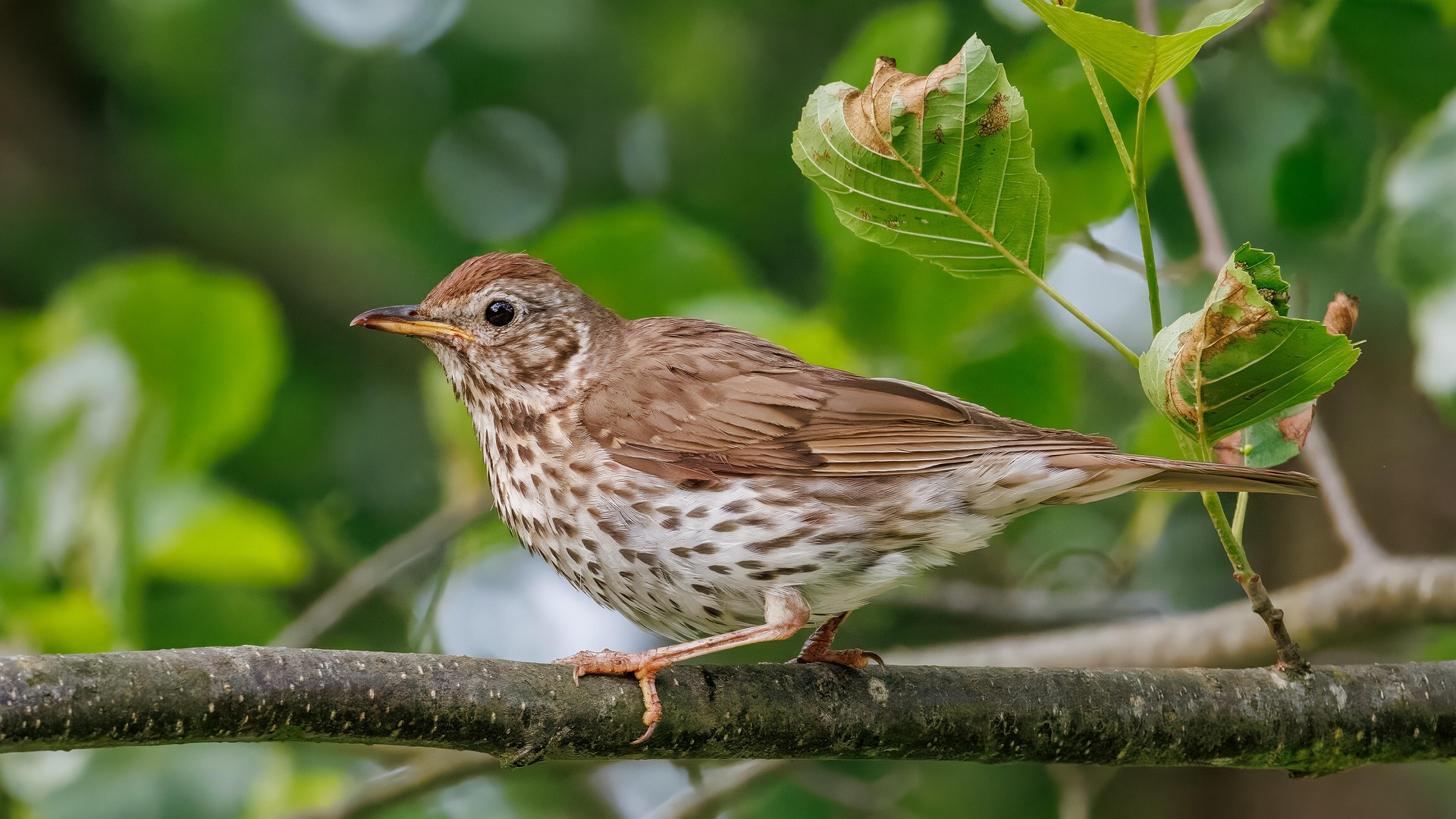
What kind of bird is the thrush, a wild bird that can be seen all over Japan? We will explain its characteristics, ecology, and habitat. This bird is well known as a migratory bird, and migrates from Russia to Southeast Asia. It is one of the most familiar birds, and there are probably many people who are not familiar with it.


What is Tsugumi? Basic Stats
The thrush is a bird classified as a member of the Turdidae family, Turdus genus, and Passeriformes order. Its scientific name is Turdus eunomus, and its English name is Dusky Thrush, written in kanji as 鶇. Its total length is 24cm, its wingspan is 38-39cm, and its weight is 65-90g. The list of information is as follows.
| Japanese(和名) | ツグミ |
| English(英名) | Dusky thrush |
| scientific name(学名) | Turdus eunomus |
| classification(分類) | Aves、 Passeriformes、 Turdidae、Turdus 鳥綱、スズメ目、ツグミ科、ツグミ属 |
| IUCN Status(保全状況) | LEAST CONCERN |
| Length(体長) | 24cm |
| Weight(体重) | 65~90g |
Thrush taxonomy
- 界(Kingdom):動物界 (Animalia)
- 門(Phylum):脊索動物門 (Chordata)
- 綱(Class):鳥綱 (Aves)
- 目(Order):スズメ目 (Passeriformes)
- 科(Family):ヒタキ科 (Turdidae)
- 属(Genus):ツグミ属 (Turdus)
- 種(Species):ツグミ (Turdus eunomus)
What are the roots and origins of the Dusky Thrush?
The bird commonly referred to as “Tsugumi” in Japan is classified today as Turdus eunomus. Its English name is the Dusky Thrush. It migrates to Japan as a winter visitor.
🌏 Tracing its ancestry?
Interestingly, phylogeographic studies suggest a high probability that the genus Turdus—to which the Dusky Thrush belongs—originated in the Eastern Palearctic (East Asia).
A large-scale study conducted in 2019 analyzed 72 Turdus species and identified the Eastern Palearctic as the most likely ancestral region for the entire genus. In other words, if one traces the distant ancestry of the Turdus species found worldwide today, it is highly likely that Asia was a key region of origin.
However, findings regarding the ancient phylogenetic relationships within the genus vary between studies, and the question of its origin has not yet been fully settled. Even in genome-wide studies, uncertainties remain concerning early lineage divergence and geographical dispersal.
🧬 What about the Dusky Thrush itself?
The Dusky Thrush (Turdus eunomus) breeds in the region stretching from central Siberia to Kamchatka. In winter, it migrates south to areas such as:
Siberia
↓
China and the Korean Peninsula
↓
Japan
It is also very closely related to Turdus naumanni (Naumann’s Thrush).
These two were often treated as the same species in the past, and their taxonomic relationship remains a subject of ongoing research. 🌳 Evolutionary Overview
Ancestral thrushes (Turdinae)
↓
Genus Turdus
↓
Diversification centered in East Asia
↓
┌─────────────┐
│ │
Various thrush species Turdus lineage
↓
T. eunomus
(Dusky Thrush)
↓
Breeds in Siberia and the Russian Far East
↓
Migrates to Japan, China, and the Korean Peninsula
Looking further back, the subfamily Turdinae (which includes the genus Turdus) is considered an ancient avian lineage that emerged during the Miocene epoch (approximately 23 to 5.3 million years ago).
🇯🇵 So, what about the Dusky Thrush in Japan?
Rather than being a bird “native to Japan,” it is a migratory bird that breeds in Siberia and the Russian Far East.
Viewed within the broader context of evolutionary history, the easiest way to visualize this is:
An ancient Turdus lineage originating in East Asia → Evolution of the Dusky Thrush in the Russian Far East and Siberia → Migration to Japan for the winter.
Habitat
Thrushes breed around Russia and migrate to Japan and southern China in the winter. In some cases, they even fly south to Southeast Asia. They come to Japan as winter birds.
Habitat of the Japanese Thrush
- Breeding Grounds
Summer (breeding season) Found mainly in eastern Siberia and Northeast Asia
Breeding in forest edges, open woodlands, and shrub thickets
Build nests on the ground or in shrubs and lay eggs
- Wintering Grounds (including Japan)
In winter, they migrate south to Japan, eastern China, the Korean Peninsula, and parts of Southeast Asia
Winter in forests, parks, farmlands, riverbanks, and other areas where there is an abundance of food, such as fallen leaves and ground food
In winter, they are often seen in urban parks and shrines in Japan
- Habitat Characteristics
They forage for insects and earthworms on the ground, so they prefer areas with fallen leaves and soil
They need safe places to rest, such as scrub forests, parks, and forests along rivers
- Migration
Japanese Thrushes are migratory birds, migrating seasonally from their breeding grounds to their wintering grounds
During migration, they rest in flat forests and riverbanks while flying

What are its characteristics? What kind of creature is it?
The color of the beak of the thrush is black, and the base of the lower beak is yellow. The feathers from the top of the head to the back of the neck are blackish brown, the feathers on the back are brown, the throat to the chest are pale yellow, and the feathers from the chest to the abdomen are white black or blackish brown. Thrushes live in grasslands and forests from plains to mountainous areas. They are very well known birds because they can be seen in cultivated fields and parks in urban areas. They often live in large flocks.
Characteristics of the Japanese Thrush
- Body Size
Total Length: Approximately 24 cm
Weight: Approximately 70-90 g
A medium-sized bird among the passerines
- Body Structure
Feathers:
Back and wings are brown
Dark spots on the chest and belly
Light-colored around the eyes, giving the face a soft appearance
Beak: Medium length, yellowish
Legs: Slightly thin, adapted for walking on the ground
- Behavior and Personality
Forages for insects, earthworms, fruit, etc. on the ground
Cautious, but may appear near humans
Moves alone or in small groups
Calls low, making a “chii” or “hee” sound
- Ecological Characteristics
A migratory bird, it breeds in Siberia and winters in Japan and East Asia.
It excels at foraging on the ground, searching for insects and earthworms in fallen leaves and soil.
It adapts well to environments such as forests, forest edges, parks, and farmlands.
What is their ecology?
Thrushes live by eating nuts, insects, spiders, and earthworms. They breed in Siberia from May to August. They breed oviparously. They breed monogamously, laying about 3 to 6 eggs and incubating them. They live for 10 years.
Ecology of the Japanese Thrush
- Living Environment
They live mainly in forests, parks, forest edges, agricultural fields, and riverbanks, where they can forage on the ground.
They often search for insects and earthworms in fallen leaves and soil.
They breed in northern forests (eastern Siberia) and winter in Japan and East Asia.
- Activity Patterns
They are diurnal and forage during the day.
They search for insects and earthworms while walking on the ground.
They may rest in trees as needed.
- Diet
They are omnivorous, but primarily eat insects.
They feed on small animals such as insects, earthworms, and spiders.
They also eat fruits and seeds.
They obtain energy in winter by eating a large diet of fruits and nuts.
- Breeding
Breeding season is summer (May to July).
Nests are built in shrubs or on the forest floor.
Number of eggs: 3-5
Both parents take turns incubating and feeding the eggs.
Chicks leave the nest approximately 2-3 weeks after hatching and take several more weeks to become independent.
- Sociality
They generally live alone or in small groups.
They may form small flocks in their wintering grounds.
They are wary, but some individuals have adapted to human and urban environments.
- Migration
Thrushes are migratory birds.
They migrate south from their breeding grounds (eastern Siberia) to Japan and East Asia in winter.
They spend the winter in areas with abundant food and return to their breeding grounds in the spring.
Do they have any natural enemies?
Birds of prey are the natural enemies of thrushes.

About Thrush Chicks
Here’s a detailed summary of Thrush chicks.
Characteristics of Goldeneye Chicks
- Birth
Number of Eggs: 3-5 Typically
Hatching Days: Approximately 12-14 Days
Chicks are not hairless; they hatch with a light down.
Their eyes are already open, and they are able to move around immediately after being fed by their parents (“swimming chicks”).
Body Length: Approximately 3-4 cm, very light weight
- Growth and Development
Feather Development: Feathers begin to grow from the down about a week after hatching.
Feeding: Parents feed them insects and earthworms by mouth.
Fledge: They leave the nest approximately 12-14 days after hatching.
They stay close to their parents for a while after leaving the nest and learn how to forage.
- Behavior and Personality
They become active near their parents immediately after birth.
They develop physical strength and foraging skills by playing with their siblings.
Before leaving the nest, they rest in the nest and wait for their parents to feed them.
- Parent-Child Relationship
Both parents take turns feeding and watching over the nest.
Even after leaving the nest, the young stay close to their parents for a while, learning how to find food and avoid danger.
Are thrushes an endangered species?
Thrushes are classified as least concern and are not endangered. They are kept in zoos and other places and events are held, so follow the guide and take part. They are active on riverbanks and in farming areas and you can often hear them calling. Look for photos and videos online.
Conservation Status
Scientific Name: Turdus eunomus
IUCN Red List: Least Concern (LC)
Global populations are stable and show no signs of decline.
The species migrates widely throughout Japan as a winter bird, resulting in a relatively large population.
Important Notes
While populations are stable, localized impacts may occur in breeding and wintering areas due to deforestation, agricultural land development, and pesticide use.
As a migratory bird, environmental conservation of wintering areas and migration routes is important in the long term.
Can thrushes be kept as pets?
Thrushes are strictly protected under the Wildlife Protection Act, so the general public cannot keep them as pets.
- Legal Restrictions
In Japan, thrushes are protected wild birds under the Wildlife Protection Act.
Capturing and raising them without permission is illegal.
Keeping them for research or educational purposes requires special permission from the Ministry of the Environment or prefectural governments.
- Ecological and Behavioral Reasons
Thrushes are migratory birds and have a habit of traveling over a wide area.
Because they live alone or in small groups, they are not suited to small cages or solitary captivity.
Their main foraging behavior is searching for insects and earthworms on the ground, making it difficult to secure food in an artificial environment.
- Difficulties in Raising
Wild individuals are highly cautious and do not easily habituate to humans.
They require the ability to fly, and cannot maintain their health without sufficient space for exercise.
Due to their migratory instinct, they tend to move during the seasons.
Zoos Keeping the Species (Japan & Worldwide)
A note of caution is needed here. While the Dusky Thrush (Turdus eunomus) is very commonly seen in the wild, it is not a bird that is permanently on display in zoos.
🇯🇵 Japan
Based on currently available information, the following facilities have confirmed records of keeping the species:
| Facility | Status |
|---|---|
| Sapporo Maruyama Zoo | Records of husbandry exist. |
| Higashiyama Zoo and Botanical Gardens | Official record of keeping and displaying one Dusky Thrush in the “Small Bird and Squirrel Forest” in 2015. |
| Shunan City Tokuyama Zoo | Video footage exists documenting a Dusky Thrush kept at the facility. |
Documents from Sapporo Maruyama Zoo explicitly list the “Dusky Thrush” among their captive bird species.
Additionally, Higashiyama Zoo and Botanical Gardens recorded on their official blog that a single Dusky Thrush joined the “Small Bird and Squirrel Forest” exhibit in 2015.
There are also records of a Dusky Thrush being filmed at Shunan City Tokuyama Zoo.
🌎 Worldwide
Regarding zoos overseas, I was unable to find a comprehensive public list of facilities currently exhibiting the Dusky Thrush (Turdus eunomus).
This is a crucial point:
It is not the case that Dusky Thrushes are commonly kept in zoos around the world.
While large numbers of Dusky Thrushes can be observed annually in places like Japan, zoos prioritize rare species, large birds, and species involved in breeding programs over the display of common wild birds.
In fact, in Japan today, it is far easier to observe wild Dusky Thrushes in parks, along riverbanks, or in agricultural fields than in zoos. There are numerous records of sightings across Japan.
⚠️ “Dusky Thrush” vs. “White’s Thrush” (Tiger Thrush)
This is a point where confusion often arises when researching zoo information.
Dusky Thrush → Turdus eunomus
White’s Thrush (Tiger Thrush) → Zoothera aurea (etc.)
For example, Tokyo Zoo Net contains information on the White’s Thrush (Zoothera aurea), but this is a different species from the common Dusky Thrush.
Recommended articles
コメント