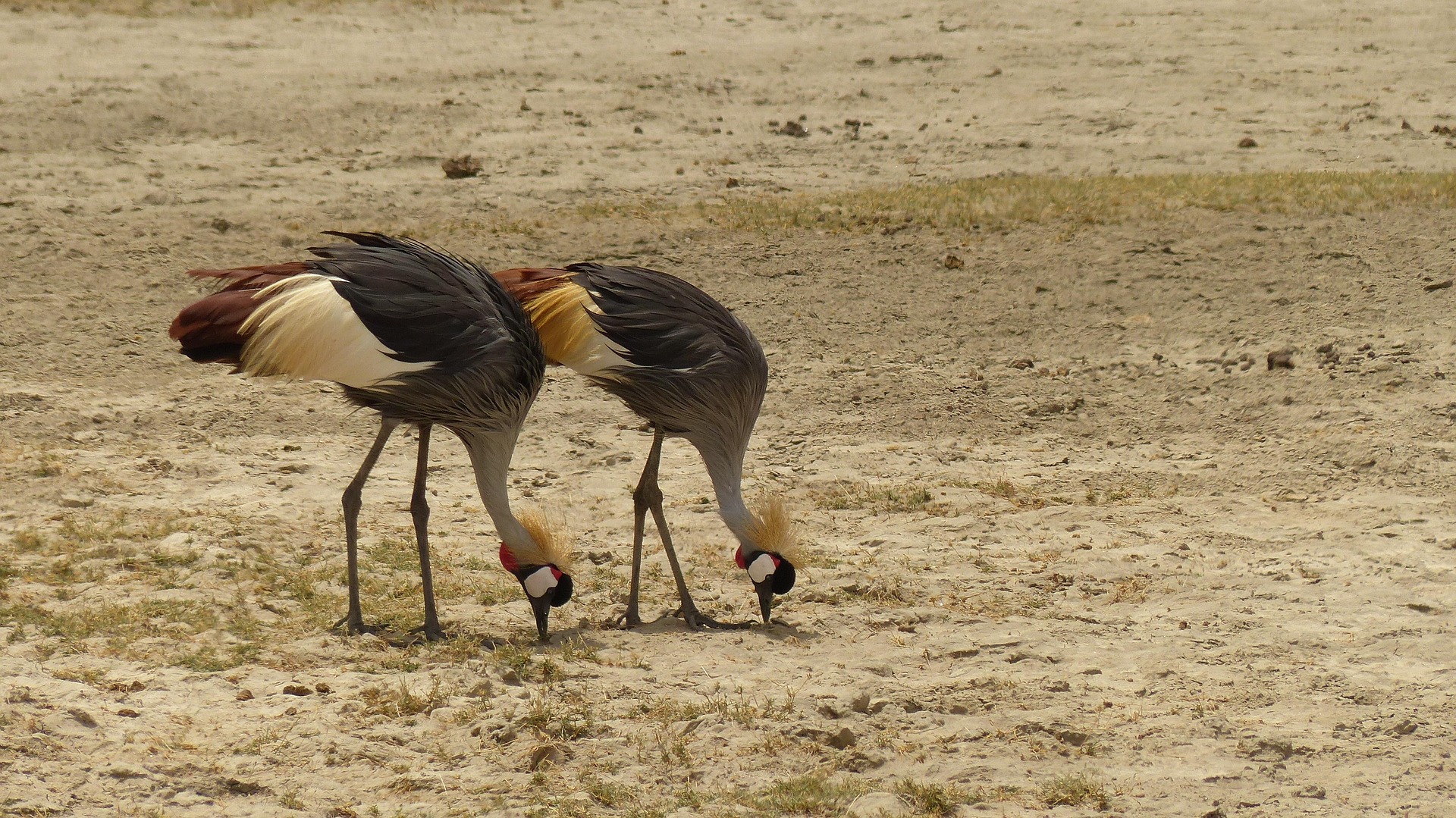
What kind of bird is the Crowned Crane, an animal characterized by its crest and red cheeks? We will introduce and explain its characteristics, ecology, and habitat. It is a bird that is distributed in central and western sub-Saharan Africa, and is characterized by its very flashy head. This crane, which can be seen widely in Africa, is actually designated as an endangered species.


- What is a Crowned Crane? Basic Stats
- What are the roots and origins of the crowned crane?
- Habitat
- What are its characteristics? What does it look like?
- What is its ecology?
- About Crowned Crane Chicks
- Are Crowned Cranes Endangered?
- Can Crowned Cranes be kept as pets?
- Zoos Housing the Species (Japan & Worldwide)
- Recommended articles
What is a Crowned Crane? Basic Stats
The Crested Crane is a bird that belongs to the Crested Crane genus, Gruidae family, and Gruidae order. Its scientific name is Balearica pavonina, and its English name is Black crowned crane. Its kanji is 柿鶴. Its body length and total length are 100cm, and its weight is 3.5kg. Its wingspan is 1.9m. The full list of information is as follows. Its crown and cheeks are its main features.
| Japanese(和名) | カンムリヅル |
| English(英名) | Black crowned cran |
| scientific name(学名) | Balearica pavonina |
| classification(分類) | Aves、 Gruiformes、 Gruidae、pavonina 鳥綱、ツル目、ツル科、カンムリヅル属 |
| IUCN Status(保全状況) | VULNERABLE |
| Length(体長) | 100cm |
| Weight(体重) | 3.5kg |
Organism classification (class)
- ドメイン:真核生物 Eukaryota
- 界:動物界 Animalia
- 門:脊索動物門 Chordata
- 綱:鳥綱 Aves
- 目:ツル目 Gruiformes
- 科:ツル科 Gruidae
- 亜科:カンムリヅル亜科 Balearicinae
- 属:カンムリヅル属 Balearica
What are the roots and origins of the crowned crane?
The origins of the crowned crane are quite fascinating. In short, crowned cranes represent a particularly ancient lineage among extant cranes; they are considered “primitive-type cranes” that have persisted in modern-day Africa.
🐦 The Crowned Crane Lineage
Crowned cranes belong to the genus Balearica.
There are two extant species:
Grey Crowned Crane
Balearica regulorum
Black Crowned Crane
Balearica pavonina
Taxonomically, both belong to the family Gruidae (true cranes), but their lineage diverged from that of typical cranes at a very early stage.
DNA-based research has confirmed a split into two major lineages:
Crowned cranes (Balearicinae)
↓
Typical cranes (Gruinae)
While estimates regarding the timing of this divergence vary by study, it is generally thought to have occurred approximately 31 to 37 million years ago.
In other words,
The crowned crane lineage diverged much earlier than that of modern species such as the Red-crowned Crane, White-naped Crane, or Demoiselle Crane.
🌍 So, where is their “origin”?
This point requires some nuance.
There is no definitive fossil record stating, “Crowned cranes originated in Africa [X] years ago.”
The fossil record for the crane family (Gruidae) as a whole is fragmentary, and classifying ancient fossils belonging to the crowned crane lineage can be difficult.
However, the two extant crowned crane species are endemic to sub-Saharan Africa.
In particular, they inhabit:
Savannas
Grasslands
Wetlands
Areas surrounding rivers and lakes
Given this current biogeography, it is natural to conclude that the center of crowned crane evolution shifted to Africa.
🦖 If they are “ancient cranes,” why do they have a crown on their heads?
This is the most distinctive feature of the crowned crane. Typical cranes have evolved
with long necks, long legs, and adaptations for wetlands and grasslands.
In contrast, crowned cranes
retain unique physical characteristics—such as legs capable of perching in trees,
a relatively short beak,
a crown of feathers on the head,
and throat wattles—
along with adaptations for savannas and wetlands.
The ability to perch in trees is particularly significant.
Among extant cranes, crowned cranes are the only group capable of resting or roosting in trees.
This is a crucial point suggesting that crowned cranes may retain ancient evolutionary traits that differ from those of typical cranes.
Habitat
The Crowned Crane is found in central, western and southern Africa, including Uganda in sub-Saharan Africa. It is already extinct in Nigeria.
- Crowned Crane (Balearica regulorum) — Eastern and Southern Africa
Geographic Distribution
East Africa: Kenya, Uganda, Tanzania
Southern Africa: Zimbabwe, South Africa, Botswana
Habitat
Grasslands near savannas and wetlands
Lake and river wetlands are important habitats
Sometimes found in highlands and forest edges
Ability to perch on tree branches allows for habitat in open wooded environments
Subspecies Characteristics
B. r. regulorum (Southern Crowned Crane): Mainly found in South Africa
B. r. gibbericeps (Eastern Crowned Crane): Grassland wetlands of Kenya and Tanzania
- Black Crowned Crane (Balearica pavonina) — West Africa
Geographic Distribution
West Africa: Senegal, Ghana, Nigeria, Mali, Niger
Limited to tropical grasslands and wetlands south of the Sahara Desert
Habitat
Dependent on wetlands such as rivers, lakes, and swamps
Sometimes spotted around agricultural areas
Able to perch in forests and tall trees, they are common in wetlands with scattered trees
Characteristics of each subspecies
B. p. pavonina: Mainly found in Senegal and Ghana
B. p. ceciliae: Mainly found in Nigeria and Chad
- Common Habitat Features
Grasslands and savannas with wetlands and water sources are essential
Ability to perch on tree branches allows them to adapt to forest-like environments better than other cranes
Non-migratory, but may move to neighboring areas during droughts

What are its characteristics? What does it look like?
The crowned crane has a black top and a yellow crest at the back of its head. The upper cheeks appear white, the lower cheeks pink, and the body is black. The feathers and wing coverts are white, and the primary feathers are black. The crowned crane lives on rivers, streams, and wetlands. The crowned crane is a resident bird that tends to stay in place. It is the national bird of Nigeria.
- Physical Characteristics
Head
Their most distinctive feature is their golden or black crest.
Crowned Crane: Bright golden crest
Black Crested Crane: Dark golden to black crest
Their distinctive red and white patterning on their cheeks varies between individuals and species.
Long, slender beak
Body
Body Length: Approximately 100-120 cm
Weight: Approximately 3-4 kg
Mainly gray or black feathers
White feathers on the wingtips create a beautiful contrast in flight.
Legs/Feet
Their long, slender legs allow them to walk and run on the ground.
Their well-developed hind toes allow them to perch on branches.
- Behavioral and Ecological Characteristics
Walking and Flight
They primarily walk on the ground and are also good at running.
They can fly, but do not fly long distances.
A rare crane that can perch on tree branches.
Diet
Omnivorous: Plant seeds, grasses, and fruit.
They may also eat insects, small reptiles, and amphibians.
They also prey on aquatic creatures, so they are closely associated with wetlands.
Social
They often live in groups.
They are known for their spectacular courtship dance, which involves jumping, flapping their wings, and shaking their heads.
They call with a high-pitched, clanging sound.
Breeding
Lays 2-3 eggs.
They build nests in trees or near wetlands.
Both parents raise their young.
What is its ecology?
The crowned crane lives on grass and grain seeds, as well as insects and reptiles such as frogs. It is an oviparous breeding method. It builds nests in wetlands and lays two to three eggs. The incubation period is one month. Its lifespan is 50 to 60 years.
- Habitat Relationship
Dependent on wetlands, grasslands, and savannas
Prefers open grasslands and wetlands near water
Able to perch on tree branches, they can also live in shrublands and forest edges near wetlands
Because of their arboreal abilities, they are better adapted to forest-like environments than other cranes
Sensitive to environmental changes (drought and agricultural land development)
- Diet
Omnivorous
Plants: seeds, grasses, fruits
Families: insects, earthworms, small reptiles, amphibians
Often preys on wetland organisms
Dietary diversity influences habitat selection
- Behavior Pattern
Migration
Does not migrate long distances (non-migratory)
However, they may travel short distances during dry seasons or droughts
Sociality
Typically lives in groups
Flocks form even outside of the breeding season
Flocks often cooperate and protect themselves from predators
Breeding Behavior
Extraordinary courtship dance
Jumping, flapping wings, and head bobbing
Attracts mates with calls and movements
Nests are built in marsh grasslands or on tree branches
Egg size: 2-3
Chicks are often raised by both parents
Do they have any natural enemies?
The crowned crane has no significant natural enemies.

About Crowned Crane Chicks
This article provides a detailed summary of Crowned Crane (Balearica) chicks, focusing on their appearance, behavior, and habitat.
- Egg Laying and Hatching
Egg Size: 2-3 per clutch
Nest Location: Wetland grasses or shrubs, sometimes on branches
Egg Size: Approximately 5-6 cm, pale green to white
Incubation Time: Approximately 28-31 days
- Chick Appearance
Feathers are soft and generally grayish-brown.
The crest on the head is not yet fully developed.
Due to their small body and short legs, they cannot fly or climb trees at first.
As they grow, the crest and red-and-white patterning on their cheeks appear.
- Chick Behavior
Stay with their parents.
Both parents feed and protect them from predators.
Mainly walk on the ground; initially, they cannot fly.
They learn to explore and forage by imitating their parents’ movements.
- Growth and Flight Ability
Crest Development: A small crest appears within a few weeks of birth.
Flight Ability: First flight is possible at approximately 2-3 months of age.
Reuniting with the Flock: Once mature, they may leave their parents and join groups of young birds of the same age or other flocks.
- Survival Key Points
Vulnerable to predators, they are often targeted by crocodiles, snakes, large birds, and mammals.
Hidden areas in wetlands and grasslands are important for survival.
Protection by parents and safety within the flock increase the chick’s survival rate.
Are Crowned Cranes Endangered?
Crowned cranes are designated as an endangered species (Red List). They are also listed in Appendix II of the Convention on International Trade in Endangered Species of Wild Fauna and Flora (CITES), and international trade is strictly restricted. They are considered pests that damage crops, and are not only exterminated, but their heads and wings are traditionally used for medicinal purposes, leading to overhunting. The estimated population is 28,000 to 47,000 birds.
- Crowned Crane (Balearica regulorum) — East and Southern Africa
IUCN Red List: Endangered
Major Threats
Habitat loss due to development of wetlands and grasslands
Deterioration of food supply due to pesticides and agricultural land development
Poaching and pet trade (especially young birds)
Conservation Status
Some populations are protected in national parks and protected areas
Conservation of wetland habitats is key
- Black Crowned Crane (Balearica pavonina) — West Africa
IUCN Red List: Vulnerable
Major Threats
Wetland loss (farmland and dam development)
Decrease in perch habitat due to deforestation
Hunting and capture
Habitat is limited to parts of West Africa, resulting in regionally low populations
- Background to the Endangered Species
Crowned cranes depend on wetlands and wooded grasslands, making them sensitive to environmental changes.
Although they have greater arboreal ability than other cranes, wetland destruction directly threatens their survival.
Wild populations are declining in some areas.
- Conservation Efforts
Establishment of nature reserves across Africa
Habitat conservation and wetland restoration projects
Breeding programs (captive breeding)
Can Crowned Cranes be kept as pets?
As mentioned above, Crowned Cranes are an endangered species, so it is extremely difficult for ordinary people to keep them as pets. You can see them at zoos, etc. It is possible to see Grey Crowned Cranes and other species.
- Current Status of Captivity
There are examples of captivity in zoos and conservation facilities around the world.
Examples: Safari parks, aviaries, and conservation facilities.
They have been successfully bred in captivity and are used for conservation purposes as part of breeding programs.
- Legal and Regulatory Issues
Crowned cranes are listed in Appendix II of the Convention on International Trade in Endangered Species of Wild Fauna and Flora (CITES).
A permit is required for international trade.
Private captivity in Japan requires a national or prefectural endangered species permit.
Importing or captivity without a permit is illegal.
- Breeding Requirements
Breeding Environment
A large area is required (they primarily walk on land, but may also fly).
Recreating a waterside or wetland is desirable.
Providing perches and shrubs reduces stress.
Grass or soil is ideal for the ground; concrete is a good choice.
Diet
Omnivorous, requiring a balance of animal and plant foods.
Seeds, fruits, vegetables, insects, earthworms, etc.
Incorrect nutritional management can lead to health problems.
Sociality
Because they prefer to live in groups, solitary housing is not recommended.
Multiple birds are recommended.
- Breeding Difficulty
Specialized knowledge required: Understanding of feeding habits, reproduction, and ecology is essential.
Private breeding is extremely difficult, and most breeding is at the zoo or conservation level.
Breeding is also difficult without a well-organized social structure.

Zoos Housing the Species (Japan & Worldwide)
🇯🇵 Major Zoos in Japan Housing/Displaying the Species
Chiba Zoological Park: Grey Crowned Crane ✅ Housed/Displayed
Fukuoka City Zoo: Grey Crowned Crane ✅ Housed/Displayed
Shizuoka City Nihondaira Zoo: Grey Crowned Crane ✅ Housed/Displayed
Yagiyama Zoological Park (Fujisaki no Mori): Grey Crowned Crane ✅ Housed
Suzaka City Zoo: Grey Crowned Crane ✅ Housed/Displayed (Information available)
Itozu no Mori Park: Grey Crowned Crane ✅ Housed
Ouchiyama Zoo: Grey Crowned Crane ✅ Housed
Tennoji Zoo: Grey Crowned Crane ✅ Displayed
For instance, Chiba Zoological Park lists its current exhibit location as the “Savanna Zone” on its official webpage (updated April 2026).
Fukuoka City Zoo also currently lists a male named “Tsuyoshi.”
At Nihondaira Zoo, the bird is housed in the “Flying Mega-Dome,” where it is often seen perching atop trees.
On the other hand, Hirakawa Zoological Park does not currently house the species; their official website explicitly states, “We do not currently house this species.”
🇯🇵 Surprisingly Common in Japan
If past records are included, the species has also been confirmed at Tobu Zoo, Komoro City Zoo, Ishikawa Zoo (not the Insectarium), Toyohashi Zoo and Botanical Park, Izu Shaboten Zoo, Izu Animal Kingdom, Miyazaki City Phoenix Zoo, and Kumamoto City Zoological and Botanical Gardens.
However, it is important to distinguish between “having housed them in the past” and “currently displaying them as of 2026.”
🌍 What About the Rest of the World?
They are even more common globally, with crowned cranes being housed in numerous zoos and bird parks, particularly across Europe. Grey Crowned Crane
According to databases of European zoological facilities, records of the species being kept include the following:
🇧🇪 Pairi Daiza
🇩🇰 Copenhagen Zoo
🇩🇪 Tierpark Berlin
🇩🇪 Zoo Dresden
🇩🇪 Zoo Leipzig
🇩🇪 Zoo Wuppertal
🇩🇪 Zoo Frankfurt
🇫🇷 Parc Zoologique de Paris
🇫🇷 ZooParc de Beauval
🇪🇸 Bioparc Valencia
🇬🇧 Paignton Zoo
🇬🇧 Newquay Zoo
A particularly large number of facilities are listed, especially in Germany.
Recommended articles
コメント