What kind of animal is the Malayan sun bear? We will explain its characteristics, ecology, and habitat. It is the smallest of all bears, but it can be found in various parts of Asia. It is the least aggressive and dangerous to humans among all bears, so it is not very dangerous.


- What is a Malayan sun bear? Basic stats
- What are the roots and origins of the sun bear?
- Habitat
- What are their characteristics? What kind of creature are they?
- What is their personality like?
- What is their ecology like?
- About Malayan Sun Bear Cubs
- Are Malayan sun bears an endangered species?
- Can you keep a Malayan sun bear as a pet?
- Zoos Housing the Species (Japan & Worldwide)
- Recommended articles
What is a Malayan sun bear? Basic stats
The Malayan sun bear is a carnivorous mammal classified in the order Carnivora, family Ursidae, genus Helarctos. Its English name is the Malayan sun bear, and its scientific name is Helarctos malayanus. Its body length is 1.2-1.5m, and its weight is 25-65kg. Its tail length is 3-7cm. The list of information is as follows.
| Japanese(和名) | マレーグマ |
| English(英名) | Malayan sun bear |
| scientific name(学名) | Helarctos malayanus |
| classification(分類) | Mammalia、Carnivora、 Ursidae、Helarctos 哺乳綱、食肉目、クマ科、マレーグマ属 |
| IUCN Status(保全状況) | VULNERABLE |
| Length(体長) | 1.2~1.5m |
| Weight(体重) | 25~65kg |
Taxonomy
界:動物界 (Animalia)
門:脊索動物門 (Chordata)
綱:哺乳綱 (Mammalia)
目:食肉目 (Carnivora)
科:クマ科 (Ursidae)
属:マレーグマ属 (Helarctos)
種:マレーグマ (Helarctos malayanus)
What are the roots and origins of the sun bear?
The sun bear (Helarctos malayanus) is the smallest species in the bear family (Ursidae) and originated in the rainforests of Southeast Asia.
🧬 Phylogenetic Roots
Broadly speaking, the lineage is as follows:
Order Carnivora
↓
Family Ursidae
↓
Subfamily Ursinae
↓
Genus Helarctos
↓
🐻 Sun bear (Helarctos malayanus)
The sun bear currently represents a distinct lineage, constituting the sole member of the genus Helarctos.
🌏 Where do they come from?
Their current distribution covers Southeast Asia, including:
🇲🇾 Malaysia
🇮🇩 Indonesia (Sumatra and Borneo)
🇹🇭 Thailand
🇲🇲 Myanmar
🇱🇦 Laos
🇰🇭 Cambodia
🇻🇳 Vietnam
🇧🇩 Areas around Bangladesh
Tropical forests, particularly on the islands of Borneo and Sumatra, are vital habitats for sun bears.
🐻 Where do they fit among bears?
It is easiest to think of the sun bear as a species that evolved independently in South and Southeast Asia.
Extant species in the bear family include:
Polar bear
Brown bear
American black bear
Asian black bear
Giant panda
Spectacled bear
Sloth bear
Sun bear
While sun bears share a common ancestor with these other bears, they specialized over a long period to thrive in the rainforest environments of Southeast Asia.
Habitat
The Malayan sun bear is a bear found in Asia.
- Geographic Distribution
Malayan sun bears live in the tropical rainforests of Southeast Asia.
Malay Peninsula: Malaysia, southern Thailand
Indonesia: Sumatra, Borneo (Kalimantan)
Thailand, Cambodia, Laos, and parts of Vietnam
Key Points: Their distribution is fragmented, and their habitat is shrinking due to deforestation.
- Habitat
Tropical lowland to montane rainforests
Densely forested, allowing for arboreal activity
Altitude: Forests ranging from mostly lowlands to approximately 1,500 m above sea level
Uses areas from the forest floor to treetops
Primarily forages and rests in trees, and also uses tree holes and fallen trees
- Ecological Relationship
Highly arboreal: Requires tree climbing to obtain fruit and honey
Solo Activity: Wide-area foraging requires extensive, contiguous forests
Securing Water and Fruit: Moves according to the seasonal distribution of food and water sources
What are their characteristics? What kind of creature are they?
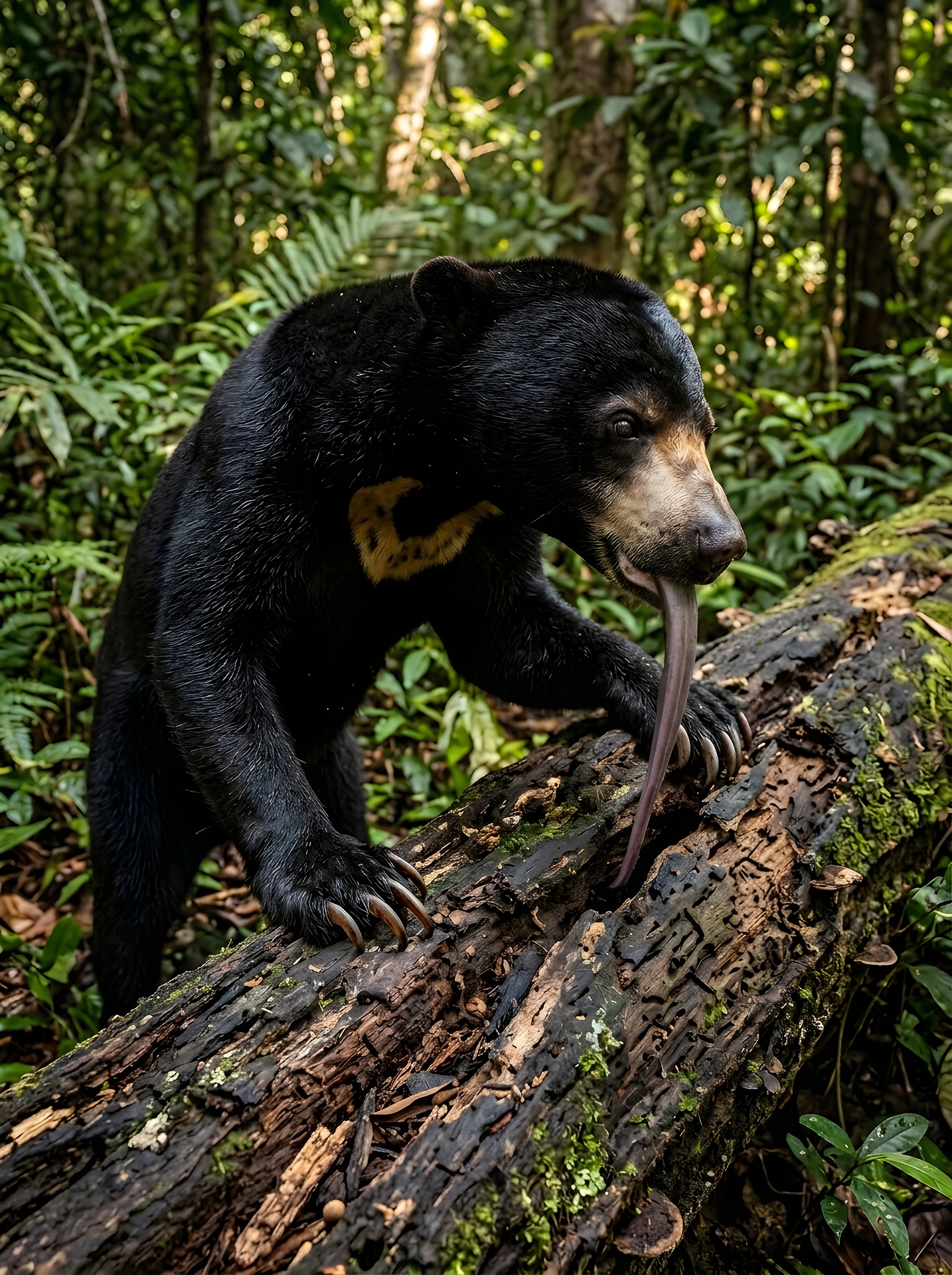
The Malayan sun bear is covered with short, shiny black or dark brown hair. Its muzzle is gray-brown or yellowish brown, and it is the smallest of all bears. Its height is only 70cm, so it doesn’t look like a bear. It has five fingers on each leg and large, sharp claws on its palms. Malayan sun bears are primarily nocturnal animals, and they often sleep between trees during the day. They like lowland forests and mangrove forests.
- Physical Characteristics
Body Size: Approximately 50-70 cm at shoulder height, 100-150 cm in length
Weight: 25-65 kg (females are slightly smaller)
Fur Color: Black fur with a crescent-shaped yellow-orange pattern on the chest
Face/Ears: Small, round ears, long tongue (suitable for licking honey and sap)
Claws/Feet: Long, curved, sharp claws specialized for climbing
Key Points: Small size, adapted to arboreal life, and excellent climbing ability
- Physical Adaptations
Specialized for arboreal life
Strong grip on branches, allowing them to enter tree holes to collect fruit and honey
Long Tongue
Can be used to suction honeycombs and sap
Small and Lightweight
Able to move freely in trees
- Personality and Behavior Characteristics
Timid and cautious
Sensitive to predators and humans, they usually move alone and quietly
Both diurnal and nocturnal
Typically active when food is available
Low aggressiveness, but will use their powerful claws to defend themselves

What is their personality like?
Malayan sun bears tend to live alone, so they are very laid-back. However, they are the least aggressive of all bears, and some people keep them as pets.
- Timid and cautious
Sensitive to predators and humans, they usually hide and act quietly.
If they sense danger, they will quickly flee or climb trees to protect themselves.
Low aggressiveness, tending to avoid conflict.
Key point: To survive in the wild, caution and vigilance are paramount.
- Prefers solitary behavior
Generally lives alone.
They rarely form groups except during breeding season or with their young.
They often travel and eat alone.
- Curious
Due to their small size and dexterity, they actively explore in trees and on the ground, searching for objects and food.
They use their long tongues and sharp claws to find honey and fruit.
They are cautious around humans and other animals, but will approach objects that interest them for observational purposes.
- Defensive behavior
Low aggressiveness, but they use their sharp claws and powerful forelimbs in defense.
They climb trees and make threatening noises to keep prey away.
What is their ecology like?
Malayan sun bears are omnivorous, and live on lizards, birds and their eggs, small mammals, and insects. They can breed all year round, and the gestation period is about 100 days. They can give birth to one baby at a time. They are nursed for about one to one and a half years and reach sexual maturity at three years. Their lifespan is 20 to 25 years.
- Behavior
Mainly diurnal, but may also be nocturnal (depending on food and environment)
Generally solitary, only forming groups with mothers and calves.
Actively exploratory, traveling over a wide area in search of fruit, honey, and insects.
- Habitat/Hidden Places
Rests in rainforest trees, tree hollows, fallen logs, and the shade of rocks.
Often naps in trees, finding safety in tree branches or caves.
Dense forests are important, and in open areas they must be vigilant to protect themselves from predators.
- Diet
Omnivorous
Fruits (especially ripe ones)
Tree sap and nectar
Insects (termites and wasp nests)
May also prey on small vertebrates.
Specialized for licking tree sap and honey with their long tongues.
Food varies depending on season and location.
- Movement/Territory
Travels over a wide area in search of food.
Because they are solitary, each individual has its own territory.
Flexible behavior adapts to the distribution of food and water.
- Breeding
Breeding Season: Year-round, with peaks in some areas.
Gestation Period: Approximately 95-100 days
Litter Size: Usually 1-2 young
The mother takes the lead in raising the young, sheltering them in trees or caves.
Do they have any natural predators?
The natural predators of the Malayan sun bear are tigers, leopards, and clouded leopards.

About Malayan Sun Bear Cubs
This article provides detailed information about Malayan sun bear (Helarctos malayanus) cubs. Their growth process and ecology are unique to small bears.
- Birth and Development
Gestation Period: Approximately 95-100 days (approximately 3 months)
Litter Size: Usually 1-2 pups
Birth Weight: Approximately 0.5-1 kg
Birth Length: Approximately 25-35 cm
Key Points: Because they are born very small, their mother’s protection is essential.
- Appearance
Dark brown back, with a faint crescent pattern still visible on the chest.
Hair is soft, and claws and limbs are still short, resulting in immature dexterity.
Large eyes, adapted for visual communication with their mother.
- Behavior
Dependent on their mother for life.
Find safety in trees or burrows.
Learns how to eat from their mother.
Learns climbing, exploring, and vigilance behaviors through play and imitation.
When sensing danger, they hide behind their mother’s back or in their burrow.
- Time to Maturity
Cubs acquire tree climbing and foraging skills at about six months of age.
They begin to become independent from their mothers at around one year of age.
The crescent-shaped pattern on their chest and their behavioral patterns become more distinct as they grow.
Are Malayan sun bears an endangered species?
Malayan sun bears are designated as an endangered species. The main causes are deforestation and development, but poaching for food and herbal medicine is also a cause.
- International Assessment (IUCN Red List)
Classification: Malayan Sun Bear (Helarctos malayanus)
Conservation Status: Vulnerable (Endangered)
Explanation:
The population is declining, and is significantly threatened by habitat destruction and human activity.
Due to their low lifespan and reproductive rate in the wild, recovery will be slow.
- Population Size and Distribution
Distributed fragmentedly in the tropical rainforests of Southeast Asia (Malaysia, Sumatra, Borneo, Thailand, etc.)
The exact population size is unknown, but estimated to be in the thousands to tens of thousands.
Habitat fragmentation due to deforestation and land development has led to an increase in isolated populations.
- Major Threats
Deforestation
Agricultural development (palm oil plantations, plantations)
Habitat reduction due to logging and urbanization
Poaching and illegal trade
Hunted for meat, skin, and medicine
Sometimes captured for pets
Environmental change
Food shortages and changes in water resources due to climate change
Can you keep a Malayan sun bear as a pet?
As Malayan sun bears are designated as an endangered species, ordinary people cannot keep them as pets. They are listed at the top of zoos and other places, so let’s take a look at males and females.
- Personality and Behavioral Issues
Timid and cautious
Sensitive to predators and humans, and susceptible to environmental changes
Prefers solitary behavior
Stressful domestic environments can lead to aggression and health problems
Curious and dexterous
They use their long tongues and sharp claws to explore and forage, making inadequate enclosures dangerous
Key Point: Their temperament makes them unsuitable as pets
- Housing Environment Issues
Requires a vast forest environment
The ability to move freely in trees and on the ground to gather food is essential
Requires resting areas such as tree holes, fallen trees, and branches
Stress accumulates in cramped cages
- Laws and Regulations
Malaysian sun bears are protected as a vulnerable species.
In Japan, under the Convention on International Trade in Endangered Species (CITES), special permission is required for import and breeding.
Keeping is permitted only in zoos and research facilities; private ownership is prohibited.
Zoos Housing the Species (Japan & Worldwide)
The following is a summary of available information regarding the captivity of Sun Bears (Helarctos malayanus) as of 2026.
🇯🇵 Japan
As of July 11, 2025, official data from the Tokyo Metropolitan Government indicated that 14 individuals were being kept across eight facilities in Japan. Ueno Zoo was listed as having “zero” individuals on that date.
Major facilities currently confirmed to house them include:
Maruyama Zoo (Sapporo)
Yuki Park Zoo (Kofu)
Toyohashi Zoo and Botanical Park (Non Hoi Park)
Higashiyama Zoo and Botanical Gardens
Tennoji Zoo
Tobe Zoo
Kochi Prefectural Noichi Zoological Park
Tokuyama Zoo
Fukuoka City Zoological Garden
Kumamoto City Zoological and Botanical Gardens
Hirakawa Zoological Park
However, as circumstances—such as the death or transfer of individual animals—can change, it is necessary to check the latest information from each zoo to confirm whether they are currently on public display. The 2025 official announcement by the Tokyo Metropolitan Government serves as a key reference for the domestic captive population.
Ueno Zoo currently does not house any Sun Bears. “Kyoko” passed away on July 10, 2025, bringing the zoo’s count to zero.
🌍 Worldwide
They are kept in facilities across a wide range of international locations.
Europe
🇩🇪 Berlin Zoo
🇩🇪 Frankfurt Zoo
🇩🇪 Allwetterzoo Münster
🇨🇿 Olomouc Zoo
🇨🇿 Ústí nad Labem Zoo
🇳🇱 Burgers’ Zoo
🇳🇱 Ouwehands Dierenpark
🇫🇷 Paris Zoological Park
🇪🇸 Madrid Zoo
🇵🇱 Łódź Zoo
🇬🇧 Colchester Zoo
Zootierliste also lists numerous European facilities, including these, as current keepers of the species.
Asia
🇸🇬 Singapore Zoo
🇨🇳 Guangzhou Zoological Garden
🇨🇳 Shanghai Zoo
🇨🇳 Suzhou Zoo
🇰🇷 Seoul Grand Park Zoo
🇹🇭 Khao Kheow Open Zoo
🇹🇭 Chiang Mai Zoo
🇹🇭 Chiang Mai Night Safari
…among others. North America
🇺🇸 San Diego Zoo
🇺🇸 St. Louis Zoo
🇺🇸 San Antonio Zoo
🇺🇸 Akron Zoo
🇺🇸 Honolulu Zoo
🇺🇸 Oakland Zoo
…and others have records of keeping them. In particular, the Bornean subspecies (H. m. euryspilus) is housed at multiple facilities in the United States.
🇦🇺 Australia
Taronga Zoo (Sydney) also has a record of keeping sun bears.
Recommended articles
コメント