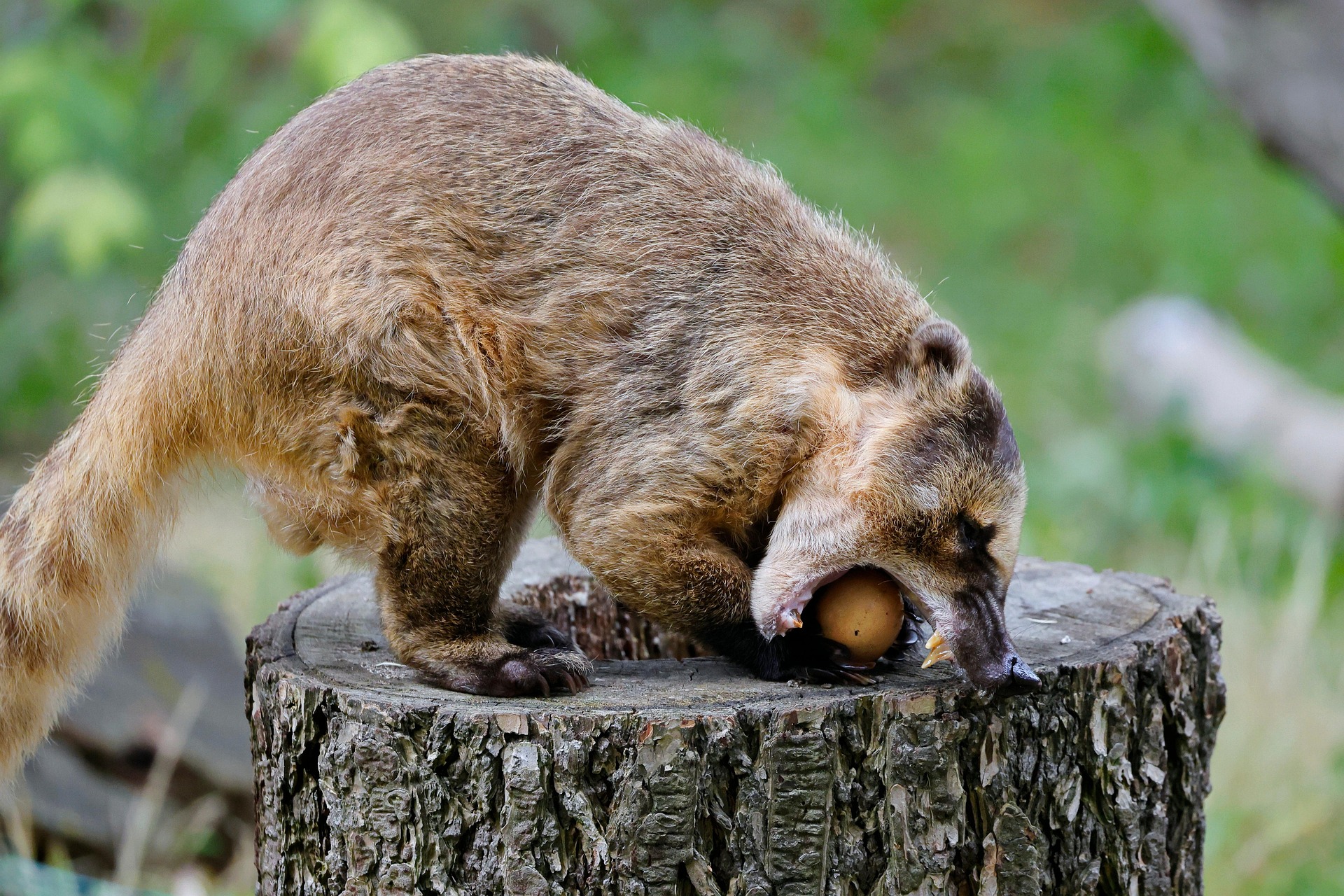
What kind of animal is the white-nosed coati? We will explain its characteristics, ecology, and habitat. This bear is distributed quite widely in the Americas, passing through Mexico and Panama, and can also be seen in Colombia and Ecuador in South America.


- What is a white-nosed coati? Basic stats
- What are the roots and origins of the white-nosed coati?
- Habitat
- What are its characteristics? What does it look like?
- What is its personality like?
- What is its ecology like?
- About White-Nosed Coati Cubs
- Is the white-nosed coati an endangered species?
- Can you keep a white-nosed coati as a pet?
- Zoos housing the species (Japan & Worldwide)
- Recommended articles
What is a white-nosed coati? Basic stats
The White-nosed Coati is a carnivore classified in the Mammalia class, Carnivora order, Procyonidae family, Nasua genus. Its scientific name is Nasua narica, and its English name is Nasua narica. Its body length is 45-60cm, its weight is 2.5-7kg, and its tail length is 45-60cm. A list of information about it is below.
| Japanese(和名) | ハナジロハナグマ シロバナハナグマ |
| English(英名) | White-nosed Coati |
| scientific name(学名) | Nasua narica |
| classification(分類) | Mammalia、Carnivora、 Procyonidae、Nasua 哺乳綱、食肉目、アライグマ科、ハナグマ属 |
| IUCN Status(保全状況) | LEAST CONCERN |
| Length(体長) | 45~60cm |
| Weight(体重) | 2.5~7kg |
Basic classification
| 分類階級 | 名称 |
|---|---|
| 界 | 動物界 Animalia |
| 門 | 脊索動物門 Chordata |
| 綱 | 哺乳綱 Mammalia |
| 目 | 食肉目 Carnivora |
| 亜目 | ネコ亜目 Feliformia |
| 科 | アライグマ科 Procyonidae |
| 属 | ハナグマ属 Nasua |
| 種 | ハナジロハナグマ Nasua narica |
What are the roots and origins of the white-nosed coati?
The white-nosed coati (Nasua narica) is a carnivorous mammal native to Central and South America that belongs to the Procyonidae family. Although related to raccoons, it has undergone its own unique evolution within the genus Nasua.
🧬 Evolutionary Position
Mammals
↓
Order Carnivora
↓
Suborder Caniformia
↓
Procyonid lineage
↓
Family Procyonidae
↓
Genus Nasua
↓
White-nosed coati
Nasua narica
The white-nosed coati belongs to the same family (Procyonidae) as raccoons, crab-eating raccoons, and kinkajous.
🌎 Where did they originate?
This is a particularly interesting aspect.
Current genetic research suggests a high probability that the common ancestor of extant coatis was distributed across South or Central America approximately 6 million years ago.
Broadly speaking, the prevailing theory follows this path:
South/Central America
↓
Approx. 6 million years ago
Ancestor of coatis
↓
Divergence of the genus Nasua
↓
Migration northward toward Central America
↓
Mexico
↓
Southwestern North America
↓
Modern white-nosed coati
Notably, a 2019 study in molecular phylogeography indicated that the white-nosed coati expanded its range from south to north. This contradicts the previously held scenario of a “North America to South” migration.
🗺️ The importance of the Panamanian population
It has been determined that the population in Panama represents a very ancient lineage that diverged early on within the white-nosed coati group. Research has confirmed the following genetic structure:
The Panama lineage diverged early, approximately 3.8 million years ago.
Northern populations diverged primarily within the last 1.2 million years.
In short, Central America is considered a crucial region in the evolutionary history of the white-nosed coati.
🌉 Relationship with the Isthmus of Panama
The Isthmus of Panama and the “Great American Biotic Interchange” are essential to understanding the history of the white-nosed coati.
Large-scale animal migration occurred between North and South America following the geological formation of the land bridge.
In the case of the white-nosed coati, genetic studies support a northward dispersal pattern:
South America/Central America
→ Central America
→ Mexico
→ Southwestern North America
Wild populations currently exist in the southwestern United States, with Arizona marking the northern limit of their range.
🦝 Relatives in the genus Nasua
Prominent members of the genus Nasua today include:
White-nosed coati (Nasua narica)
South American coati (Nasua nasua)
The white-nosed coati is distributed primarily from Mexico and Central America down to northwestern South America; its distribution range and evolutionary history differ from those of the South American coati.
Habitat
The white-nosed coati is found in the United States, Mexico, and South America.
Habitat Overview
■ Distribution Area
The white-nosed coati is widely distributed from southern North America to Central America.
Main Countries:
Southwestern United States (Arizona, New Mexico, southern Texas)
Mexico
Guatemala
Belize
Honduras
Nicaragua
Costa Rica
Panama
Endemic to the New World (the Americas).
Preferred Habitat
Highly adaptable, it lives in a variety of environments, primarily forests.
Main Habitat
Tropical Rainforest
Subtropical Forest
Dry Forest
Montane Forest
Shrub Forest
Edge Environments between Forest and Grassland
While not suited to full deserts or cold climates,
it can survive in a wide range of environments, from humid to semi-arid.
Uses both arboreal and terrestrial habitats
Ground: Mainly foraging and movement
Tree: Resting, hunting, and avoiding predators
The white-nosed coati
is a semi-arboreal animal with a slightly greater terrestrial presence.
⛰️ Habitat
0m to approximately 3,000m above sea level
They are particularly common in lowland to mid-altitude forest areas.
This wide altitudinal range is also one of the reasons for their widespread habitat.
What are its characteristics? What does it look like?
The white-nosed coati resemble the red coati, with a fairly long tail. Its fur is black, dark brown, or light reddish, with a white or yellowish neck and shoulders, and dark brown around the eyes. It has a white stripe from the tip of its nose to between its eyes. The tips of its ears are white, and there are white markings on the back. The underside of its body is yellowish or dark brown. It mostly lives in forests.
Basic Characteristics (Size and Body Shape)
Body Length: 40-70cm (excluding tail)
Tail Length: 40-60cm
Weight: 3-6kg (females are lighter, males are heavier)
Body Type: Slender and supple
Appearance: A combination of a slender raccoon and a long nose.
Physical Characteristics
● Face and Nose
White nose tip (hence the name)
Slender, mobile nose
Highly developed sense of smell
Explores by digging in the ground and inserting its nose into crevices.
● Hair/Body Color
Hair color is
Reddish-brown
Brown
Gray
Very variable, but slightly coarse.
● Tail
Very long tail
Black and light stripes
Balances during movement and tree climbing.
Physical Ability
Dexterous fingers
Grabbing and digging with front legs
High athletic ability
Excellent at climbing trees
Excellent at running and jumping
Acute sense of smell
Discovers insects and fruit underground

What is its personality like?
The white-nosed coati is a highly social animal, and forms groups of 4-25 individuals, each consisting of a female and her family. Males tend to live alone, with differences between the sexes. It has five fingers on its limbs, is very good at climbing trees, and lives mainly in both arboreal and terrestrial habitats, and is mainly diurnal.
Basic Personality
● Extremely curious
Easily responds to new objects, sounds, and smells
Always on the move rather than standing still
Explore the ground, trees, and shade
When they find something,
they will thoroughly investigate it with their nose and front paws.
● High Intelligence
Strong problem-solving skills
Understand their role and situation within the pack
Learn danger and use it to improve the future
Not simply a “noisy animal,”
they are thoughtful and proactive.
Sociality and Personality
● Personality within the pack
Females and young live in packs
Cooperate and help each other
Frequently communicate through calls and gestures
In the pack,
they are chatty and lively.
● Male Personality
Mature males are solitary.
Usually cautious, but have a strong territorial instinct.
Can become aggressive during breeding season.
⚠️ Vigilance and Aggression
Basically timid.
If they sense danger, they will flee quickly.
If cornered, they will engage in defensive behaviors such as biting and scratching.
Approaching wild individuals is especially dangerous.
Attitude Toward People
● In the Wild
While wary of humans, some individuals have become habituated to humans in tourist areas.
They may approach people carrying food.
● Risk of Human Habituation
If they become too accustomed to humans, it can lead to biting, scavenging, and an increased risk of infectious diseases.
It’s important to position them as “cute, but wild animals.”
What is its ecology like?
White-nosed coatis omnivorous, living off fruit, small birds and bird eggs, small mammals, reptiles, and insects. The breeding season is from January to March, with a gestation period of 70 days. Females can give birth to 2-6 pups at a time. Newborn pups open their eyes after 10 days. They are weaned for 4 months and live for about 15 years.
1. Life Rhythm (Activity Time)
● Diurnal
Active during the day and resting at night
Especially active from morning to noon
Sleep in trees or other safe places at night
In contrast to raccoons (nocturnal), they are quite different.
2. Social Structure (Pack Ecology)
● Group Life
Females and their children form groups.
Pack Size: 10-30 individuals (up to 40 or more).
Travel, feed, and guard in groups.
● Male Behavior
Mature males are solitary.
Approach groups only during breeding season.
Groups are advantageous for policing predators and sharing information.
3. Diet (What they eat)
● Omnivorous
They have a very diverse diet.
Fruits and Nuts
Insects (ants, beetles, larvae)
Small vertebrates (lizards, frogs, mice)
Bird eggs
Carrion
● Feeding Methods
Digging the ground with their trunks
Turning over fallen leaves and logs with their front legs
Climbing trees to gather fruit
Their sense of smell and dexterous front legs are key to their survival.
Do they have any natural enemies?
White-nosed coatis often preyed upon by jaguars and snakes. For this reason, they tend to live in groups to protect themselves.

About White-Nosed Coati Cubs
This article provides an easy-to-understand explanation of the developmental stages of white-nosed coati (Nasua narica) cubs, from birth to independence.
1. Cubs Immediately After Birth
● Condition at Birth
Eyes closed
Thin fur, small body
Cannot move independently
Immature thermoregulation
Completely dependent on mother for a period after birth.
2. Birthing Location and Early Care
Before giving birth, the mother leaves the pack.
She builds a tree nest (made of branches and leaves) and gives birth.
She raises her cubs alone to protect them from predators.
During this period, the mother becomes extremely cautious.
3. Growth and Behavioral Changes
Growth Stages: Cubs: First Week After Birth: Begins to Open Their Legs; 2-3 Weeks: Able to Walk; 4-5 Weeks: Begins Climbing; 5-6 Weeks: Descends to the Ground; 6-7 Weeks: Joins the Group
4. Group Life and Socialization
Once reunited with the group, they are raised collectively.
Tends to be “cooperative parenting” with other females watching over them.
Learns through play with other cubs of the same age.
Through play, they acquire
physical abilities
social rules
danger avoidance
Is the white-nosed coati an endangered species?
The white-nosed coati is classified as least concern and is not endangered. In some areas, it is captured for meat, which is a problem. In the state of New Mexico, the white-nosed coati is endangered.
✅ International Union for Conservation of Nature (IUCN) Rating
IUCN Red List: Least Concern
→ Not at high risk of extinction.
→ Has a wide distribution range, and populations are assessed as relatively stable.
⚠️ Regional Situation Caution
While the species is generally considered to be of Least Concern, conservation issues have been reported in some areas.
In New Mexico, USA, the species is listed as endangered due to its low population size.
Furthermore, local population declines have occurred in some areas due to deforestation and hunting.
Can you keep a white-nosed coati as a pet?
It is said that white-nosed coati are not very suitable for keeping as pets, as they can be susceptible to canine distemper and rabies. You can see many of them in zoos in the Americas. Enjoy watching them.
⚖️ 1. Can I legally keep one?
Treatment varies by country and region.
White-nosed coatis not a domesticated animal, but is classified as a wild animal (exotic animal).
■ In Japan
Wildlife Protection and Management Act
Capturing and keeping wild individuals in Japan is prohibited.
Invasive Alien Species Act
White-nosed coatis not a “specified alien species.”
However, “freely keeping one” does not necessarily mean it is safe or legal.
In many municipalities,
Keeping notification and permission are required.
Escape prevention equipment is required.
Consideration for neighbors is required, or in practice, is not permitted.
In reality, it is extremely difficult for individuals to keep one as a pet.
■ Overseas (e.g., the United States)
Laws vary by state.
In some states,
Permits are required.
Completely prohibited.
Only permitted in zoos and research facilities.
Many states prohibit keeping them as pets.
2. Biologically “suitable for keeping”?
❌ Reasons why they are not suitable for keeping.
● Highly active.
Moving around all day.
Large range of movement required.
Cage keeping is very stressful.
● Overly intelligent.
Frequent destructive behavior, aggressive behavior, and escape attempts occur when bored.
● Risk of aggression.
Even if normally gentle,
mature.
Estrus.
Bites and scratches due to fear or restraint.
Reports of bites.
● Risk of infectious diseases.
Rabies.
Parasites.
Zoonotic diseases.
Zoos housing the species (Japan & Worldwide)
🇯🇵 Japan
A note of caution is required here.
Currently, the species most easily confirmed in major Japanese zoos is the South American coati (Nasua nasua).
For example, the species currently exhibited at Chiba Zoological Park is the South American coati (Nasua nasua), not the white-nosed coati.
Therefore, at this time, it is safe to conclude that:
🇯🇵 Japan: No facilities currently housing the white-nosed coati (Nasua narica) have been confirmed; it is an extremely rare species in the country.
🌍 Major facilities worldwide
They are quite common overseas, particularly in Germany, the UK, Belgium, Denmark, and the USA. Current facilities are listed on Zootierliste.
🇩🇪 Germany
Berlin Zoo
Chemnitz Zoo
Cottbus Zoo
Darmstadt Zoo
Duisburg Zoo
Frankfurt Zoo
Leipzig Zoo
Hagenbeck Zoo
Hamm Zoo
Nordhorn Zoo
More than 20 facilities in Germany alone appear on the current Zootierliste.
🇬🇧 United Kingdom
London Zoo
Hamerton Zoo Park
Shepreth Wildlife Park
Belfast Zoo
…and others.
ZooTrack also lists London Zoo, Hamerton Zoo Park, and others as current holding facilities.
🇧🇪 Belgium
Antwerp Zoo
Planckendael
Bellewaerde Park
…and others.
🇩🇰 Denmark
Aalborg Zoo
Givskud Zoo
Randers Regnskov
Skaerup Zoo
Glad Zoo
…can be confirmed.
🇨🇿 Czech Republic
Prague Zoo
…and others.
🇦🇹 Austria
Schönbrunn Zoo
There are also instances of mixed-species exhibits featuring both white-nosed coatis and South American coatis.
🇺🇸 USA
Orange County Zoo
The Living Desert Zoo & Gardens
San Antonio Zoo
Fort Worth Zoo
Bergen County Zoo
ZooAmerica
Phoenix Zoo
Sedgwick County Zoo
…have been confirmed.
Recommended articles
コメント