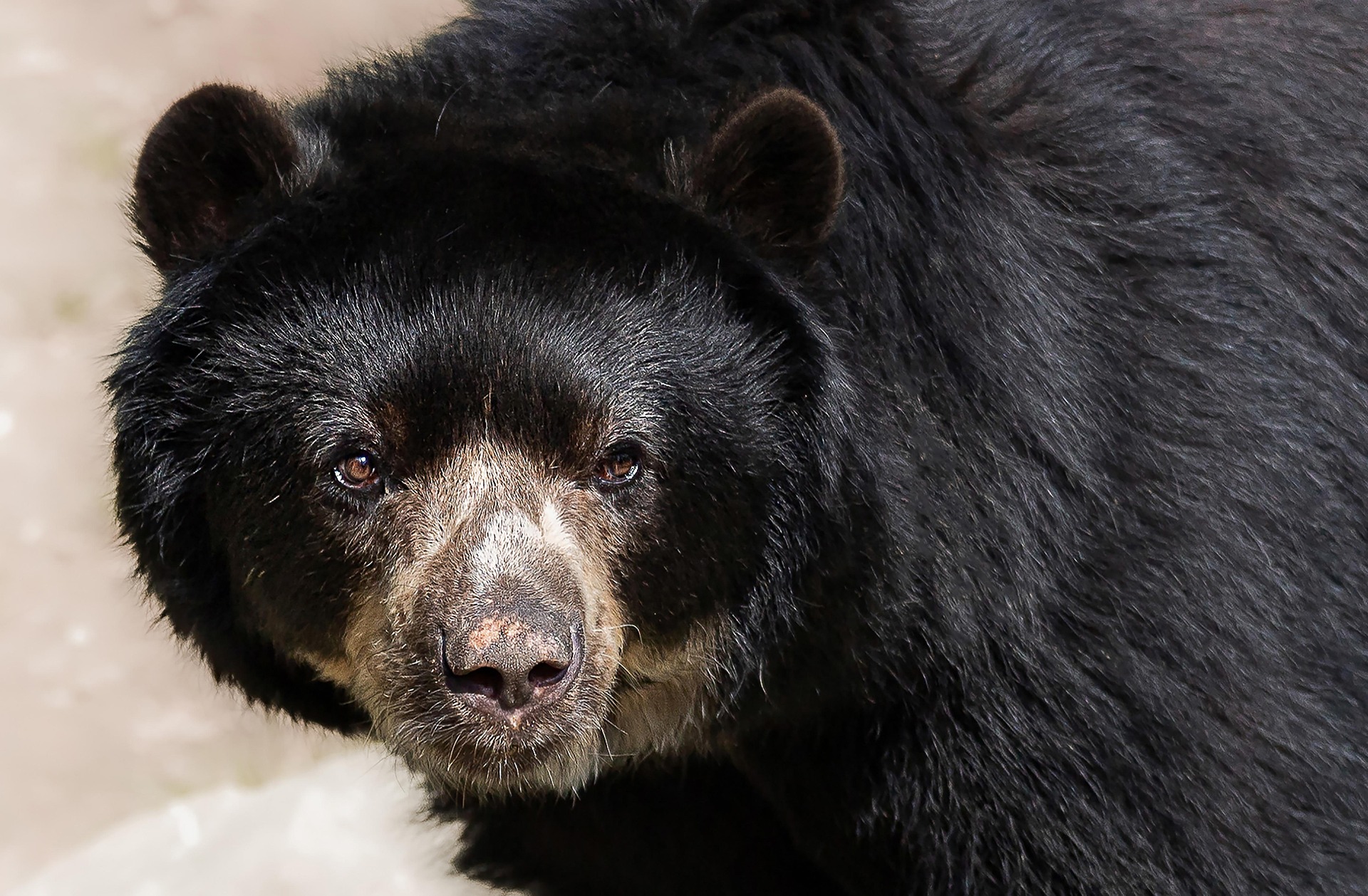
What kind of animal is the spectacled bear? We will explain its characteristics, ecology, and habitat. It is the only bear endemic to South America. It is distributed from western Venezuela to Colombia, Ecuador, Peru, Bolivia, etc., but it is also an endangered species.


- What is a Spectacled Bear? Basic Stats
- What are the roots and origins of the spectacled bear?
- Habitat
- What are its characteristics? What kind of creature is it?
- What is its personality like?
- What is its ecology?
- About Molting
- About Their Vocalizations
- Seasonal Activities
- About spectacled bear cubs
- Is the spectacled bear an endangered species?
- Can spectacled bears be kept as pets?
- Zoos Housing the Species (Japan & Worldwide)
- Recommended articles
What is a Spectacled Bear? Basic Stats
The spectacled bear is a bear classified in the mammalian order Carnivora, family Ursidae, genus Tremarctos. Its scientific name is Tremarctos ornatus, its English name is Andean bear, or Spectacled bear, and its kanji is メガネ熊. Its body length is 120-200cm, and its weight is 130-200kg. The list of information is as follows.
| Japanese(和名) | メガネグマ |
| English(英名) | Andean bear Spectacled bear |
| scientific name(学名) | Tremarctos ornatus |
| classification(分類) | Mammalia、Carnivora、 Ursidae、Tremarctos 哺乳綱、ネコ目、クマ科、メガネグマ属 |
| IUCN Status(保全状況) | VULNERABLE |
| Length(体長) | 120-200cm |
| Weight(体重) | 130-200kg |
Spectacled bear taxonomy
- 界 (Kingdom): 動物界 (Animalia)
- 門 (Phylum): 脊索動物門 (Chordata)
- 綱 (Class): 哺乳綱 (Mammalia)
- 目 (Order): 食肉目 (Carnivora)
- 科 (Family): クマ科 (Ursidae)
- 属 (Genus): メガネグマ属 (Tremarctos)
- 種 (Species): メガネグマ(Tremarctos ornatus)
What are the roots and origins of the spectacled bear?
The scientific name for the spectacled bear (also known as the Andean bear) is Tremarctos ornatus. It is currently the only species of bear inhabiting South America.
🌎 Where did they come from?
The ancestors of the spectacled bear were not originally native to South America.
Tracing their lineage leads back to the Tremarctinae (spectacled bear subfamily), which evolved in North America.
The general progression looks like this:
Ancient North American bears
↓
Evolution of the spectacled bear subfamily
↓
Formation of the Isthmus of Panama
↓
Migration from North America to South America
↓
Unique evolution within South America
↓
🐻 The modern spectacled bear
🧬 The key factor: The Isthmus of Panama
About 3 million years ago, the formation of the Isthmus of Panama created a land bridge connecting North and South America, enabling large-scale animal migration between the two continents.
This event is famously known as the “Great American Biotic Interchange.”
It is believed that the ancestors of the spectacled bear also utilized this southward migration route.
🦴 They actually had many more relatives in the past
While the spectacled bear is the only surviving species today, the Tremarctinae subfamily included multiple lineages in the past.
Particularly famous among them are giant bears such as Arctodus.
The massive short-faced bear flourished in North America.
In short:
After an era that included giant ancient bear relatives, the spectacled bear is the lineage that survived to the present day in South America.
🏔️ Why did they adapt to the Andes?
Some of the lineages that migrated to South America adapted to the environment of the Andes Mountains.
Modern spectacled bears inhabit environments with significant elevation ranges, including:
Andean highlands
Cloud forests
Mountain forests
Grasslands
Another highly distinctive feature is their strong adaptation to a plant-based diet.
Habitat
Spectacled bears are found in South America (Venezuela, Colombia, Ecuador, Peru, Bolivia, etc.).
- Main Distribution Area
Andes Mountains (South America)
Countries: Venezuela, Colombia, Ecuador, Peru, Bolivia, and northern Argentina
Inhabits a wide range of mountainous areas, from approximately 900 to 4,000 meters above sea level.
- Habitat
Highly forested
Various habitats, including subalpine forests, cloud forests, dry forests, and bamboo forests
Highly arboreal and skilled at climbing trees
Prefers to be near water sources
Hydrates near streams and wetlands
Also uses open grasslands and rocky areas
Foraging, migration, sunbathing, etc.
- Habitat
Habitat fragmentation due to deforestation and agricultural expansion
Habitat fragmentation leads to population isolation
In some countries, the species is protected in national parks and protected areas.
What are its characteristics? What kind of creature is it?
The spectacled bear has black or dark brown fur with white or yellowish-white markings around the eyes and throat, which make it look like glasses. It is a bear that can adapt to various environments, from alpine forests at an altitude of 3,000m to grasslands, scrub forests, and lowland savannas. It has short limbs and is plantigrade, walking with the soles of its feet on the ground up to its heels, is very good at climbing trees, and has sharp, hook-shaped claws.
- Appearance
Size: Medium to large bear
Body Length: 1.2-1.8m
Weight: Males 100-200kg, Females 35-82kg
Coat Color: Primarily black or dark brown
Facial Markings:
Each individual has a unique white or yellow pattern, giving the appearance of wearing glasses.
Face and chest patterns are common.
Tail: Short
- Personality and Behavior
Timid and often solitary
Highly wary of humans and other predators
Highly intelligent and curious
Excellent tree climbers, they use ingenuity when gathering fruit and leaves
Diurnal to crepuscular
Mostly active during the day, resting at night
- Diet
Primarily herbivorous but omnivorous
Fruit, bark, leaves, flowers, cactus fruit, etc.
May also eat insects and small animals
Gathers food both in trees and on the ground
- Ecological Characteristics
Adapted to arboreal life
Excellent at climbing trees, they gather fruit and rest there.
Reproduction
Gestation period: Approximately 5-8 months
Gives birth to one calf at a time
Calves depend on their mother for growth
Lifespan: Approximately 20-25 years in the wild

What is its personality like?
Spectacled bears are nocturnal and rest in their nests during the day. They are weakly social and tend to act alone.
- Timid and cautious
If they encounter humans or predators, they will immediately flee or hide.
Preferring to be solitary, they have little social support like packs.
Frequently use hiding places in forests and rocky areas.
- Highly intelligent and curious
Highly observant of food and the environment, they are creative when foraging.
Excellent at climbing trees and exploring rocky areas.
Ability to adapt to changes in the natural environment and new foods.
- Highly solitary
Only come into contact with other bears during breeding season.
Usually, they tend to be solitary and leisurely.
Highly cautious and keep their distance from other animals.
- Gentle but active
Low aggressiveness, prioritizing avoidance of danger.
Active, they spend their time climbing trees and searching for food.
They are often seen moving up and down treetops to forage for fruit and leaves.
What is its ecology?
Spectacled bears live by eating fruit, insects, leaves, bulbs, cacti, and other plants. They reproduce viviparously. The gestation period is 160-225 days, and they can give birth to one baby. Males reach sexual maturity on average at 5 years old, and females at 4-7 years old. Their lifespan is 30 to 40 years.
- Habitat
Region: South American Andes Mountains (Venezuela, Colombia, Ecuador, Peru, Bolivia, northern Argentina)
Altitude: Approximately 900-4,000m
Environment: Cloud forest, subalpine forest, bamboo forest, dry forest, etc.
Active both in trees and on the ground
Rests and feeds in trees
Movement and forages on the ground
- Activity Pattern
Diurnal
Active during the day and rests at night
Mostly solitary
Actively exploratory when searching for food, often climbing trees
- Diet
Omnivorous, but primarily plant-based
Fruits, leaves, flowers, bark, and cactus fruit
May also consume insects and small animals
Forages in trees and on the ground
- Reproduction
Gestation Period: 5-8 months
Birth: One baby per litter
Baby littermates are dependent on their mother and take over a year to develop
Sexual maturity: Females reach 4-5 years of age, males reach 5-6 years of age
- Behavior and Adaptation
Very cautious and timid
Hide and escape from predators and humans
Highly intelligent, adapted to their environment and diet
Ingenious food gathering and migration routes
Uses both arboreal and ground habitats, and has a wide range of habitats
Do they have any natural predators?
Spectacled bear cubs are sometimes attacked by jaguars and pumas.

About Molting
Spectacled bears (Andean bears) do molt. However, unlike polar bears or brown bears, they do not undergo a dramatic physical transformation between “winter coat” and “summer coat.”
🧥 Coat replacement occurs throughout the year
Because spectacled bears inhabit regions ranging from tropical zones to high-altitude mountains—areas that are relatively mild—they do not exhibit a distinct seasonal switch between winter and summer coats.
Essentially, the molting process follows this pattern:
Old fur sheds
↓
New fur grows
↓
The coat is gradually replaced
🌡️ Influenced more by habitat than by seasons
Temperatures in the Andes Mountains vary significantly depending on elevation.
While it gets quite cold at high altitudes, spectacled bears live in tropical regions and do not experience the intense seasonal changes seen in Japanese bears.
Therefore, factors such as:
Temperature
Rainy and dry seasons
Elevation
Food availability
Individual age and health status
…all influence the condition of their fur.
🐻 Fur is quite long and dense
Spectacled bears have black to dark brown fur, with white to yellowish-brown markings on their faces.
These facial markings vary greatly from individual to individual;
Some have markings encircling their eyes like “spectacles,”
while others have large white markings extending down to their chests.
The molting process does not change these distinctive markings themselves.
About Their Vocalizations
Contrary to their appearance, spectacled bears engage in a surprisingly wide range of vocal communication.
🔊 Typical Vocalizations
- “Hn-hn” / Snorting sounds
They sometimes emit low, snorting-like sounds from their noses when interacting with others at close range.
This is observed in relatively calm situations, such as interactions between a mother and her cub.
- “Urr” / Growls
They emit low growls when on alert or trying to make another individual keep their distance.
These growls can serve as a threat; the bear conveys its intent by combining the sound with physical signals, such as body posture and mouth movements.
- Cub vocalizations
Cubs have higher-pitched voices than adults,
making sounds like “kun-kun” or “pee-pee”
to communicate with their mothers.
These sounds are crucial for calling their mothers or attracting attention.
🐻 Surprisingly, they are not animals that “bark loudly”
Spectacled bears do not frequently emit loud, far-carrying calls like a lion.
Instead,
short-range communication using quiet sounds, nasal noises, and growls
plays a key role.
Furthermore, because spectacled bears often lead solitary lives, they do not require the frequent vocal communication seen in animals that live in herds or packs.
Seasonal Activities
Since the spectacled bear inhabits the tropical and subtropical regions of the Andes, it does not follow the “hibernate in winter, resume activity in spring” lifestyle typical of bears like the Japanese brown bear.
They remain active year-round, with seasonal changes driven primarily by the alternation between wet and dry seasons and the resulting shifts in food availability.
🌧️ Around Spring: Foraging While Remaining Active
While the onset of the rainy season varies by region, increased rainfall stimulates plant growth in the forest.
Foraging for fruits and plants
Climbing trees to feed
Moving through the forest
Consuming plants with high water content
Spectacled bears are highly adapted to an arboreal lifestyle and often climb trees to feed on fruits and other vegetation.
☀️ Around Summer: Actively Feeding on Fruit
In areas where food becomes abundant, opportunities to feed on fruits and other items increase.
They frequently repeat a cycle of:
Foraging for fruit → Moving → Feeding → Resting
They may rest in the forest during the hottest parts of the day and become active during cooler periods.
🍂 Around Autumn: Moving in Response to Changing Food Sources
In regions transitioning to the dry season, the availability of plants and fruits changes.
Consequently, spectacled bears exhibit flexible behaviors, such as:
Seeking areas with abundant food
Changing elevation
Moving between forests and highland grasslands
Utilizing alternative food sources like nuts and other plants
❄️ Winter: No Hibernation
This is a major difference compared to bears like the brown bear.
Spectacled bears generally do not hibernate.
Because the Andes are close to the equator, they do not face the same severe food shortages during winter that bears in temperate regions experience.
Therefore, even in winter, they continue their normal routine of:
Feeding → Moving → Resting
About spectacled bear cubs
Let’s take a closer look at spectacled bear (Tremarctos ornatus) cubs.
- Appearance
Immediately after birth, they weigh approximately 1-2 kg and are approximately 30-40 cm long.
Fur color is lighter than that of their mother, ranging from brown to tan.
Facial markings are not yet clearly defined, but as they mature, a unique “spectacled pattern” develops.
Their tails are short and barely noticeable, just like in adults.
- Behavior
They spend most of their time closely attached to their mother.
For the first few months of their lives, they spend most of their time clinging to their mother’s back or belly.
They are active in play and exploration.
They learn motor skills and social skills through tree climbing and chasing.
They quickly retreat to their mother or a hiding place if they sense danger.
- Diet
For the first few months of life, they are completely dependent on their mother’s milk.
From around 3-6 months of age, they gradually begin to learn to eat fruits, leaves, and insects.
Weaning is completed in about a year.
- Sociality
Pups learn from their mother and other members of the pack.
Foraging methods, tree climbing, danger avoidance, etc.
Pups play with each other. Directly linked to the development of motor skills, social skills, and intelligence.
- Growth
They grow to roughly half their original size in one year.
The juvenile stage (ages 0-2) is a time for learning their mother’s behavior.
Sexual maturity: Females reach maturity at age 4-5, males at age 5-6.
Is the spectacled bear an endangered species?
The spectacled bear is an endangered species. It is listed in Appendix I of the Convention on International Trade in Endangered Spectacles, so international trade is strictly restricted. Its habitat is destroyed by deforestation and development, it is exterminated as a pest, and it is also eaten, so it is being overhunted. It is legally protected in its habitat, and protected areas have been established and activities are being carried out.
- IUCN Assessment
Classified as Endangered (EN)
Wild populations are declining and require protection.
- Main Causes of Extinction
Deforestation and Habitat Destruction
Habitat Fragmentation Due to Forest Development and Expansion of Agricultural Land in the Andes
Hunting and Human Activities
Capture for Food and Traditional Medicine
Stress from Contact with Humans
Limited Habitat
Since it is found only in specific areas of the Andes Mountains in South America, it is vulnerable to environmental changes.
- Conservation Activities
Habitat Protection in National Parks and Protected Areas
Restrictions on Capture and Hunting
Reforestation and Habitat Conservation
Can spectacled bears be kept as pets?
As mentioned above, the spectacled bear is designated as an endangered species and is also listed in the Convention on International Trade in Endangered Spectacles, so international trade is strictly restricted. Therefore, it is extremely difficult to keep it as a pet. We recommend that you have a guide at a zoo or event to view it. Enter the zoo after it opens, check the details, and then take a look at the individual bears in the zoo.
- Endangered Species
Spectacled Bears are IUCN Endangered (EN) species.
Capturing and exporting wild specimens is prohibited by law.
It is illegal for individuals to keep them as pets.
- Difficult to Keep Due to Their Biology and Personality
They are primarily solitary and cautious.
They are not social animals, but they need freedom in their natural environment.
They are highly intelligent and curious.
A monotonous environment can lead to stress and behavioral problems.
They are active both in trees and on the ground.
They are prone to lack of exercise in captivity, which can have a negative impact on their health and mental health.
- Environmental Issues
Their diet is diverse, including fruits, leaves, bark, and insects, making it difficult to replicate a diet similar to that of their natural environment.
They frequently climb and explore trees, requiring ample space.
Captivity can extend their lifespan, but there is a high risk of psychological stress and aggressive behavior.
- Realistic Breeding Examples
They can only be kept in zoos or conservation facilities.
They must be kept in facilities managed by experts and with a recreated environment.
Keeping them in private homes is illegal and dangerous.
Zoos Housing the Species (Japan & Worldwide)
Spectacled bears (also known as Andean bears) are kept in zoos around the world. According to the IUCN Bear Specialist Group, as of 2018, there were approximately 250 individuals in captivity globally: 56% in Central and South America, 25% in Europe, 16% in North America, and 3% in Asia.
🇯🇵 Japan
A prominent facility in Japan where they can currently be seen is:
Yokohama Zoological Gardens “Zoorasia” (Kanagawa Prefecture)
Zoorasia is also listed in global zoo databases as a facility that houses spectacled bears.
They are quite rare in Japan, and Zoorasia is considered the go-to place if you want to see a spectacled bear in the country.
🌎 Major Zoos Overseas
🇺🇸 United States
San Diego Zoo
Smithsonian National Zoo
Philadelphia Zoo
Cincinnati Zoo
Houston Zoo
Saint Louis Zoo
These are also listed in global databases of captive facilities.
🇩🇪 Germany
Tierpark Berlin
Berlin Zoo
Dortmund Zoo
Wilhelma Zoological-Botanical Garden
Frankfurt Zoo
Germany is a particularly important region for the husbandry and breeding of spectacled bears. The birth of a cub at Tierpark Berlin has also been reported.
🇨🇭 Switzerland
Zurich Zoo
Zurich houses multiple individuals and has successfully bred them.
🇬🇧 United Kingdom
Chester Zoo
Belfast Zoo
Noah’s Ark Farm
Knowsley Safari
…among others, have records of keeping them.
🇳🇱 Netherlands
Amersfoort Zoo
…also houses them.
🇵🇪🇨🇴🇪🇨🇧🇴 South America
As this is their native habitat, zoos and conservation centers in South America are particularly important. Facilities such as the following are recorded:
Peru: Parque de las Leyendas
Colombia: Cali Zoo
Colombia: Bioparque Ukumarí
Colombia: Bioparque Los Ocarros
Colombia: Zoológico Santacruz
Brazil: BioParque do Rio
Recommended articles
コメント