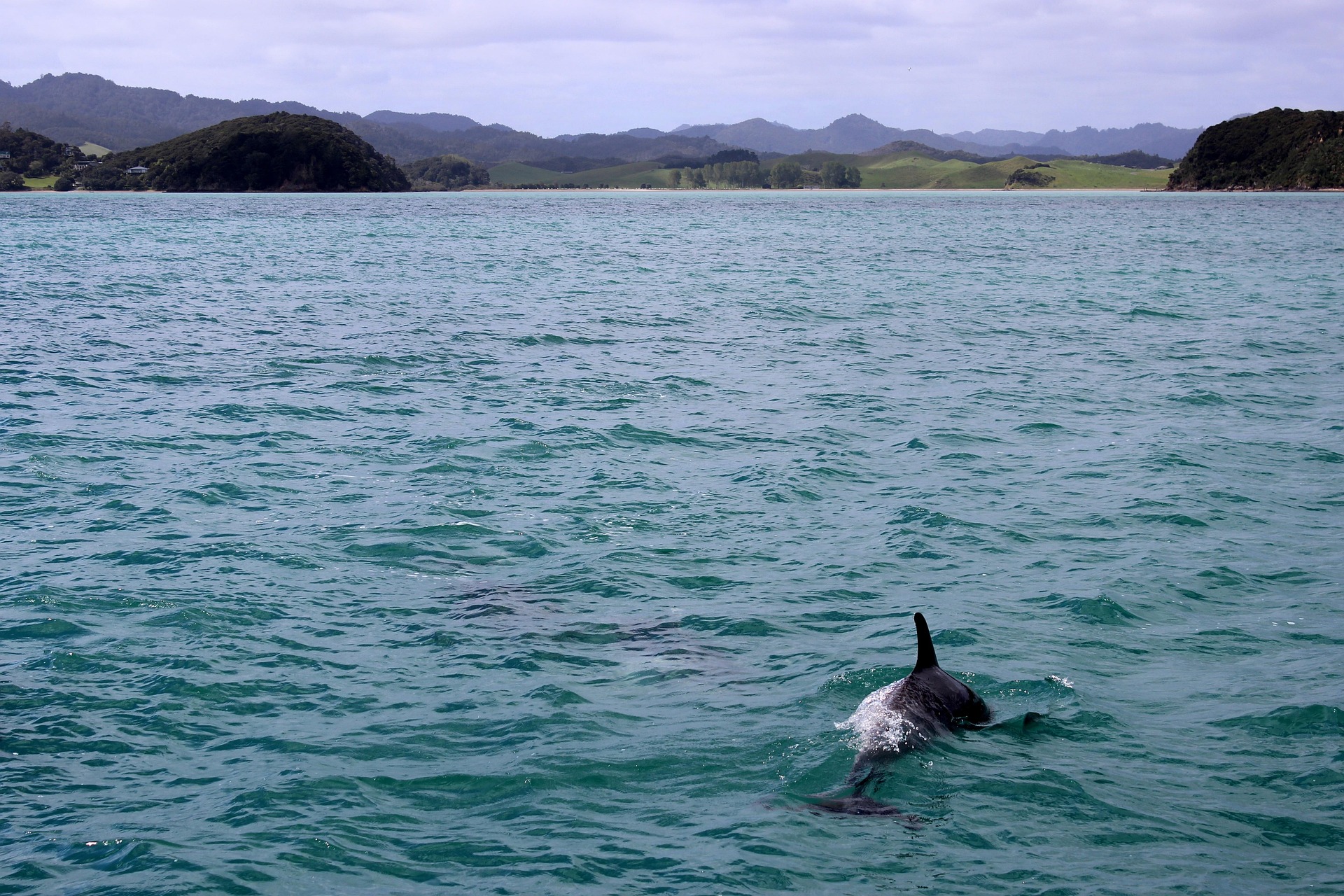
What kind of animal is the Commelin’s dolphin? We will explain its characteristics, ecology, and habitat. The Commelin’s dolphin is also called the Panda dolphin, and its body is mainly black and white. It lives around Tierra del Fuego at the southern tip of South America and the Falkland Islands, and is distributed close to Antarctica.


- What is a Commelinus dolphin? Basic stats
- What are the roots and origins of Commerson’s dolphin?
- Habitat
- What are its characteristics? What is it like?
- What is its personality like?
- What is their ecology like?
- About the juvenile Commelin’s dolphin
- Is the Commelin’s dolphin an endangered species?
- Can the Commelin’s dolphin be kept as a pet?
- Facilities Housing Commerson’s Dolphins (Japan & Worldwide)
- Recommended articles
What is a Commelinus dolphin? Basic stats
The Commerson’s Dolphin is a type of dolphin belonging to the Cetacean order, Odontoceti suborder, Delphinidae family, and the Commerson’s genus. Its scientific name is Cephalorhynchus commersonii, its English name is Commerson’s Dolphin, and its kanji is 色分海トン. Its body length is 1.2 to 1.7 meters and its weight is 35 to 65 kg. The list of information is as follows.
| Japanese(和名) | イロワケイルカ |
| English(英名) | Commerson’s Dolphin |
| scientific name(学名) | Cephalorhynchus commersonii |
| classification(分類) | Mammalia、Cetartiodactyla、 Delphinidae、Cephalorhynchus 哺乳綱、クジラ目、マイルカ科、イロワケイルカ属 |
| IUCN Status(保全状況) | LEAST CONCERN |
| Length(体長) | 1.2~1.7m |
| Weight(体重) | 35~65kg |
Taxonomy of the Commerson’s dolphin
- 界(Kingdom):動物界 (Animalia)
- 門(Phylum):脊索動物門 (Chordata)
- 綱(Class):哺乳綱 (Mammalia)
- 目(Order):鯨偶蹄目 (Cetartiodactyla)
- 亜目(Suborder):鯨亜目 (Cetacea)
- 下目(Infraorder):ハクジラ下目 (Odontoceti)
- 科(Family):マイルカ科 (Delphinidae)
- 属(Genus):マイルカ属 (Lagenorhynchus)
- 種(Species):イロワケイルカ (Lagenorhynchus cruciger)
What are the roots and origins of Commerson’s dolphin?
Commerson’s dolphin (Cephalorhynchus commersonii) is a small toothed whale adapted to the cold coastal waters of the Southern Hemisphere. Taxonomically, it belongs to the family Delphinidae (oceanic dolphins).
🌍 Origins traced to the South Africa region
Interestingly, although Commerson’s dolphins are currently found primarily in southern South America, genetic studies suggest that the genus Cephalorhynchus originated in the waters off South Africa.
The general evolutionary and dispersal route follows this scenario:
Around South Africa
↓
🌊 Drifted east on the West Wind Drift
↓
Around New Zealand
↓
Reached South America
↓
Diverged in southern South America
↓
🐬 Commerson’s dolphin
Studies using mitochondrial DNA support the theory that the Cephalorhynchus genus diverged from a single lineage.
🧬 When did they become Commerson’s dolphins?
The exact “date of origin” is unknown due to a scarcity of fossil records.
However, research suggests that environmental changes during the Ice Age around Tierra del Fuego played a role in the divergence between Commerson’s dolphin and the Chilean dolphin (Cephalorhynchus eutropia).
Furthermore, in addition to the population on the South American mainland, there is an isolated population of Commerson’s dolphins in the Kerguelen Islands, located approximately 8,500 km away. This population is believed to have been established by individuals migrating from South America, with studies proposing a dispersal event occurring around 10,000 years ago.
🗺️ Current distribution
Their primary habitats include:
🇦🇷 The coast of Argentina
🇨🇱 Southern Chile
🇦🇷🇬🇧 Around the Falkland Islands
🏝️ The Kerguelen Islands
…and other cold coastal waters of the Southern Hemisphere.
Habitat
The commercial dolphin is found in the waters around Tierra del Fuego and the Falkland Islands in South America, and in the waters around the Kerguelen Islands in the southern Indian Ocean.
- Distribution (Natural Distribution)
Common commercial dolphins live in the cold open oceans of the Southern Hemisphere.
Main Distribution Areas:
Around the Antarctic Ocean
Waters south of 45 degrees south latitude
South Atlantic Ocean
South Pacific Ocean
South Indian Ocean
This dolphin’s distribution roughly surrounds Antarctica.
- Preferred Sea Areas
Cold to subarctic waters
Pelagic (offshore)
Does not approach coastal waters
Water Temperature: Approximately -1°C to 10°C
Depth: Mainly deep waters (several hundred to several thousand meters)
- Relationship with Sea Ice
Often observed around the edge of sea ice (around polynyas)
Active swimmers even near ice
Highly adapted to cold environments
- Reasons for Rare Observations
Habitat:
Open ocean with little human activity
Rough weather and cold waters
For this reason:
Biology is not yet fully understood
Observations have mainly been recorded by research vessels and Antarctic observation vessels
What are its characteristics? What is it like?
The Commelin’s dolphin is the smallest of the cetacean species. Its pattern is quite distinctive, with its head, pectoral fins, dorsal fin, and tail fin being black, and its throat and body being white, so it is also called the Panda dolphin. The dorsal fin is straight on the head side, has almost no snout, and has a notch in the middle of the tail fin. Commelin’s dolphins are found in coastal areas up to a depth of about 200m.
- Appearance (Most Distinctive)
Body Length: Approximately 1.5-1.8m
Weight: Approximately 90-120kg
Body Color: Distinct black and white two-tone
Black back
White abdomen
Hourglass-shaped white spots on the sides
Dorsal fin: High, pointed, triangular
Body Shape: Slender and streamlined
A strikingly contrasting appearance, even in Antarctic waters.
- Athletic Ability/Movement
Very fast swimmers
They can sometimes ride the waves and swim alongside boats
They have high jumping ability and can even launch themselves into the air
They possess the agility and power typical of the Delphinidae family
- Adaptation to Cold Environments
They have a thick layer of subcutaneous fat, allowing them to survive in extremely cold waters
They have a small body structure that prevents heat loss
They can swim comfortably even near sea ice
- Behavior/Appearance
They live in open oceans and are not easily seen in public
They live in small to medium-sized schools
They are active and energetic when observed

What is its personality like?
Commelin’s dolphins are often seen in small groups, and are known to be highly cooperative animals. Sometimes there are large groups of about 100 individuals. Commelin’s dolphins are very active. They can swim and jump at high speeds on the surface of the sea.
- Basic Personality
Active and energetic
Fast swimmers and frequent jumpers
Curious but cautious
May approach boats, but do not stay for long
Highly wild
Not highly dependent on people or objects
- Sociality
Live in groups
Several individuals to several dozen
Good coordination within the group, with synchronized movements
Not overly “friendly”
- Comparison with other dolphins
Bottlenose dolphin
→ Sociable and friendly
Common dolphin
→ Cool, agile, and keeps its distance
- Response to danger
Highly alert, and will immediately retreat if it senses something unusual
Aggressive behavior has rarely been recorded
Highly capable of escape
What is their ecology like?
Commelin’s dolphins live by eating fish such as sardines and squid. The breeding season is from September to February, and the gestation period is about one year. Newborn calves are 50 to 75 cm long, and the nursing period is unknown. Females reach sexual maturity at 5-8 years, and males at 6-9 years. Their lifespan is said to be 20-30 years.
- Life Rhythm
Active day and night (due to its pelagic nature, it does not have a clear diurnal rhythm)
Mainly migrates offshore (open ocean) at high speeds
Live by moving along the edge of sea ice and cold currents
- School/Social Structure
Live in Schools
Generally range in size from a few to a few dozen individuals
School movements are highly coordinated
Large schools are rare
- Diet
Carnivorous
Main diet:
Small fish
Squid
Krill and other crustaceans
Searches for prey using echolocation
High-speed swimming for pursuing prey
- Athletic Ability and Behavior
Very fast swimmer
May ride the bow wave of a ship
Frequently jumps and breaks through the water, demonstrating high athletic ability even among the delphinidae family
Can be active in rough sea conditions
- Reproduction (details unknown)
Breeding season: Unclear
Litter size: Usually one
Due to the Antarctic environment,
Breeding and rearing are thought to occur in relatively stable waters.
Do they have any natural predators?
The natural predators of commercial dolphins are killer whales and sharks.

About the juvenile Commelin’s dolphin
This article summarizes and explains what is known and what is presumed about the juvenile Commelin’s dolphin (Lagenorhynchus cruciger).
Since there have been few observations of this species, this explanation will be based on general knowledge about the Delphinidae family and the unique environment of the Commelin’s dolphin.
- Characteristics at Birth
Litter Size: Usually 1
Body Length at Birth: Approximately 80-100 cm (Estimated)
Weight: Approximately several tens of kg (Estimated)
Body Color:
Not as contrasting as in adults
The black and white pattern (hourglass shape) is vague
Subcutaneous Fat:
Relatively thick from birth, adapted to cold waters
- Behavior Immediately After Birth
Able to swim immediately after birth
Swim directly next to the mother (slipstream)
→ Use the mother’s current to reduce energy consumption
Protected near the center of the school
- Nursing and Growth
Nursing Period: Approximately 1 year (Estimated)
Mother’s milk:
Very high in fat
Essential for rapid growth and maintaining body temperature
As they grow:
Begin practicing catching small fish and squid
Learn how to use echolocation
- Mother-child relationships and groups
They form a very strong bond with their mothers.
Young animals:
They imitate their mothers’ swimming behavior
They learn the movements of the group
They rarely go alone
- Personality and Behavior of Young Animals
More curious than adults:
They are somewhat clumsy
However, because they live in the open ocean,
They rarely get too close to people or boats.
They develop a sense of caution early on in order to survive.
Is the Commelin’s dolphin an endangered species?
The Commelin’s dolphin is not an endangered species overall. However, it is listed in Appendix II of the Convention on International Trade in Endangered Species of Wild Fauna and Flora (CITES), which restricts commercial trade between countries that have signed the convention.
Why isn’t it an endangered species?
✔ The estimated population is in the hundreds of thousands (over 140,000).
✔ Commercial hunting (such as whaling) is virtually nonexistent.
✔ Because its primary habitat is the open ocean of the Antarctic and sub-Antarctic, which is less affected by human activity, there are currently few major threats.
⚠ What are the future risks?
Changes in ocean temperatures and food chains due to climate change
Marine pollution
These are considered indirect threats, but they do not directly pose an immediate risk of extinction.
Can the Commelin’s dolphin be kept as a pet?
Comelin’s dolphins are large in size, so the general public cannot keep them as pets. If you are looking for one, we recommend visiting an aquarium to view them and having someone show you around at events. You can also find details in illustrated guides, so check out their online pages. They are also available as merchandise for purchase, depending on the aquarium’s policy.
① From the perspective of laws and international rules
Common Commercial Dolphins are wild cetaceans (dolphins)
In many countries:
Wild capture is strictly restricted
Only permitted for research and conservation purposes
Even in Japan:
Captivity and captivity of cetaceans is limited to national, local, and research institutions
Not permitted by individuals or private facilities
Pet captivity is completely impossible
② Reasons for ecological incapacity:
The fatal condition of being an oceanic dolphin
Common Commercial Dolphins:
Cold open oceans around Antarctica
Migrates at high speeds of tens to hundreds of kilometers
Vast range, including the deep sea
This means:
Aquarium-sized tanks provide insufficient exercise
Stress makes it impossible to maintain health
③ Environment cannot be replicated
Required environment:
Water temperature: around 0-5°C
Strong ocean currents
Deep and wide ocean areas
School life
➡️ Cannot be replicated in land-based facilities
Facilities Housing Commerson’s Dolphins (Japan & Worldwide)
Currently, the number of facilities housing Commerson’s dolphins (Cephalorhynchus commersonii) is quite limited. As of 2026, the confirmed existing facilities are two in Japan and one in the United States.
🇯🇵 Japan
- Sendai Umino-Mori Aquarium (Miyagi Prefecture)
Currently houses Commerson’s dolphins. - Toba Aquarium (Mie Prefecture)
Currently houses them; individuals such as Lala, Kai, and Stella have been confirmed there.
These are the two confirmed facilities in Japan.
🇺🇸 United States
Aquatica Orlando (Orlando, Florida)
This is the currently confirmed facility in the United States. It is listed as an active facility on Zootierliste.
🌍 There used to be more
In the past, they were also housed at:
Germany: Duisburg Zoo
USA: SeaWorld San Diego
USA: Mystic Aquarium
Japan: Yokohama Hakkeijima Sea Paradise
Japan: Adventure World
Japan: Notojima Aquarium
Japan: Sunshine Aquarium
Japan: Kamogawa Sea World
Japan: Osaka Aquarium Kaiyukan
…among others, but these facilities no longer house the species.
Recommended articles

コメント