What kind of animal is the cotton-top tamarin? This page provides information about its characteristics, ecology, and habitat. It is found in tropical forests in northwestern Colombia, but since it can only be seen in this area, many people do not know about it. This animal is designated as an endangered species.


- What is Cotton-Top Tamarin? Basic Stats
- What are the roots and origins of the cotton-top tamarin?
- Habitat
- What are its characteristics? What kind of creature is it?
- What is their personality like?
- What is their ecology like?
- About Cotton-Top Tamarin Hatchery
- Is the cotton-top tamarin an endangered species?
- Can the cotton-top tamarin be kept as a pet?
- Zoos Housing the Species (Japan & Worldwide)
- Recommended articles
What is Cotton-Top Tamarin? Basic Stats
Cotton-top tamarins are monkeys classified in the genus Saguinus, family Capuchin monkeys, order Primates. Their English name is Cotton-head tamarin, and their scientific name is Saguinus oedipus. They are also known as cotton-top panchés. They are 20–30 cm long and weigh 0.4–0.6 kg. The list of information is as follows:
| Japanese(和名) | ワタボウシタマリン |
| English(英名) | Cotton-head tamarin Cotton-top Cotton-top pinché Cotton-top tamarin |
| scientific name(学名) | Saguinus oedipus |
| classification(分類) | Mammalia、Primate、 Cebidae、Saguinus 哺乳綱、サル目、オマキザル科、タマリン属 |
| IUCN Status(保全状況) | CRITICALLY ENDANGERED |
| Length(体長) | 20–30cm |
| Weight(体重) | 0.4-0.6kg |
Taxonomy
| 階級 | 分類 |
|---|---|
| ドメイン | 真核生物 (Eukaryota) |
| 界 | 動物界 (Animalia) |
| 門 | 脊索動物門 (Chordata) |
| 綱 | 哺乳綱 (Mammalia) |
| 目 | 霊長目 (Primates) |
| 亜目 | 新世界ザル亜目 (Platyrrhini) |
| 科 | オマキザル科 (Callitrichidae) |
| 属 | タマリン属 (Saguinus) |
| 種 | Saguinus oedipus |
What are the roots and origins of the cotton-top tamarin?
The cotton-top tamarin (Saguinus oedipus) is a small New World monkey characterized by the long, white hair on its head. Currently, its natural distribution is limited to northwestern Colombia.
🌎 Broadly speaking, they are “South American New World monkeys”
Cotton-top tamarins are New World monkeys (platyrrhines), a lineage distinct from Old World monkeys and apes.
The general evolutionary trajectory is as follows:
Early New World monkeys
↓
Cebidae lineage
↓
Callitrichinae (marmosets and tamarins)
↓
Saguinus (tamarin genus)
↓
Cotton-top tamarin
↓
🐒 Saguinus oedipus
Molecular phylogenetic studies estimate that the lineage leading to tamarins and marmosets was established approximately 15 million years ago.
🧬 An early branch within the tamarin group
Interestingly, the genus Saguinus is considered to have diverged quite early in the evolutionary history of the marmoset-tamarin group.
While research findings regarding specific phylogenetic relationships vary, Saguinus is generally regarded as one of the earliest groups to diverge within the Callitrichinae subfamily.
Subsequently, various species within the Saguinus genus diversified across regions such as northern South America.
🗺️ Where did the cotton-top tamarin evolve?
Its current distribution range is quite limited,
restricted to the forests of
northwestern Colombia.
While closely related tamarin species are distributed across various parts of South America, the cotton-top tamarin represents a lineage specialized for the forest environments of northwestern Colombia.
Geographic isolation—caused by factors such as rivers or forest fragmentation—is believed to have played a role in the speciation of tamarins. In fact, some studies estimate that the divergence from its close relative, the Geoffroy’s tamarin (S. geoffroyi), occurred approximately 700,000 years ago. 🐒 “Shrinking” Was Also a Key Evolutionary Step
Members of the subfamily Callitrichinae—including the cotton-top tamarin—are characterized by bodies that are smaller than those of many other New World monkeys.
Over the course of their evolution, this group underwent a reduction in body size,
allowing them to utilize a wide range of forest resources, such as:
fruits
flowers
tree sap and resin
insects and other small animals.
Their small size made it easier to navigate even the thinnest branches, an attribute believed to have been advantageous for exploiting the complex, three-dimensional structure of the forest.
Habitat
The cotton-top tamarin is endemic to Colombia.
- Geographic Distribution
Distribution: Northern South America, especially northwestern Colombia
Its distribution is very limited and it is known as an endangered species.
Originally widespread in lowland tropical rainforests, its habitat has been reduced due to deforestation.
- Habitat Characteristics
Live in the lowlands and hilly regions of tropical rainforests.
Live by moving between tree branches and shrubs.
Mostly active in the dense canopy or mid-story branches.
Stay away from water or open areas.
- Habitat Segregation
As a small monkey, it rarely competes with other large primates.
Move around the canopy to efficiently gather fruit and insects.
Live in small groups (parent-child groups or multiple pairs).
- Importance of Habitat Conditions
Forest continuity is important.
Forest fragmentation has a significant impact on movement, feeding, and reproduction.
Tropical rainforests with their diverse tree species are the ideal environment.
Human development and conversion to farmland are the biggest threats to its habitat.
What are its characteristics? What kind of creature is it?
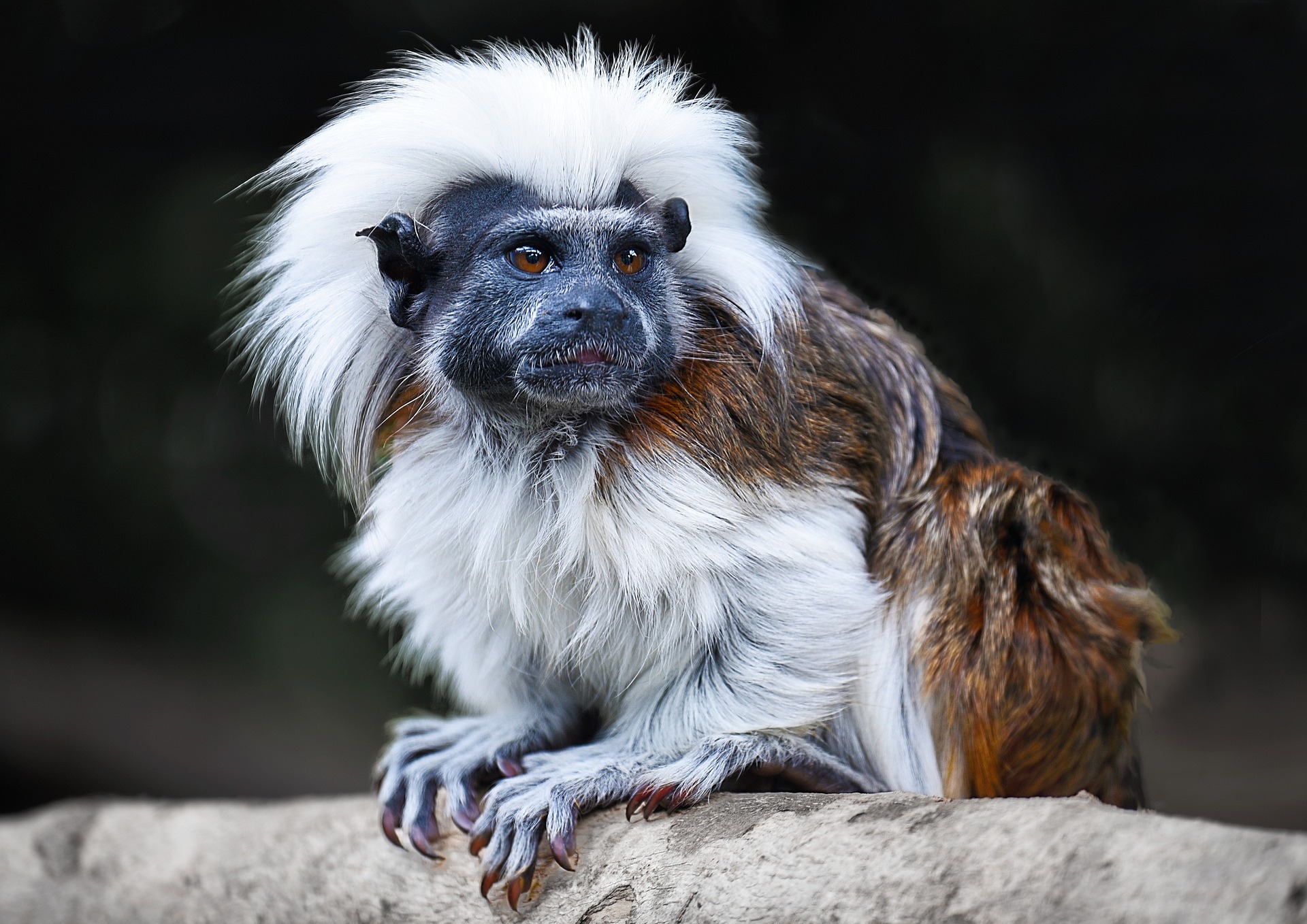
Cotton-top tamarins are small monkeys with tails longer than their bodies. Their faces are black, with white fur from the eyes to the nose and around the mouth. Their backs and tails are brown or dark brown, their chests, abdomens and front legs are white, and they have white tufts on the top of their heads and extend from their necks to their backs. They are diurnal animals and live in tropical and secondary forests. They live in trees and sometimes come down to the ground. They are active and can move swiftly from branch to branch.
- Physical Size and Appearance
Small Monkey
Body Length: 15–25 cm (excluding tail)
Tail Length: Approximately 35 cm
Weight: Approximately 400–500 g
Their most distinctive feature is the white crest on their head.
Their name comes from their white “cotton hat”-like fur.
Body Color
Face: Black
Body: Brown to Brown
Limbs and Tail: Thin and slender, dark brown
Their long tail is used for balance in trees.
- Face and Head
Their black face and short fur allow for clear facial expressions.
Their large eyes provide excellent vision.
Their small ears are highlighted by the white crest on their head.
- Limbs and Mobility
They use their slender, agile limbs to grasp branches.
Their fingers are thin and slender, with sharp claws, making them well-suited for climbing.
They primarily live in trees (arboreal).
They move quickly through the forest canopy and mid-story.
- Behavioral and Personality Traits
Highly sociable, they live in small family groups.
They exhibit a wide variety of feeding, play, and communication behaviors.
They are highly alert, and if they sense danger, they will quickly move to a branch and hide.
They communicate with their companions through vocalizations and body movements.
- Diet-Related Characteristics
Their jaws and teeth are adapted to feeding on small fruits, sap, and insects.
Their dexterous tongues allow them to peel bark and lick the sap.

What is their personality like?
Cotton-top tamarins form groups centered around a family consisting of a male and female and their children, making them very social animals.
- Sociality
Highly sociable small monkeys
Live in small family groups (usually 3-9 individuals)
Typically composed of parents, children, or siblings
Groups cooperate to forage, guard, and raise their young
- Vigilance and Cautiousness
Highly alert and timid
If they sense an enemy or human, they will quickly move between branches to hide
Because their small size makes them vulnerable to predators, they always act cautiously
- Cooperativeness and Family Attachment
The entire group cooperates in raising their young
Females and males other than the mother also help care for their young
Cooperative behavior within the group is common, even when foraging and moving
They communicate with others through vocalizations and body movements, maintaining the safety of the group
- Curiosity and Playfulness
Highly curious, they are interested in branches, leaves, bark, fruit, and other elements
They develop motor skills and social skills through play
Playful behavior is observed not only in young animals but also in adults
What is their ecology like?
Cotton-top tamarins are omnivorous and can eat fruits, young leaves, sap, etc. They reproduce viviparously. They are monogamous and give birth to two young at a time, twice a year, after a gestation period of about six months. Females reach sexual maturity at one and a half years, and males at about two years, and have a lifespan of about 15 years.
- Habitat
Arboreal life, mainly in the lowlands and hilly regions of the tropical rainforest
Movement primarily in the canopy and midstory
Rarely uses waterside or open areas, and tree continuity is important
Distribution is limited to northwestern Colombia, and deforestation has fragmented its habitat
- Foraging Behavior
Omnivorous (mainly fruits, sap, and insects)
Adjusts movement range and time depending on food type
Specialized in collecting sap and resin, ingesting them with their tongues and hands
Foraging in groups, which also functions as a form of cooperative and social behavior
- Sociality and Group Behavior
Live in small family groups (usually 3-9 individuals)
Usually consists of one breeding pair and their offspring
Cooperative parenting
Males and females other than the mother help care for their young
Communicate with others through vocalizations and physical movements
Highly cautious, quickly fleeing as a group when predators approach
- Breeding and Rearing
Breeding occurs year-round, but varies depending on environmental conditions.
Gestation Period: Approximately 4.5 months
Birth: Usually two cubs (twins)
Cubs are breastfed and cared for by the entire herd.
Members other than the mother may also be involved in nursing and carrying them.
Cooperation in rearing is important for improving survival rates.
- Exercise and Play
They move quickly in trees and excel at branch crossing and jumping.
They have well-developed play behaviors, and both cubs and adults play.
Play contributes to the development of motor skills and social skills.
They are inquisitive and actively participate in food hunting and exploration.
Do they have any natural predators?
Natural predators of the cotton-top tamarin include jaguars and ocelots.

About Cotton-Top Tamarin Hatchery
This article provides a detailed overview of cotton-top tamarin (Saguinus oedipus) hatchlings.
- Birth and Early Life
Litter Size: Usually 2 (Twins are common)
Birth Weight: Approximately 30–50 g
Body Length at Birth: Approximately 10–12 cm (excluding tail)
Coat Color: Light gray to brown throughout the body, with a white crest gradually appearing from birth.
- Nursing and Nutrition
Breastfeeding (mainly for approximately 3 months)
Breast milk is high in fat and supports growth.
Raising is done by the entire group.
Males and other females other than the mother also carry the young and assist with nursing.
Initially, young are largely dependent on their mother and other group members.
- Behavior and Sociality
Early on birth, they begin practicing climbing and jumping using their limbs.
Active play is important for the development of motor skills and social skills.
Communicate with parents and siblings through vocalizations and gestures.
When sensing danger, they cling closely to their mother and the group to ensure safety.
- Developmental Stages
Around 3 months: Begins transition from nursing to solid food
Around 6 months: Almost independent, able to forage for fruit and insects
Around 1 year: Physical size approaches that of an adult, and they learn social behavior and group cooperation.
Because they are born as twins, play and competition between siblings are also important for their development.
- Key Points for Survival
Protection from predators (raptors, snakes, medium-sized mammals) is important.
Protection and cooperative parenting by the mother and group directly affect survival.
Learns arboreal skills through play and imitation.
Is the cotton-top tamarin an endangered species?
The cotton-top tamarin is an endangered species. When the Convention on International Trade in Endangered Species of Wild Fauna and Flora came into force in 1975, it was listed in Appendix I of the Convention on International Trade in Endangered Species of Wild Fauna and Flora, and international trade is strictly restricted. The species’ habitat has been destroyed by deforestation and development, and it is also eaten by humans, so it is being overfished. The current population is said to be around 1,000.
- IUCN Red List Classification
Classification: Critically Endangered (CR)
Reasons:
Habitat deforestation and fragmentation
Illegal pet trade and capture
Natural populations have declined significantly
- Population and Distribution
Habitat: Limited tropical rainforest in northwestern Colombia
Natural population estimated at fewer than a few thousand individuals
Large areas of the former range have been lost due to deforestation and agricultural conversion
- Main Threats
Deforestation and Habitat Fragmentation
Traffic rainforest decline due to agricultural and ranch development
Illegal pet trade
Captured as a small, popular New World monkey
Ecosystem destruction
Although predators and natural enemies have not increased, colony maintenance has become difficult
- Conservation Status
Internationally listed on CITES Appendix I, international trade is prohibited
Protected areas and reintroduction programs are underway in Colombia
Reforestation and habitat protection are directly linked to survival
Can the cotton-top tamarin be kept as a pet?
As mentioned above, the cotton-top tamarin is designated as an endangered species and is also listed in the Convention on International Trade in Endangered Species of Wild Fauna and Flora, so international trade is strictly restricted. Therefore, it is extremely difficult to keep it as a pet.
- Legal and Conservation Reasons
Critically Endangered (CR)
Listed on CITES Appendix I, international trade is prohibited.
Capturing and keeping wild individuals is prohibited by law in Japan and other countries.
Keeping individuals without permission is subject to severe legal penalties.
- Ecological and Behavioral Reasons
Specialized for arboreal life
Movement is primarily in the forest canopy and mid-story, requiring ample space for movement.
Highly social, living in groups.
Keeping them alone can lead to stress and behavioral abnormalities.
Complex feeding behavior.
Because they feed on fruit, sap, and insects, it is difficult to recreate their natural environment.
- Conditions in Captivity
Zoos and conservation facilities display and keep them in groups.
They are often kept for the purposes of reintroduction and conservation research, making it nearly impossible for individuals to keep them as pets.
If they are sold as pets, they are likely to have been captured illegally.
Zoos Housing the Species (Japan & Worldwide)
The cotton-top tamarin (Saguinus oedipus) is a primate at extremely high risk of extinction and is classified as CR (Critically Endangered) by the IUCN. They continue to be kept and bred in zoos around the world.
🇯🇵 Japan
Two major facilities where they can currently be found are:
Ueno Zoological Gardens (Tokyo)
Edogawa Natural Zoo
Ueno Zoo, in particular, lists the cotton-top tamarin in its official animal encyclopedia and exhibits them in the Small Mammal House.
Husbandry records for Ueno Zoo and Edogawa Natural Zoo can also be confirmed in global zoo databases.
🇬🇧 United Kingdom
Edinburgh Zoo
Currently houses three individuals; an infant was born there in June 2024.
🇩🇪 Germany
Berlin Zoo
Duisburg Zoo
Leipzig Zoo
Halle Zoo
Magdeburg Zoo
Munich Hellabrunn Zoo
Chemnitz Zoo
…and many other facilities.
🇩🇰 Denmark
Copenhagen Zoo
Aalborg Zoo
Knuthenborg Safari Park
Ree Park Safari
…and others.
🇨🇿 Czech Republic
Prague Zoo
Olomouc Zoo
Liberec Zoo
Plzeň Zoo
Jihlava Zoo
…and others.
🇺🇸 United States
Bronx Zoo
Saint Louis Zoo
Minnesota Zoo
Phoenix Zoo
Kansas City Zoo
Wildlife World Zoo
…among others.
🇨🇴 Colombia
As this is the species’ native country, they are also kept in local zoos and conservation facilities.
Zoológico de Cali
Parque Jaime Duque
…can be cited as examples.
🌏 Others
Global records of animals in captivity also include:
🇸🇬 Singapore Zoo
🇨🇳 Shanghai Zoo
🇦🇺 National Zoo & Aquarium (Canberra)
🇮🇱 Jerusalem Zoo
🇮🇱 Ramat Gan Zoo
🇪🇸 Faunia
🇳🇱 Amsterdam Zoo
🇧🇪 Pairi Daiza
🇮🇹 Parco Natura Viva
Recommended articles
コメント