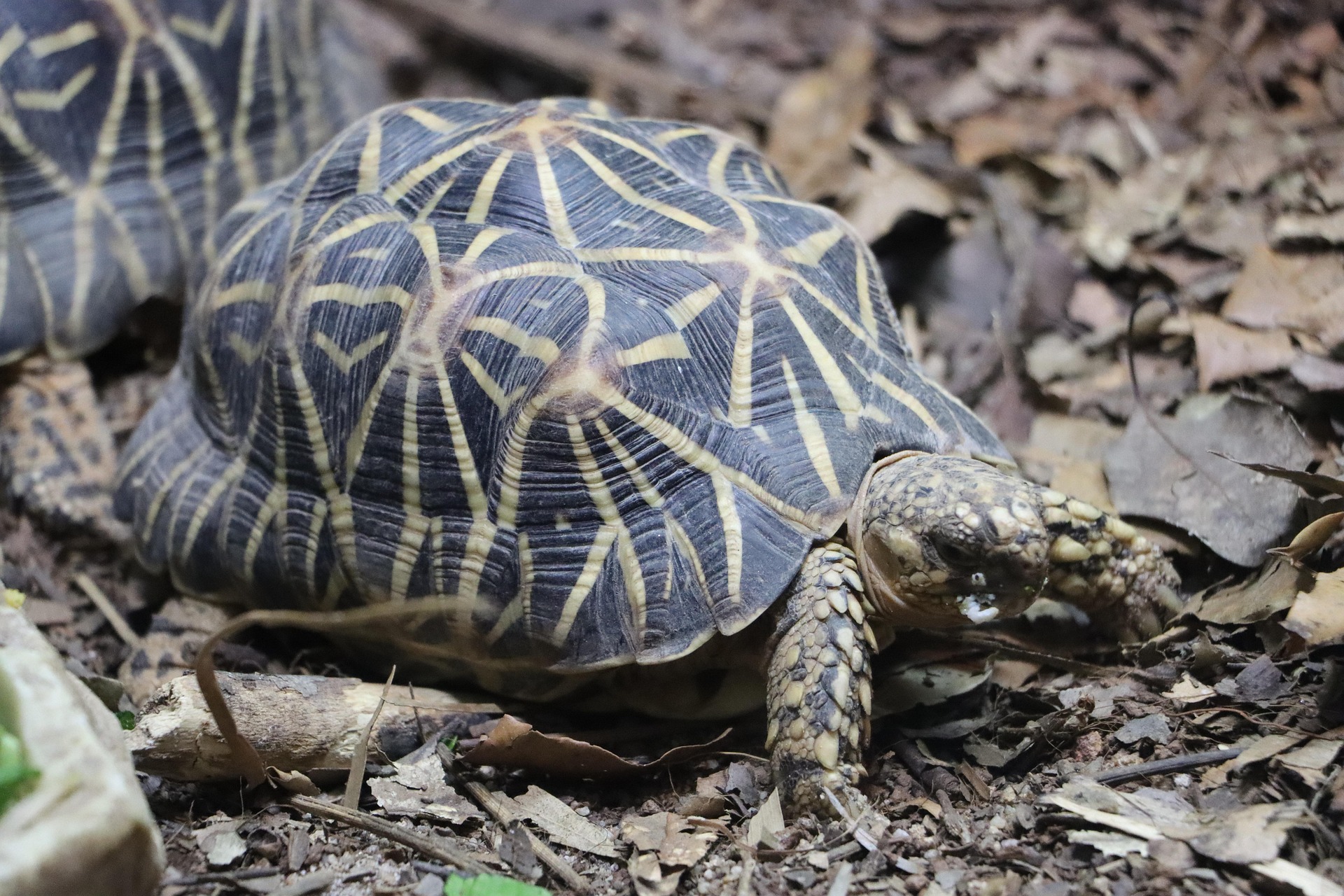
What kind of animal is the Indian star tortoise? We will explain the species, characteristics, personality, ecology, and habitat. The Indian star tortoise is a small turtle that can be found in India, Sri Lanka, Pakistan, etc., and many people keep it as a pet, but it is designated as an endangered species.


- What is the Indian Star Tortoise? Basic Stats
- What are the roots and origins of the Indian Star Tortoise?
- Habitat
- What are its characteristics? What kind of creature is it?
- What is their personality like?
- What is their ecology like?
- About Indian Star Tortoise Hatchery
- Is the Indian star tortoise an endangered species?
- Can the Indian star tortoise be kept as a pet?
- Zoos Housing the Species (Japan & Worldwide)
- Recommended articles
What is the Indian Star Tortoise? Basic Stats
The Indian star tortoise is classified as a turtle in the order Testudins, family Testudinidae, and genus Testudin. Its Japanese name is Indo-hoshi-game, scientific name is Geochelone elegans, and English is Indian star tortoise. Its shell length is 38.1cm, its weight is 5-7kg, and its body length is 20-30cm. The list of information is as follows.
| Japanese(和名) | インドホシガメ |
| English(英名) | Indian star tortoise/Indian starred tortoise |
| scientific name(学名) | Geochelone elegans |
| classification(分類) | Reptilia、Testudines、 Testudinidae、Geochelone 爬虫綱、カメ目、リクガメ科、リクガメ属 |
| IUCN Status(保全状況) | VULNERABLE |
| Length(体長) | 20~30cm |
| Weight(体重) | 5~7kg |
Taxonomy of the Indian Star Tortoise (Geochelone elegans)
| 分類階級 | 学名・内容 |
|---|---|
| 界(Kingdom) | Animalia(動物界) |
| 門(Phylum) | Chordata(脊索動物門) |
| 綱(Class) | Reptilia(爬虫綱) |
| 目(Order) | Testudines(カメ目) |
| 科(Family) | Testudinidae(リクガメ科) |
| 属(Genus) | Geochelone(ジオケロン属) |
| 種(Species) | Geochelone elegans(インドホシガメ) |
What are the roots and origins of the Indian Star Tortoise?
As its name suggests, the Indian Star Tortoise (Geochelone elegans) is a tortoise species originating from the Indian subcontinent. Its current distribution in the wild spans India, southeastern Pakistan, and Sri Lanka.
🌏 Where did this tortoise come from?
In terms of broad evolutionary history, it is positioned as follows:
Ancient tortoises
↓
Testudinidae (Tortoise family)
↓
Divergence of lineages including those in Asia
↓
South Asian tortoises
↓
Indian Star Tortoise (Geochelone elegans)
Regarding the Testudinidae family as a whole, research combining fossil records and molecular phylogenetics estimates that the major lineages of derived tortoises were established by the Late Eocene (approximately 37 to 34 million years ago).
However, current research has not yet clearly pinpointed exactly how many tens of millions of years ago the Indian Star Tortoise species itself emerged.
🧬 Significant differences between “India” and “Sri Lanka” populations
This is a fascinating aspect of the Indian Star Tortoise’s evolutionary history.
Current genetic research has identified distinct genetic groupings among Indian Star Tortoises:
Northwestern group
Southern group
South India
Sri Lanka
A 2024 study suggests the possibility that the Northwestern and Southern groups diverged approximately 2 million years ago.
In other words, the hypothesized history is:
Around 2 million years ago
↓
Geographical separation of populations within the Indian subcontinent
↓
Genetic divergence into Northwestern and Southern lineages
↓
Evolution into the current populations found in India and Sri Lanka
⭐ The Asian “Star Tortoise” group
A very close relative of the Indian Star Tortoise is the Burmese Star Tortoise (Geochelone platynota) found in Myanmar. Genetic analysis has confirmed that the Indian star tortoise and the Burmese star tortoise group together as closely related sister species.
Habitat
The Indian star tortoise is found in India, Sri Lanka and Pakistan.
- Geographic Distribution
Distributed mainly in southern India and northern Sri Lanka
In India, it is common in the arid to semi-arid regions of southern India, such as Karnataka, Tamil Nadu, and Andhra Pradesh.
In northern Sri Lanka, it is limited to the arid zone.
- Habitat Type
Prefers dry forests and savanna-like environments.
Live in grasslands, shrublands, and semi-arid areas.
Dug holes in soft soil for resting and laying eggs.
- Water Relations
Although it can live in completely arid areas, it hydrates by consuming rainwater and puddles.
During the rainy season, it travels longer distances and expands its range in search of food and water.
- Habitat Characteristics
Tolerant of high temperatures and dryness, but does not tolerate overly humid environments.
Mainly finds areas with a good source of grass, leaves, and fruit.
Prefers areas with few predators.
What are its characteristics? What kind of creature is it?
Indian star tortoises have a black shell with star-shaped dark yellow or gray-brown lines on the carapace. The carapace is dome-shaped and somewhat elongated when viewed from above. The head, limbs, and tail are also black with pale yellow or yellowish brown spots. Indian star tortoises live in forests, scrub forests, and dry grasslands in plains and low mountain areas.
- Body Size and Morphology
Body Length: Approximately 25-35 cm (adult)
Weight: Approximately 3-5 kg
Carapace (Dorsum):
Dark brown to black base with a yellow or light-colored radial pattern (star-shaped pattern)
The star-shaped pattern varies from individual to individual and is the origin of the species’ name.
Head and Limbs:
The face and limbs are yellowish-brown.
The head is small compared to the carapace, and the eyes are round and expressive.
The limbs are sturdy, adapted for digging and walking.
- Behavior and Personality
Slow and relaxed movements.
Very non-aggressive, timid and cautious.
Often solitary and not very social.
- Diet
Primarily herbivorous.
Food:
Grass, leaves, fruit, cactus, etc.
Can stretch its neck to eat grass and leaves.
Eats slowly and takes time to digest.
- Biological Impressions
Popular among small to medium-sized tortoises due to their beautiful appearance.
Shy and gentle, they live at ease in environments with few predators.
Long-lived, they can live for over 50 years in captivity.

What is their personality like?
Indian star tortoises are active during the day in the rainy season, and are mainly active in the early morning and dusk in the dry season, and often rest during the day. They are very gentle animals and many people keep them as pets.
- Gentle and docile
Little aggressiveness, easygoing personality
Generally timid and prone to fleeing from humans and other animals
- Timid and wary
When sensing danger, they retract their neck and limbs into their shells to protect themselves
Sensitive to environmental changes and loud noises
- Low sociality
Generally solitary
They may interact with others at feeding and watering places, but do not form groups
- Patience and stability-oriented
They travel short distances and can tolerate their environment by remaining still
Long-lived and gentle, they adapt to their environment without strain
- Intelligence and learning ability
While they lack complex social behavior, they have a high ability to remember the locations of food and water
They can change their behavior patterns depending on the season and environment
What is their ecology like?
Indian star tortoises are herbivorous, and live mainly on fallen fruit, leaves, buds, and grasses. They reproduce oviparously, and often lay a large number of eggs. Hatching often takes about 100 days. Their lifespan depends on the species, but they can live for about 8 to 10 years, making them a long-lived animal.
- Lifestyle
Diurnal, active during the day, foraging and moving.
They move slowly, but may travel hundreds of meters to several kilometers in search of food and water.
They rest in the shade of rocks, under shrubs, or on soft soil.
- Diet
They are primarily herbivorous.
Food:
Grass, leaves, fruit, shrub branches, and cacti.
Foraging Method:
Stretches their neck to collect grass and leaves.
Chews slowly, taking time to digest.
- Reproduction and Rearing
Breeding Season: Active mainly during the rainy season.
They are oviparous. Females dig nests in soft soil and lay 3-8 eggs.
Incubation Period: Approximately 90-120 days.
Young Independence:
They can survive on their own immediately after hatching.
They hide in their shells to protect themselves from predators.
- Behavior and Sociality
Primarily solitary
Interactions with other individuals are observed at water sources and feeding areas
Behavior patterns change depending on the season and the distribution of water sources and food sources
- Habitat Relationship
Adapted to arid to semi-arid shrubland and grasslands
Movement is centered around areas with water and food sources
In environments with few predators, they lead a relaxed lifestyle
Do they have any natural enemies?
Natural enemies of the Indian star tortoise include wolves and foxes.

About Indian Star Tortoise Hatchery
This article provides a detailed overview of the characteristics and ecology of Indian star tortoise (Geochelone elegans) hatchlings.
- Birth and Hatching
Egg-laying (oviparous)
Females dig nests in soft soil and lay 3-8 eggs.
Incubation Period:
Approximately 90-120 days (varies depending on temperature and humidity)
Body Length and Weight:
Body Length: Approximately 5-8 cm
Weight: Approximately 50-100 g
Appearance:
Shell is small and soft.
The star-shaped pattern on the carapace is already visible, but the color is paler and not as vibrant as that of adults.
- Growth Stages
Immediately after hatching
Leaves the burrow and begins to move on its own
Hides under shrubs or rocks to protect itself from predators
Begins to eat small amounts of grass and leaves
Juvenile Stage (Several months to 1 year)
Their shells gradually harden, and their colors and patterns become more distinct.
Feeding increases, and they move more frequently in search of water and food.
Juvenile Stage (1 to 5 years)
Their bodies grow larger and their range of activity expands.
Survival rates are higher in environments with few predators, and they grow slowly.
- Juvenile Personality and Behavior
Tiny and cautious: They hide in their shells when they sense danger.
Curious but cautious: They forage while observing their surroundings.
Highly independent: They are independent and independent from their mothers immediately after hatching.
Low sociality: They are primarily solitary.
- Habitat Relationship
Young animals tend to stay in safe places such as under shrubs, under grass, or under rocks.
They hydrate themselves, but prefer small puddles and moist areas.
In environments with few predators, they have a higher survival rate and grow more slowly.
Is the Indian star tortoise an endangered species?
The Indian star tortoise is listed in Appendix I of the Convention on International Trade in Endangered Species of Wild Fauna and Flora, and international trade is restricted. Not only has its habitat been reduced due to recent development, but it has also been overfished as a pet, which has become a problem.
- IUCN Assessment
The Indian star tortoise is listed as Vulnerable (VU) on the IUCN Red List.
While the species is at moderate risk of extinction, its population is declining and protection is necessary.
- Causes of Decline
Poaching and Pet Trade
The beautiful star pattern on its carapace makes it popular as an ornamental animal and pet.
Population declines due to illegal trade and poaching.
Habitat Destruction
Habitat reduction due to agricultural land development, urbanization, and road construction.
Impact of Invasive Species
Predation of young by rats and dogs.
Climate Change
Drought and water shortages affect populations.
- Conservation Efforts
Habitat protection in nature reserves and national parks in India and Sri Lanka.
Monitoring and regulating illegal trade.
Hatchery protection and population management.
Can the Indian star tortoise be kept as a pet?
The Indian star tortoise can be kept as a pet. The following items are necessary for keeping a turtle. Small individuals are newly registered and sold, and there are many adoption requests, so check them out. Pay attention to the type of food and cage. They also have a long lifespan, so take that into consideration. Check the food and insulation method. There are many products available in shops, and it is easy to purchase supplies such as food, cases, and lights.
Cage
Depending on the size of the shell and the growth rate, a cage with a width of about 60 cm is required at the shop. It is recommended to use a reptile cage made of glass, acrylic, or plastic.
Flooring
There are various types of flooring categories, from large to small. There are various types, such as Akadama soil, coconut shells, and artificial turf. Sometimes they are sold at a low price during campaigns.
Heater
If necessary, prepare an air conditioner or heating appliance to make sure your turtle is comfortable. There are panel heaters, spot lamps, and basking lights.
Thermo-hygrometer
When raising amphibious turtles, it is very important to control the temperature and humidity. It is best to keep the temperature at around 30 degrees.
Lighting
Turtles are animals that maintain their health by producing vitamin D3 in their bodies, which promotes calcium absorption, by exposing them to strong ultraviolet rays in a day. Therefore, lighting is essential. There are incandescent and fluorescent tube types, and it is best to choose one that suits the cage. Use the sunlight hours as a guide for lighting.
Shelter
Turtles are living creatures, so it is a good idea to have a shelter as a point to create a place where individuals can escape indoors. Make sure to install it properly so as not to cause too much stress.
Water dish
A water dish is also essential. Wash the water bowl every day and provide fresh water.
Pet Food
Turtles are herbivorous and their food consists mainly of small vegetables and fruits, with some also eating mustard spinach and mushrooms. Some turtles eat wild plants instead of vegetables. Give them fruits such as bananas, watermelons, apples, strawberries, kiwis, and mangoes as snacks. Some people also give supplements as a reference. It is a good idea to start by offering commercially available products. These contain all the nutrients that living creatures need.
Zoos Housing the Species (Japan & Worldwide)
The Indian Star Tortoise (Geochelone elegans) is kept at multiple zoos in Japan.
🇯🇵 Japan
- Ikeda Zoo (Okayama Prefecture): ✅ Confirmed on the official website.
- Hirakawa Zoological Park (Kagoshima Prefecture): ✅ Confirmed on the official website, including the specific exhibit location.
- Tennoji Zoo (Osaka Prefecture): ✅ Confirmed as a species held there in Ministry of the Environment certification documents (2026).
- Adachi Park of Living Things (Tokyo): ✅ Confirmed as Geochelone elegans in Ministry of the Environment documents.
Hirakawa Zoological Park, in particular, explicitly lists the “Reptile and Nocturnal Animal House” as the exhibit location on its official webpage.
Additionally, the Indian Star Tortoise is a species covered by CITES (Washington Convention) and is treated as an “International Endangered Species of Wild Fauna and Flora” in Japan. Ministry of the Environment certification documents (2026) also confirm that zoos such as Tennoji Zoo hold the species.
🌍 Worldwide
The species is widely kept in facilities overseas.
Current records from Zootierliste confirm its presence in at least the following countries and regions:
🇩🇪 Germany
- Zoo Augsburg
- Tierpark Bad Liebenstein
- Schmetterlingshaus Jonsdorf
- Zoo Kaiserslautern
- Reptilium Landau
- Schildkröten- und Reptilienzoo Neu-Ulm
- Zoo Neuwied
- Holland-Park
- Westküstenpark
- Tiergarten Straubing
- Reptilienhaus Unteruhldingen
Eleven facilities in Germany alone are listed in the current records.
🇫🇷 France
- Le Village des Tortues (Carnoules)
- Multiple other facilities
Zootierliste lists several facilities currently housing the species in France as well.
🇩🇰 Denmark
- Skaerup Zoo
🇧🇬 Bulgaria
- Plovdiv Aquarium (Regionalen prirodonauchen muzey)
Recommended articles

コメント