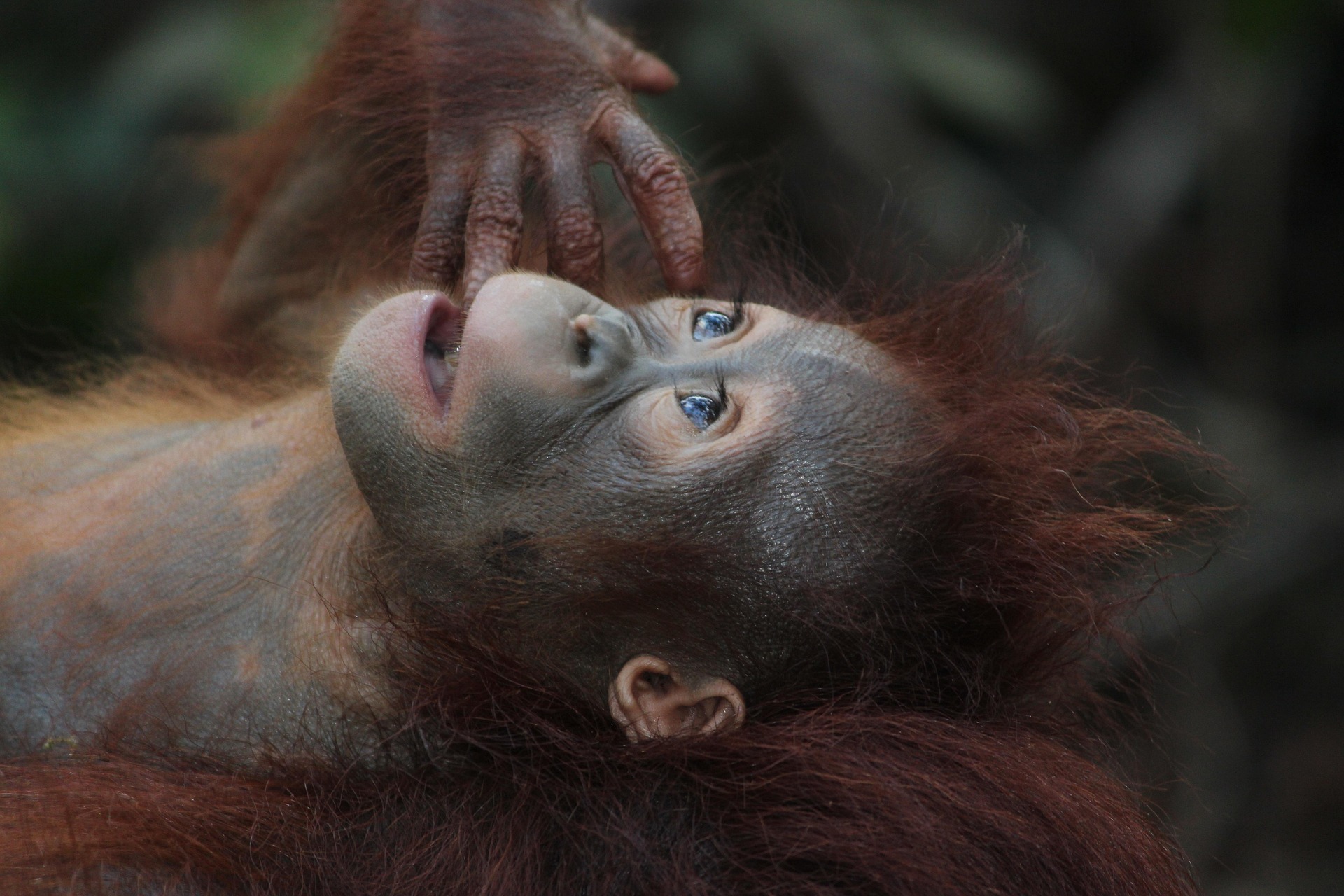
What kind of animals are Sumatran and Bornean orangutans? We will introduce and explain many of the characteristics, ecology, and habitats of these animals. Orangutans are highly intelligent animals found on the island of Kalimantan (Borneo) in Indonesia. Although they are a familiar animal that everyone knows, they are actually designated as an endangered species.


- What is an Orangutan? Basic Stats
- What are the roots and origins of the orangutan?
- Habitat
- What are its characteristics? What kind of creature is it?
- What is their personality like?
- What is their ecology like?
- About Orangutan Babies
- Are orangutans endangered?
- Can you keep orangutans as pets?
- Zoos Housing Orangutans (Japan & Worldwide)
- Recommended articles
What is an Orangutan? Basic Stats
Orangutans are animals classified in the Hominidae family, Pongo genus. Their English name is Orang-utan, and their scientific name is Pongo pygmaeus. Males are 100-150cm long, females 80-120cm long, sitting height 70-90cm, and weights are 60-110kg for males and 40-50kg for females. A list of information is below. There is a significant difference in physical size between males and females.
| Japanese(和名) | オランウータン |
| English(英名) | Orang-utan |
| scientific name(学名) | Pongo pygmaeus |
| classification(分類) | Mammalia、Primates、Hominidae、Pongo 哺乳綱、霊長目、ヒト科、オランウータン属 |
| IUCN Status(保全状況) | ENDANGERED |
| Length(体長) | 100~150cm |
| Weight(体重) | 40~110kg |
About classification
There are the following subspecies of orangutans. Quoted from Wiki.
- Pongo abelii スマトラオランウータン Sumatran orang-utan
- Pongo pygmaeus ボルネオオランウータン Bornean orang-utan
- Pongo tapanuliensis タパヌリオランウータン Tapanuli orangutan
Basic classification
Orangutans are a type of great ape that are closely related to humans within the primate order.
- 界:動物界 Animalia
- 門:脊索動物門 Chordata
- 綱:哺乳綱 Mammalia
- 目:霊長目 Primates
- 科:ヒト科 Hominidae
- 亜科:ヒト亜科 Homininae
- 属:オランウータン属 Pongo
What are the roots and origins of the orangutan?
Orangutans belong to one of the oldest lineages among extant (living) great apes.
The general evolutionary trajectory is as follows:
Early primates
↓
Hominoids (Hominoidea)
↓
Great apes (Hominidae)
↓
Orangutan lineage (Ponginae)
↓
Extant orangutan genus (Pongo)
🌏 Where did they originate?
The lineage leading to modern orangutans is believed to have originated in Asia.
Of particular importance is Sivapithecus, a genus whose fossils have been discovered in the region of India and Pakistan.
Living approximately 12 to 8 million years ago, Sivapithecus is considered highly likely to belong to the lineage closely related to modern orangutans, based on characteristics such as its skull structure.
In short, the history looks like this:
About 10 million years ago
→ Ancestors of the orangutan lineage existed in Asian forests
↓
Lineages subsequently diverged across Asia
↓
Expansion into Southeast Asia, followed by range contraction
↓
Evolution into the modern orangutans of Sumatra and Borneo
🧬 How closely related are they to humans?
Both orangutans and humans are great apes (Hominidae), so they share a common ancestor.
However,
Orangutan
↕
Gorilla
↕
Chimpanzee/Bonobo
↕
Human
…this does not represent a simple linear progression of “Orangutan → Gorilla → Chimpanzee → Human.”
Rather, each group branched off onto a separate evolutionary path from a common ancestor.
🌳 Why did they remain in Southeast Asia?
It is believed that the ancestors of orangutans once inhabited a much wider area of Asia than they do today.
However, climate change and shifts in forest environments caused their habitat to shrink, eventually leaving modern orangutans primarily in:
Borneo
Sumatra The currently known extant species are:
Bornean orangutan
Sumatran orangutan
Tapanuli orangutan
The Tapanuli orangutan, in particular, is a very recently recognized distinct species—officially classified as such in 2017—and inhabits a limited area of Sumatra.
🦧 An interesting fact
The name “orangutan” comes from the Malay and Indonesian phrase orang hutan, meaning “person of the forest.”
And when looking at their evolutionary history, it is a remarkably fitting name.
Habitat
Orangutans are found only in parts of the tropical rainforests of Borneo and Sumatra. During the Pleistocene, they were also found in Southeast Asia and southern China, but are gradually losing their habitat.
- Overview of Habitat
Orangutans currently only naturally occur on two islands in Southeast Asia:
Borneo
Sumatra
Furthermore, they only live in limited areas of the rainforest, not across the entire island.
- Habitat by Species
① Bornean Orangutan (Pongo pygmaeus)
Habitat
Borneo (
Indonesia (Kalimantan)
Malaysia (Sabah and Sarawak))
Environment
Lowland tropical rainforest
Peat swamp forest
Riverside forest
Characteristics
Prefers low-altitude forests
Most affected by deforestation
② Sumatran Orangutan (Pongo abelii)
Habitat
Northern Sumatra
(Aceh, North Sumatra)
Environment
Tropical rainforests from lowlands to mountains
Can live up to approximately 1,000 meters above sea level
Characteristics
Remains in areas with relatively continuous forests
Prefers fruit-rich forests
③ Tapanuli Orangutan (Pongo tapanuliensis)
Habitat
Tapanuli Region, Southern Sumatra
(Batan Toru Forest)
Environment
Montaneous tropical rainforest (approximately 300-1,300m above sea level)
Steep, inaccessible forest
Characteristics
Very restricted distribution
The great ape with the smallest habitat in the world
- Habitat commonality
Orangutans are highly adapted to arboreal life.
They spend most of their lives in trees.
Fruit-based diet (durian, fig, etc.)
They build a new “nest” in a tree each night.
Therefore, forest continuity is essential for their survival.
What are its characteristics? What kind of creature is it?
Orangutans are apes, and are the second largest animal after gorillas. Their body hair is quite long, and their whole body is chestnut or reddish brown, with very long hair on their shoulders and back. Their ears are small, their face is black, and their nose is round and protruding along with their mouth. There is hair around their mouth, and they have a throat pouch. Males have a flat protrusion called a “flange.” Their thumbs are short, but they are opposed to the other four, making it easy to grasp things.
- Physical Characteristics (Appearance)
Long, reddish-brown fur covering the entire body
Extremely long arms (much longer than legs, approximately 1.5 times the body length)
Expressive, human-like eyes
Mature males develop facial flanges (cheek bulges)
⚖️ Weight
Male: Approximately 50-90 kg
Female: Approximately 30-50 kg
Specialized for arboreal life, using their arms to move from branch to branch.
- Behavioral Characteristics (Lifestyle)
Spend almost their entire lives in trees
Rarely descend to the ground
Rather than brachiation, they move slowly by grasping branches (prioritizing safety)
️ Build nests every night
Make a new sleeping area every day by combining leaves and branches
Sometimes even build a “roof” to protect from the rain
- Diet
Mainly eats fruit (60-70%)
Also eats leaves, bark, flowers, and insects
Sustains during times of food scarcity by consuming low-nutrient foods
Memory is important for keeping up with seasonal changes in fruit availability.

What is their personality like?
Orangutans mostly live in trees in forests and other places, and do not come down to the ground. They swing their bodies while hanging from one hand, stretch out their other arm to grab a branch, and move slowly from branch to branch, and usually live alone, but their range of movement is about 2.2 to 6 km2. They also live in groups on rare occasions, so they are very social and intelligent. They cannot swim, but can walk across shallow rivers.
About Intelligence
Orangutans are one of the most intelligent non-human primates. Zoo Atlanta has a touch screen computer where you can see two Sumatran orangutans playing games when they have time. Orangutans can also use sticks and other objects skillfully to make life easier, and it is known that they are quite intelligent.
- Basic Personality
Gentle and calm
Moves slowly (does not waste energy)
Cautious and observant
Avoids pointless conflicts
Among great apes, they are the quietest.
- Aggression?
Generally very low
Keeps distance if trouble seems imminent
Choosing to leave rather than threaten
*However,
Mothers protecting their young
Male-male interactions during breeding season
They may become aggressive in exceptional cases.
- Interpersonal and peer behavior
Solitary but not lonely
Usually solitary
When encountering other individuals:
Lightly observe the situation
Spending only short periods together
Quietly separate
Not forming groups does not necessarily mean they are unsociable.
- Curiosity and Intelligence
Very curious
Carefully observe new objects
️ Use tools in an ingenious way
High learning ability (long-term observation of their mother’s behavior)
Not impulsive, but rather thinks before acting.
- Emotional Expression
Very expressive with expressive facial expressions and gestures
When feeling safe:
Loosen posture
Relaxed with half-closed eyes
Anxious or alert:
Stops movement
Stares intently
Even humans can easily read their emotions.
What is their ecology like?
Orangutans live mainly on fruit, plants, leaves and buds, sap, bark, etc. They reproduce viviparously. They are polygamous and have no set breeding season. The gestation period is 270 days and they can give birth to one baby at a time. Babies are weaned and independent after 2 to 3 years. They change from milk teeth to permanent teeth in about 5 to 8 years, and reach sexual maturity in males at 8 to 15 years and females at 6 to 11 years. They can live for 30 to 50 years in the wild and over 50 years in captivity.
- Basic Ecology
Mainly arboreal life (rarely descends to the ground)
Primarily solitary
Mainly fruit-eating
️ Extremely slow life rhythm
One of the longest rearing periods among primates
A species that “lives in quiet forests for a long time.”
- Daily Life Rhythm
Morning
Wakes up from nest (sleeping place)
Slowly moves around searching for fruit
Lunch
Eats → Rests → Moves repeatedly
Often takes a nap during the day
Evening
Builds a new nest during the day
Goes to sleep before sunset
Activity periods are short, with no unnecessary movements.
- Movement and Home Range
Move using their arms, carefully grasping branches.
Almost no jumping (avoids falling).
Home Range
Males: Wide
Females: Relatively Narrow (Food Resources-Based)
- Diet and Seasonal Variations
Staple Food
Fruit (Figs, Durian, etc.)
Supplementary Food
Young Leaves, Bark, Flowers, Insects, Honey
Fruit Scarcity Periods
Sustain Low Nutritional Value Food
Reduced Activity Level (Energy-Saving Lifestyle)
- Social Structure (Unique)
Does Not Form Groups
Encounters Are Temporary
Mother-Child Relationships are the Core of Society
The “Mother + Child” Unit is the Basic Unit
- Breeding and Rearing
Gestation Period: Approximately 8.5 months
Birth: One baby per litter
Birth Interval: 7–9 years (one of the longest among mammals)
Baby:
Always stays with their mother until around age 5
Becomes independent after 7–9 years
Learns knowledge (food, movement, and danger avoidance) over time
- Lifespan
Wild: Approximately 35–45 years
Captive: Can live for over 50 years
Do they have any natural enemies?
Orangutans have no natural predators other than humans, but their babies can be attacked by snakes and other creatures.

About Orangutan Babies
Orangutan babies (babies and young children) are particularly dependent on their mothers,
and have a long learning period, which is one of their most distinctive features among primates.
Let’s explain each developmental stage in an easy-to-understand manner.
- Immediately After Birth (0-1 Years Old)
Birth Weight: Approximately 1.5-2kg
Short fur, dark face
Clings to mother for most of their life
Cannot move independently
Nutrition is solely through breast milk
Their mother’s arms, belly, and back are their “entire world.”
- Infancy (1-3 Years Old)
Slowly Becomes Interested in Their Surroundings
Strays from Mother’s Arms and Touches Branches
“Imitates” Food and Puts It to Their Mouth
Still Has Constant Physical Contact
This is the time to learn the basics of the forest through play.
- Infancy (Ages 3-5)
Move short distances independently
Keep mother in sight
Increase solid food intake, but continue nursing
Observe and imitate nest building
Golden age of observational learning.
- Juvenile Stage (Ages 5-7)
Nursing is almost complete
Range of activity expands
Learn risk avoidance and food selection through practice
Still sleep in the mother’s nest at night
“Almost independent, but not completely independent.”
- Independence Stage (Ages 7-9)
Completely separate from the mother
Females tend to remain near the mother’s range
Males travel further
The longest mother-infant relationship among primates.
- Why do we raise our infants for so long?
A very wide variety of food
Tree-climbing is dangerous
Knowledge and judgment are the difference between life and death
→ This is because “learning” is more important than “instinct” in their ecology.
- Personality Traits (Young Animals)
Extremely curious
Cuddly
Keen observation skills
Easily returns to mother when startled
More emotionally expressive than adults.
- Survival Rate and Challenges for Young Animals
If they lose their mother, they are virtually impossible to survive.
Most vulnerable to poaching and deforestation.
In rescue facilities, it can take more than 10 years for them to become independent.
Are orangutans endangered?
Orangutans have lost more than 80% of their forest habitat due to deforestation and development, and their habitat is fragmented. They are currently listed as an endangered species and in Appendix I of the Convention on International Trade in Endangered Species of Wild Fauna and Flora (CITES), which prohibits unauthorized trade under international law. They are highly protected due to their high risk of extinction in the near future. A 2018 study found that the Bornean orangutan population decreased by 148,500 between 1999 and 2015. They need immediate protection.
- Conclusion
All three orangutan species are classified as “CR (Critically Endangered)” on the IUCN Red List.
CR (Critically Endangered)
= Imminent extinction in the wild.
- Status of Each Species
- Bornean Orangutan
(Pongo pygmaeus)
Estimated population: Approximately 100,000 (but rapidly declining)
Decreased by more than 50% over the past 60 years
Major threats:
Oil palm plantation development
Forest fires
Illegal logging
Large population, but declining very rapidly.
- Sumatran Orangutan
(Pongo abelii)
Estimated population: Approximately 14,000
Habitat limited to the northern part of the island
Major threats:
Forest fragmentation
Road and plantation development
Small habitat, high risk of rapid decline
③ Tapanuli Orangutan
(Pongo tapanuliensis)
Estimated population: Approximately 800 or less
Habitat: Only one location
Major threats:
Dam construction
Forest fragmentation
The world’s most endangered great ape.
- Why is it so endangered?
The unique biology of orangutans plays a role.
Their birth intervals are extremely long, at 7-9 years.
They cannot survive if the forest is cut off.
They are learning-dependent, and young cannot survive if they lose their mother.
Once populations decline, recovery is extremely slow.
Can you keep orangutans as pets?
As mentioned above, orangutans are designated as endangered species, so they cannot be kept as pets. There will be information about events at the zoo, so enter the zoo and enjoy watching them. When the zoo opens, go to the general information desk to see the herd exhibit. There are also videos and links on the Internet.
- Can I legally keep one?
❌ Ordinary people/individuals → Not possible
Orangutans are listed in Appendix I of the Convention on International Trade in Endangered Species (CITES)
IUCN: Critically Endangered (CR)
Trade, import, and personal ownership are strictly prohibited internationally.
Even in Japan, keeping them as pets and personal ownership are not permitted.
- So why are they in zoos?
⭕ Keeping them is permitted only in limited facilities.
Exceptions are permitted only under the following strict conditions:
️ Zoos and research facilities approved by the national or local government
Breeding and research for the purpose of species conservation
Special permission is required for international movement
The purpose is not “exhibition,” but species conservation.
Zoos Housing Orangutans (Japan & Worldwide)
🇯🇵 Major Zoos in Japan
| Zoo | Species | Key Points |
|---|---|---|
| Tama Zoological Park (Tokyo) | Bornean | Largest group in Japan (10 individuals). A female was born on March 10, 2026. |
| Yokohama Zoological Gardens “Zoorasia” (Kanagawa) | Bornean | A major facility for the species in Japan. |
| Sapporo Maruyama Zoo (Hokkaido) | Bornean | Houses Bornean orangutans. |
| Asahiyama Zoo (Hokkaido) | Bornean | Houses and exhibits the species. |
| Sendai Yagiyama Zoological Park (Miyagi) | Bornean | Houses and exhibits the species. |
| Hamamatsu Zoo (Shizuoka) | Bornean | Houses and exhibits the species. |
| Higashiyama Zoo and Botanical Gardens (Aichi) | Bornean | Houses and exhibits the species. |
| Toyohashi Zoo and Botanical Park (Aichi) | Bornean | Houses and exhibits the species. |
| Kyoto City Zoo (Kyoto) | Sumatran, etc. | Involved in housing and conservation activities. |
| Tennoji Zoo (Osaka) | — | Has a history of housing orangutans. |
| Fukuoka City Zoo (Fukuoka) | — | Houses and exhibits the species. |
※ For a detailed, up-to-date breakdown of the 16 facilities in Japan, please refer to the latest information provided by the Japan Orangutan Research Center.
⭐ Special Focus: Tama Zoological Park
A female Bornean orangutan was born at Tama Zoological Park on March 10, 2026. As of March 26, 2026, the park housed a total of 10 individuals. She has been on public display since May 15.
🌎 Worldwide
Many more zoos overseas house these animals.
🇺🇸🇨🇦🇲🇽🇰🇷 North America & South Korea
In North America, Mexico, and South Korea alone, over 200 individuals are housed across more than 50 AZA-accredited facilities.
Representative examples:
San Diego Zoo
Cincinnati Zoo
Cleveland Metroparks Zoo
Brookfield Zoo
Houston Zoo
Audubon Zoo
Albuquerque BioPark Zoo
Cheyenne Mountain Zoo
Omaha’s Henry Doorly Zoo
Smithsonian’s National Zoo
Zoo Atlanta
Columbus Zoo and Aquarium
Busch Gardens Tampa
🌏 Southeast Asia
Facilities housing orangutans also exist in regions close to their natural habitats. In particular, in
🇮🇩 Indonesia and
🇲🇾 Malaysia,
many individuals are being cared for not only in zoos but also in rescue and rehabilitation facilities.
However, it is necessary to distinguish between “individuals on public display in zoos” and “individuals being cared for with the aim of release back into the wild.”
Recommended articles
コメント