What kind of animal is the Somali wild ass (African wild ass)? We will explain its characteristics, ecology, and habitat. As its name suggests, it is a type of donkey that can be seen widely in the African continent. However, they are in a very dangerous situation because they are designated as an endangered species.


- What is an African wild ass? Basic stats
- What are the roots and origins of the Somali wild ass?
- About habitat
- What are its characteristics? What kind of creature is it?
- What is its personality like?
- What is its ecology?
- About African wild asses (Equus africanus) calves
- Is the African wild ass an endangered species?
- Can African wild asses be kept as pets?
- Zoos Housing the Species (Japan & Worldwide)
- Recommended articles
What is an African wild ass? Basic stats
The African wild ass is classified as a perissodactyl, a mammalian animal of the order Perissodactyla, family Equidae, genus Equus. Its scientific name is Equus africanus, and its English name is Somali Wild Ass or African ass. Its body length is 200 cm and its weight is 200 kg. The list of information is as follows.
| Japanese(和名) | アフリカノロバ ソマリノロバ |
| English(英名) | Somali Wild Ass African ass |
| scientific name(学名) | Equus africanus |
| classification(分類) | Mammalia、Perissodactyla、 Equidae、Equus 哺乳綱、奇蹄目、ウマ科、ウマ属 |
| IUCN Status(保全状況) | VULNERABLE |
| Length(体長) | 200cm |
| Weight(体重) | 200kg |
About classification
This page treats African wild asses and Somali wild asses as the same, but strictly speaking, they are both African donkeys with subspecies Somali and Nubian wild asses. Somali wild asses live in northeastern Ethiopia and Eritrea, while Nubian wild asses live in Sudan and Eritrea.
Taxonomy of African wild asses
- 界 (Kingdom): 動物界 (Animalia)
- 門 (Phylum): 脊索動物門 (Chordata)
- 綱 (Class): 哺乳綱 (Mammalia)
- 目 (Order): 奇蹄目 (Perissodactyla)
- 科 (Family): ウマ科 (Equidae)
- 属 (Genus): ウマ属 (Equus)
- 種 (Species): アフリカノロバ (Equus africanus)
What are the roots and origins of the Somali wild ass?
The Somali wild ass is a subspecies of the African wild ass; it is a wild donkey species that originated in the Horn of Africa (northeastern Africa).
🌍 Origins and Distribution
Its primary origins and habitats are in the arid grasslands and semi-desert regions of:
🇪🇹 Ethiopia
🇪🇷 Eritrea
🇩🇯 Djibouti
🇸🇴 Somalia
The area stretching from northeastern Ethiopia to northern Somalia is a particularly important habitat.
🧬 Close to the “Wild Ancestor” of Donkeys
To understand the Somali wild ass, it is important to consider its relationship with the domestic donkey.
Its general lineage is as follows:
Family Equidae
↓
Genus Equus
↓
African wild ass (Equus africanus)
↓
Somali wild ass (E. a. somaliensis)
Modern domestic donkeys (Equus asinus / E. africanus asinus) are also believed to have been domesticated from the African wild ass.
In other words, a key characteristic of the Somali wild ass is that:
It is not merely “another type of wild donkey,” but a wild animal very closely related to the ancestral lineage of the domestic donkey.
🏜️ Why did it evolve in this region?
The region inhabited by the Somali wild ass is extremely arid.
Consequently, it has adapted to an environment characterized by:
Scarcity of water
Sparse vegetation
High temperatures
Predominance of semi-desert and rocky terrain
It is particularly renowned for its resilience against water scarcity.
Donkeys have evolved to survive in arid environments, and the Somali wild ass is a prime example of this adaptation.
About habitat
African wild asses live in the northern part of Africa.
- Natural Distribution
Main Region: Northeast Africa
Eritrea
Northeastern Ethiopia
Northern and Eastern Somalia
Djibouti
Adapted to arid and semi-desert areas
Living in dry hilly and rocky mountains at altitudes between 0 and 2,000 meters above sea level
- Habitat Characteristics
Prefers arid, semi-desert, and rocky areas
Efficient water intake, allowing them to survive in water-scarce environments
Adapted to harsh, arid environments, they replenish their moisture by eating grasses and shrubs
They also utilize rugged terrain, such as rocky areas and cliffs, to escape predators
- Impacts of Human Activities
Habitat shrinks due to overgrazing and agricultural development
Survival is becoming more difficult due to the decline in water sources and food vegetation
What are its characteristics? What kind of creature is it?
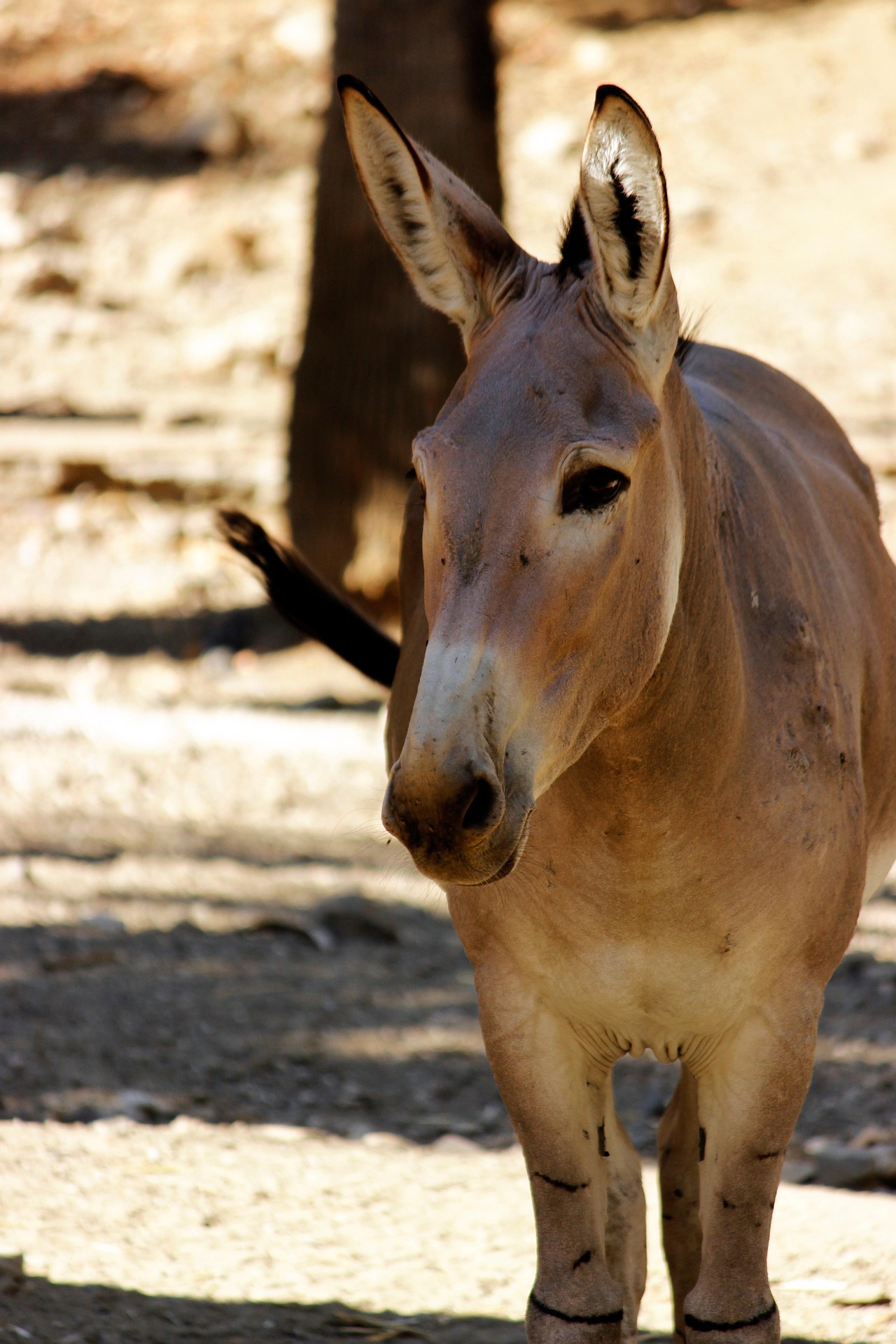
The African wild ass is gray, with white around its mouth and underside. It has long ears and a mane. It usually has a dark line down the center of its back, which extends to the tip of its tail. Donkeys live in semi-desert areas and dry grasslands. They have sharp hearing and vision, but they are also fast runners, and can run at up to 50km per hour when they sense danger.
- Appearance and Physical Characteristics
Body Length: Approximately 220-250 cm (head-to-tail length)
Shoulder Height: Approximately 110-140 cm
Weight: 200-250 kg
Coat Color:
Mostly grayish brown to light brown
Some individuals have vertical black stripes along their sides (especially on their legs, giving them a “striped” pattern)
Tail: Has a black tuft of fur at the tip
Ears: Relatively long, demonstrating the alertness of a wild species
Face: Slightly elongated, with large, expressive eyes
- Ecological Characteristics
Herbivory: Feeds primarily on grasses and shrubs in arid regions
High Water Ability:
Can efficiently obtain moisture from food, even in water-scarce environments
Athletic Ability:
Move agilely across hilly and rocky terrain
Developed leg strength to escape predators
- Behavior/Personality
Timid and cautious
Highly sensitive to predators (such as hyenas and lions)
Live in groups, but individuals are territorial
As a wild species that has not been domesticated, they are not easily tamed by humans
- Distinctive Impressions
They are thought of as “the ancestors of wild horses and donkeys that have adapted to arid lands”
Muscular and strong-legged, they can move nimbly over rocky and arid terrain
Wild in appearance, they excel at both short-distance and long-distance running

What is its personality like?
African wild asses tend to live in small family units and are highly social animals. However, males often live alone. African wild asses rest in the shade of rocks or trees, and are active in cooler times such as early morning and evening.
- Group Personality
Primarily Group-Living
Typically in small groups (approximately 3-15 individuals)
Groups have a sense of hierarchy and territoriality.
Cooperative
They travel and eat as a group, and will send warning signals to each other in the event of danger.
- Vigilance/Timidity
Highly cautious
They will flee immediately if they sense a predator (lion, leopard, hyena, etc.)
Sensitive to humans, making them difficult to approach in the wild.
Timid, they do not act alone, and are dependent on the group.
- Individual Differences/Male-Female Differences
Males:
Active in defending the group and maintaining their territory.
Sensitive to conflict with other males.
Females:
Highly cooperative, important for maintaining stability within the group.
Focuses on protecting and raising young.
- Behavioral Characteristics
They have a strong wild instinct, and their vigilance and agility are central to their personality.
They stay in groups to ensure each other’s safety.
They are skilled in short-distance running and navigating rocky terrain, and excel at escape maneuvers.
What is its ecology?
African wild asses are active during the day and mostly eat grass. They have a gestation period of one year and can give birth to one baby at a time. They reach sexual maturity in about 2 to 4 years, and have a lactation period of one year. They live for 20 to 40 years.
- Behavior
Diurnal (active during the day)
Life in groups
Live in small groups (approximately 3-15 individuals)
Hereditary hierarchy and territorial boundaries exist within the group
High mobility
Able to travel long distances in hilly, rocky, and arid areas
Agile legs allow them to escape predators
- Diet
Herbivore: Eat mainly grasses and shrubs in arid areas
Examples of food:
Grass, leaves, bark, and shrub branches
High water intake:
Efficient water intake from plants, even in environments with few water sources
- Reproduction
Estrous: Breeding is possible regardless of the season, but tends to occur more frequently after the dry season
Gestation period: Approximately 11-12 months
Litter size: Usually one cub (occasionally twins)
Rearing:
Mothers primarily nurse and protect their young
Cubs grow up under the protection of the pack
- Social Structure
Packs often consist of one male, multiple females, and their young.
Intra-Pack Communication:
Communicate through vocalizations and body movements.
Send warning signals and communicate pack movements.
Males are responsible for pack defense and territory maintenance.
Females are important for raising young and maintaining pack stability.
- Adaptation and Survival Strategies
Drought and heat tolerance adapted to arid and semi-desert environments.
Long-distance migration allows them to efficiently search for food and water sources.
Living in packs protects them from predators.
Do they have any natural enemies?
The natural enemies of African wild asses are lions and tigers.

About African wild asses (Equus africanus) calves
This article summarizes the developmental stages and characteristics of African wild asses (Equus africanus) calves from birth to independence.
- Birth, Weight, and Appearance
Birthing: Usually after the dry season, but breeding is possible regardless of the season.
Litter Size: Usually one (twins are rare).
Weight: Approximately 10-15 kg immediately after birth.
Body Length: Approximately 70-90 cm (excluding tail).
Fur Color: Light gray-brown to brown, soft fur.
Characteristics: A small tuft of black fur at the end of the tail, large ears.
- Cubs’ Behavior and Development
A few days to a few weeks after birth:
Nursing close to mother.
Rests in a safe place in the herd.
1-2 months after birth:
Walks around mother and herd, doing light exercise on branches and rocks.
Runs short distances and plays.
3-6 months after birth:
Begins to eat grass and shrub leaves.
Begins to learn social skills and rank within the herd.
- Socialization and Learning
Young animals learn social rules and safety behaviors through play and observation.
They learn how to forage for food and detect danger by watching their mother and other members of the pack.
They also learn pack communication (calls and posture cues) at an early age.
- Independence
Age of Independence: Approximately 2-3 years
By the time they become independent, they have fully learned food foraging and survival techniques from their mother and pack.
After independence, they form their own pack and territory.
- Personality of Young Animals
Curious and playful
They develop strength and agility by playing with their mother and siblings.
They are not yet cautious and are dependent on their mother.
Is the African wild ass an endangered species?
The African wild ass is an endangered species. It is listed in Appendix I of the Convention on International Trade in Endangered Species of Wild Fauna and Flora (CITES), so international trade is strictly restricted. The population has drastically decreased due to overhunting for food and medicine, and competition with livestock for food and water. It is legally protected in its habitat, and protected areas have been established and activities are underway. The estimated population in the 1970s was 5,000.
- Classification as an Endangered Species
IUCN Red List (International Union for Conservation of Nature) Assessment:
Critically Endangered (CR)
Wild population is extremely small, estimated at between several hundred and a thousand individuals
- Main Causes of Decline
Habitat Destruction and Fragmentation
Due to agricultural land conversion and grazing in the arid and semi-desert regions of sub-Saharan Africa and Northeast Africa, populations are declining.
Hunting and Poaching
Captivity for Meat and Fur
Interbreeding with Domesticated Donkeys also contributes to a decline in genetic diversity.
Lack of Water Sources
Climate Change and the Decrease in Water Sources Due to Dry Seasons Have a Significant Impact on Their Survival
- Conservation Efforts
International Protection:
Listed on Appendix I of CITES (Convention on International Trade in Endangered Species of Wild Fauna and Flora)
Commercial trade is prohibited, and international movement is strictly regulated.
Local Protection:
Protected areas have been established in Ethiopia, Eritrea, Somalia, etc.
Captive Breeding:
Populations are maintained through breeding programs in zoos and conservation facilities.
Can African wild asses be kept as pets?
As mentioned above, the African wild ass is designated as an endangered species and is also listed in the Convention on International Trade in Endangered Species of Wild Fauna and Flora (CITES), so international trade is strictly restricted. Therefore, it is extremely difficult to keep it as a pet.
- Legal Issues
African wild asses are listed as an endangered species (IUCN: Critically Endangered, CR)
Listed in Appendix I of the international treaty CITES (Convention on International Trade in Endangered Species of Wild Fauna and Flora)
Commercial trade, import, and export are strictly prohibited
Even in Japan, keeping them without permission is likely illegal under the Wildlife Protection Act and Animal Welfare Act.
- Difficulties in Breeding
Adults are large, weighing approximately 200-250 kg and measuring approximately 220-250 cm in length.
They have high athletic ability and the ability to migrate long distances, requiring a large amount of land.
They have a tendency to live in groups, and keeping them alone is stressful.
They have strong wild instincts and are not easily tame by humans.
- Breeding Examples
They are bred and kept in captivity in zoos and conservation facilities.
They are rarely kept in homes, posing significant ethical and safety concerns.
- Safe and Practical Alternatives
Small domesticated donkeys and horses are practical for home pets.
To observe wild African wild asses:
Zoos and sanctuaries
Documentaries and videos of wild populations
Zoos Housing the Species (Japan & Worldwide)
The Somali wild ass (Equus africanus somaliensis) is an extremely rare animal, and the number of facilities housing them is limited. Zootierliste lists current holding facilities by country.
🇯🇵 Japan
Currently, there are no confirmed zoos in Japan housing Somali wild asses.
Therefore, unlike in the previous answer, it is not possible to list multiple facilities in Japan. It is important not to confuse the Somali wild ass with other types of African wild asses commonly seen in Japanese zoos.
🌍 Major Facilities Worldwide
🇨🇭 Switzerland
Zoo Basel
One of the most important breeding centers globally. They have kept the species since 1970 and achieved their first successful breeding in 1972. They currently coordinate the EAZA Ex-situ Programme (EEP) for the Somali wild ass.
🇫🇷 France
Réserve Africaine de Sigean
They have a history of keeping the species since 1987 and have successfully bred them.
🇩🇪 Germany
Zootierliste lists the following facilities, among others, as current holders:
Tierpark Friedrichsfelde (Berlin)
Zoo Berlin (Berlin)
Tierpark Chemnitz
Wildpark Tannenbusch
Zoo Hannover
Serengeti-Park Hodenhagen
…and others.
🇧🇪 Belgium
Zoo Planckendael
Listed on Zootierliste as a current holding facility.
🇨🇿 Czech Republic
Safari Park Dvůr Králové
A Somali wild ass foal was born here as recently as 2023.
🇬🇧 United Kingdom
Africa Alive
Knowsley Safari
Woburn Safari Park
There have been recent breeding successes; births were recorded at Knowsley Safari in 2024 and at Woburn Safari Park in 2024.
🇺🇸 United States
Major facilities for housing and breeding include:
Dallas Zoo
Saint Louis Zoo
San Diego Zoo Safari Park
Zoo Miami
Denver Zoo
White Oak Conservation
…and others.
Recommended articles
コメント