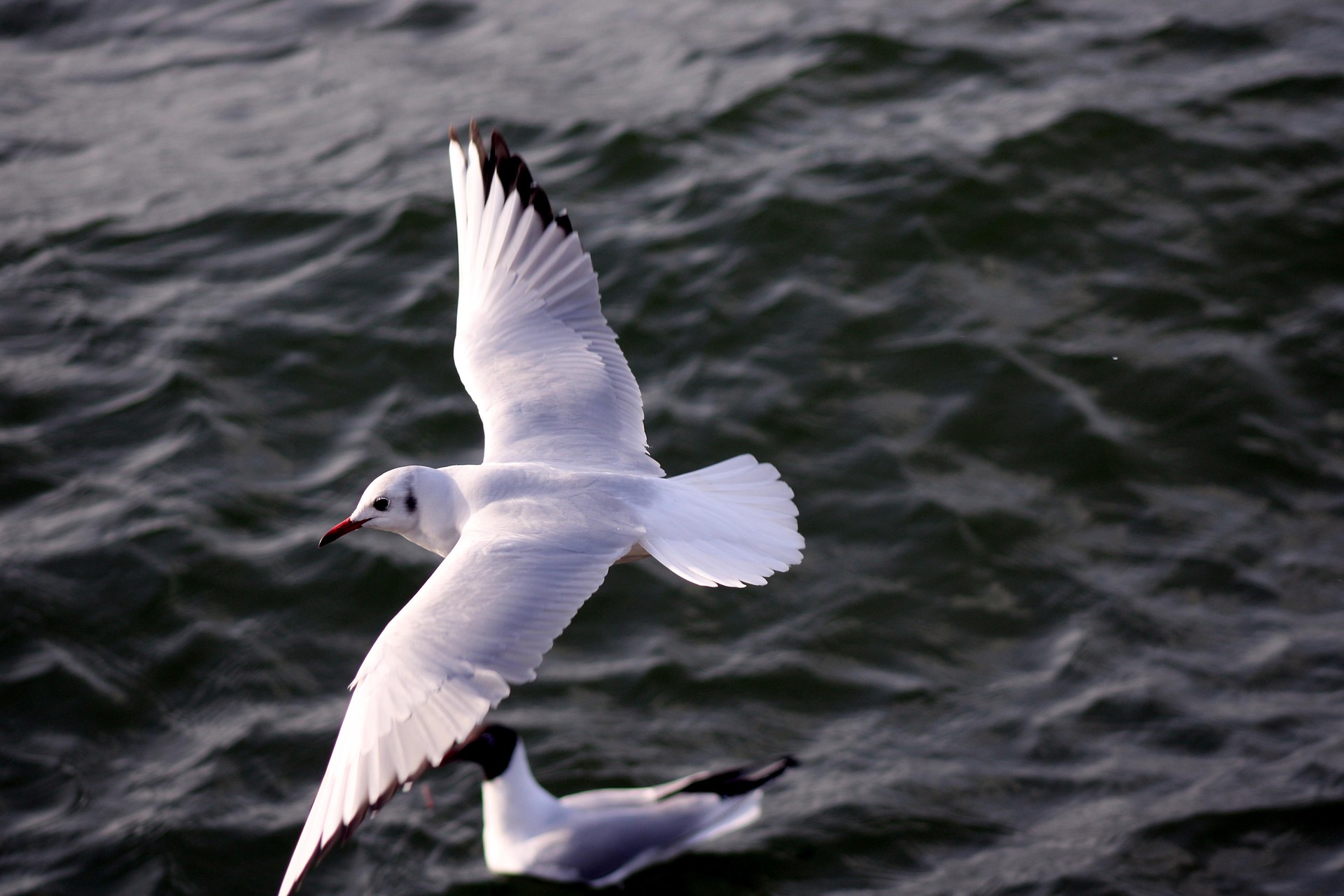
What kind of bird is a black-headed gull? We will explain its characteristics, ecology, and habitat. It is a migratory bird that migrates to Japan, Africa, India, southern China, the Indochina Peninsula, and can also be seen in North America and Europe. We will explain in detail.


- What is Black-headed Gull? Basic Stats
- What are the roots and origins of the black-headed gull (Yurikamome)?
- Habitat
- What are its characteristics? What kind of creature is it?
- What is its ecology?
- About Black-headed Gull Chicks
- Are black-headed gulls an endangered species?
- Can black-headed gulls be kept as pets?
- Captivity in Zoos (Japan & Worldwide)
- Recommended articles
What is Black-headed Gull? Basic Stats
The Black-headed Gull is a bird that belongs to the order Charadriiformes and family Laridae. Its English name is Black-headed Gull, and its scientific name is Chroicocephalus ridibundus. Its total length is 35-45cm, and its weight is 250-400g. Its wingspan is 90-110cm. The list of information is as follows:
| Japanese(和名) | ユリカモメ |
| English(英名) | Black-headed Gull |
| scientific name(学名) | Chroicocephalus ridibundus |
| classification(分類) | Aves、 Charadriiformes、 Laridae、Chroicocephalus 鳥綱、チドリ目、カモメ科、カモメ属 |
| IUCN Status(保全状況) | LEAST CONCERN |
| Length(体長) | 35~45cm |
| Weight(体重) | 250~400g |
Taxonomy of Black-headed Gulls
- 界(Kingdom):動物界 (Animalia)
- 門(Phylum):脊索動物門 (Chordata)
- 綱(Class):鳥綱 (Aves)
- 目(Order):チドリ目 (Charadriiformes)
- 科(Family):カモメ科 (Laridae)
- 属(Genus):カモメ属 (Larus)
- 種(Species):ユリカモメ (Chroicocephalus ridibundus)
What are the roots and origins of the black-headed gull (Yurikamome)?
The black-headed gull (scientific name: Larus ridibundus) is a type of gull. While commonly seen in Japan during the winter, it is not a species native solely to Japan.
🌍 Where is its original home?
Black-headed gulls have a very wide breeding range, extending across:
🇪🇺 Europe
🇷🇺 Russia and Siberia
🇨🇳 Northern China
🇲🇳 The region around Mongolia
🇯🇵 East Asia (including Hokkaido)
The wetland and lake regions of northern Eurasia—stretching from Europe through Russia and Siberia—serve as their primary breeding grounds.
Many of the individuals that visit Japan are migratory birds that travel south from these northern breeding grounds during the autumn and winter months.
🧬 So, when did the black-headed gull first appear?
It is impossible to pinpoint a specific moment—such as “tens of thousands of years ago”—when the species Larus ridibundus suddenly came into existence.
Taxonomically, the black-headed gull belongs to the family Laridae (gulls) and the genus Larus.
Broadly speaking, its evolutionary history looks like this:
Ancestral gull species
↓
Differentiation of gulls within the genus Larus
↓
Diversification of lineages, centered on Eurasia
↓
Establishment of the black-headed gull (Larus ridibundus) lineage
↓
Expansion of distribution across Europe, Siberia, and East Asia
🗺️ How did they arrive in Japan?
The black-headed gulls found in Japan exhibit a fascinating migratory pattern.
Summer:
Northern breeding grounds
↓
Migration south in autumn
↓
Arrival in regions such as the Korean Peninsula, eastern China, and Japan
↓
Overwintering
↓
Migration north again in spring
This is the cycle they follow.
The large numbers of gulls seen in places like Tokyo Bay and along the Sumida River during winter are individuals that have migrated there to spend the cold season.
Incidentally, the black-headed gull has become a very familiar bird in Tokyo and has even been designated as the official bird of Tokyo.
🐦 The Origin of the Name “Yurikamome”
“Yurikamome” is a name that has long been used in Japan.
Its current standard Japanese name is Yurikamome.
In English, however, it is known as the “Black-headed Gull.”
Yet, the Yurikamome seen in Japan during winter have pure white heads,
so you might find yourself thinking,
“But their heads aren’t black, are they?”
This is because their heads turn a dark brown color when they acquire their summer breeding plumage. In winter plumage, that color fades, leaving them with a white head.
Habitat
Black-headed gulls breed in the UK and Ireland in Europe, and migrate to Japan, India, North America and other countries in winter.
Black-headed Gull Habitat
- Breeding Grounds
Summer breeding areas are primarily in Northern Europe and Siberia.
They breed in colonies in lakes, rivers, wetlands, and coastal islands.
They often nest in safe locations in shallow waters or on islands.
- Wintering Grounds (including Japan)
They migrate south in winter to Japan, China, the Korean Peninsula, and Southeast Asia.
They form flocks in areas rich in fish and small animals, such as estuaries, lakes, harbors, tidal flats, and farmland.
In winter, they can also be seen in rivers and lakes near cities in Japan.
- Habitat Characteristics
They mainly live near water.
They prefer shallow waters and shorelines where food is abundant.
They have adapted to human activity to some extent, foraging in harbors and fishing ports.
- Collective Behavior
They form large flocks of hundreds to thousands of birds in winter.
They protect themselves from predators by resting and flying in flocks.

What are its characteristics? What kind of creature is it?
Black-headed gulls have red legs and beaks, and their summer plumage has a dark brown head. In winter plumage, their heads are white, and there is a black spot behind the eye. The tails of adults are white, but young birds have a black stripe on their tails. This small seagull is commonly seen on coasts, rivers, and swamps, and it loves waterside areas. It breeds in northern Eurasia, and migrates to Japan, Africa, and India in winter. It stays near feeding grounds during the day, and often spends the night on the sea or in lakes.
Characteristics of the Black-headed Gull
- Body Size
Total Length: Approximately 38-44cm
Wingspan: Approximately 94-105cm
Weight: Approximately 250-400g
A small gull, it is medium-sized among the gulls commonly found in Japan.
- Body Structure
Beak: Red, medium length
Feet: Red, webbed
Feathers:
Summer Plumage: Black head, white body, black wingtips
Winter Plumage: White head with black spots
Eyes: Black, sharp, and highly alert
- Behavior/Personality
Diet: Omnivorous
Fish, shrimp, insects, earthworms, seeds, breadcrumbs, etc.
In urban areas, they also eat human food.
Flight: Often fly in flocks, they are agile and good at turning.
Sociability: Very sociable and live in flocks.
Warning: They are wary of humans, but are relatively tame in urban and harbor areas.
- Call
They have a high-pitched, shrill call.
They often call out to each other in flocks.
What is its ecology?
Black-headed gulls mainly eat fish and crustaceans, but sometimes eat insects. Black-headed gulls live in relatively large flocks in rivers. They breed by laying eggs. They are said to live for about 30 years.
Black-headed Gull Ecology
- Living Environment
They live mainly near water, such as rivers, lakes, harbors, tidal flats, and coastal areas.
They winter in Japan and East Asia and breed in Northern Europe and Siberia in summer.
They prefer shallow waters and shorelines, gathering in areas with abundant food.
- Activity Patterns
They are diurnal, searching for food during the day.
They catch small fish while swimming in rivers and lakes, and eat insects and seeds on the ground.
They gather in groups to rest and roost.
- Diet
They are omnivorous: they eat fish, crustaceans, insects, earthworms, and seeds. In urban areas, they also eat breadcrumbs and food scraps.
They forage in groups, efficiently capturing food in shallow waters and harbors.
- Breeding
Breeding season is summer (May to July)
Nests are built in a safe location on the ground or on an island
Number of eggs: 2-4
Parents take turns incubating and feeding
Chicks leave the nest at about 3-4 weeks and take several weeks to become independent
- Sociality
Highly gregarious
They can gather in large flocks of hundreds of birds during the winter or at feeding grounds
Flying in flocks provides protection from predators
They rest and travel together even outside the breeding season
- Migration
Black-headed gulls are migratory birds
They migrate south from their northern breeding grounds (Northern Europe to Siberia) to East Asia and Japan in winter
They choose wintering areas with abundant food
Do they have any natural enemies?
Birds of prey such as peregrine falcons are considered natural enemies of black-headed gulls.

About Black-headed Gull Chicks
Here’s a detailed summary of Black-headed Gull chicks.
Characteristics of Black-headed Gull Chicks
- Birth
Approximately 2-4 eggs
Hatching days: Approximately 21-26 days
Immediately after hatching, chicks still have downy feathers, and their bodies are a mix of gray and brown.
Eyes are already open (gulls are “swimming chicks” whose eyes are open from birth).
Body length: Approximately 6-7cm
- Growth and Development
Feather development: Initially, fluffy down → Flight feathers grow within a few weeks
Feeding: Parents feed fish and small animals by mouth
Fleeching: They take flight approximately 3-4 weeks after hatching
They spend another few weeks learning how to forage near their parents before becoming independent
- Behavior/Personality
They can move around close to their parents immediately after birth.
They play with other chicks in the flock and wait for their parents to feed them.
They are not very cautious and are relatively safe within the nest and while their parents are guarding it.
- Parent-Child Relationship
Both parents take turns feeding their chicks.
Parents guard the chicks until they are able to fly.
Even after leaving the nest, they often learn to feed close to their parents.
Are black-headed gulls an endangered species?
Black-headed gulls are classified as least concern and are not an endangered species. They are kept in zoos and other places and events are held, so follow the guide and take part in them.
Conservation Status
Scientific Name: Chroicocephalus ridibundus
IUCN Red List: Least Concern (LC)
Global populations are stable and show no signs of decline.
They are widely observed as winter birds in Japan, where their populations are relatively large.
Conservation Considerations
The Black-headed Gull itself is not at risk of extinction, but localized habitat impacts may occur if water pollution in rivers and lakes or destruction of nesting sites by humans occurs.
Can black-headed gulls be kept as pets?
Black-headed gulls are managed by the Ministry of the Environment under the Wildlife Protection and Management Act and feeding them is prohibited.
- Legal Issues
In Japan, black-headed gulls are protected wild birds under the Wildlife Protection Act.
Capturing and raising them without permission is illegal.
Keeping them requires permission from the Ministry of the Environment or the prefecture (limited to research and educational purposes).
- Ecological Reasons
Black-headed gulls are migratory birds, living over a wide range.
They are highly social birds that live in large flocks and are not adapted to living alone.
They feed on a diverse range of fish, crustaceans, and insects, and require a fresh, aquatic environment.
- Difficulties in Raising
Wild individuals are very wary and difficult to acclimate to people.
Because of their loud calls and flock-like habits, raising them alone can be very stressful.
They require a water source and ample space to fly, making them nearly impossible to raise in a home environment.

Captivity in Zoos (Japan & Worldwide)
Since large numbers of Black-headed Gulls (Chroicocephalus ridibundus; formerly classified as Larus ridibundus) migrate to Japan as winter visitors in the wild, they are not frequently kept on permanent display in zoos.
🇯🇵 Japan
Based on currently available information regarding captivity and exhibits, the following facilities are noted:
| Facility | Location | Status |
|---|---|---|
| Kyoto City Zoo | Kyoto City, Kyoto | ✅ Kept/Displayed |
| Kobe Oji Zoo | Kobe City, Hyogo | ✅ Records of keeping exist |
| Port of Nagoya Public Aquarium | Nagoya City, Aichi | ✅ Registered as a kept animal |
| Ueno Zoological Gardens | Taito Ward, Tokyo | ⚠️ Records of keeping exist |
| Izu Mito Sea Paradise | Numazu City, Shizuoka | ⚠️ Records of keeping exist |
Kyoto City Zoo lists the Black-headed Gull in its official animal encyclopedia; they display the birds—primarily rescued individuals that could not be returned to the wild—in the wild bird aviary within the “Forest of Kyoto” zone.
Additionally, data from the Japanese Association of Zoos and Aquariums (JAZA) confirms that the Port of Nagoya Public Aquarium keeps Black-headed Gulls (Chroicocephalus ridibundus).
Records for Kobe Oji Zoo also confirm the presence of Black-headed Gulls, categorized under waterfowl and seabirds.
🌍 Worldwide
Black-headed Gulls are also kept in captivity overseas.
Examples include:
🇩🇪 Tierpark Dessau (Germany)
🇩🇰 AQUA Akvarium & Dyrepark / Silkeborg (Denmark)
🇩🇪 Weltvogelpark Walsrode (Germany)
🇨🇿 Plzeň Zoo (Czech Republic)
🇮🇱 Nahariya Zoo-Botanical Garden (Israel)
…among others.
Instances of captivity are more commonly found in European zoos and bird parks than in Japan. Zootierliste lists facilities such as Tierpark Dessau in Germany and Silkeborg in Denmark as keepers of the Black-headed Gull (Chroicocephalus ridibundus). Additionally, the black-headed gull is listed among the species to be exhibited at Weltvogelpark Walsrode in 2025.
Specimens have also been recorded at Plzeň Zoo in the Czech Republic.
There are also records of two black-headed gulls being kept at the Nahariya Zoo-Botanical Garden in Israel.
Recommended articles
コメント