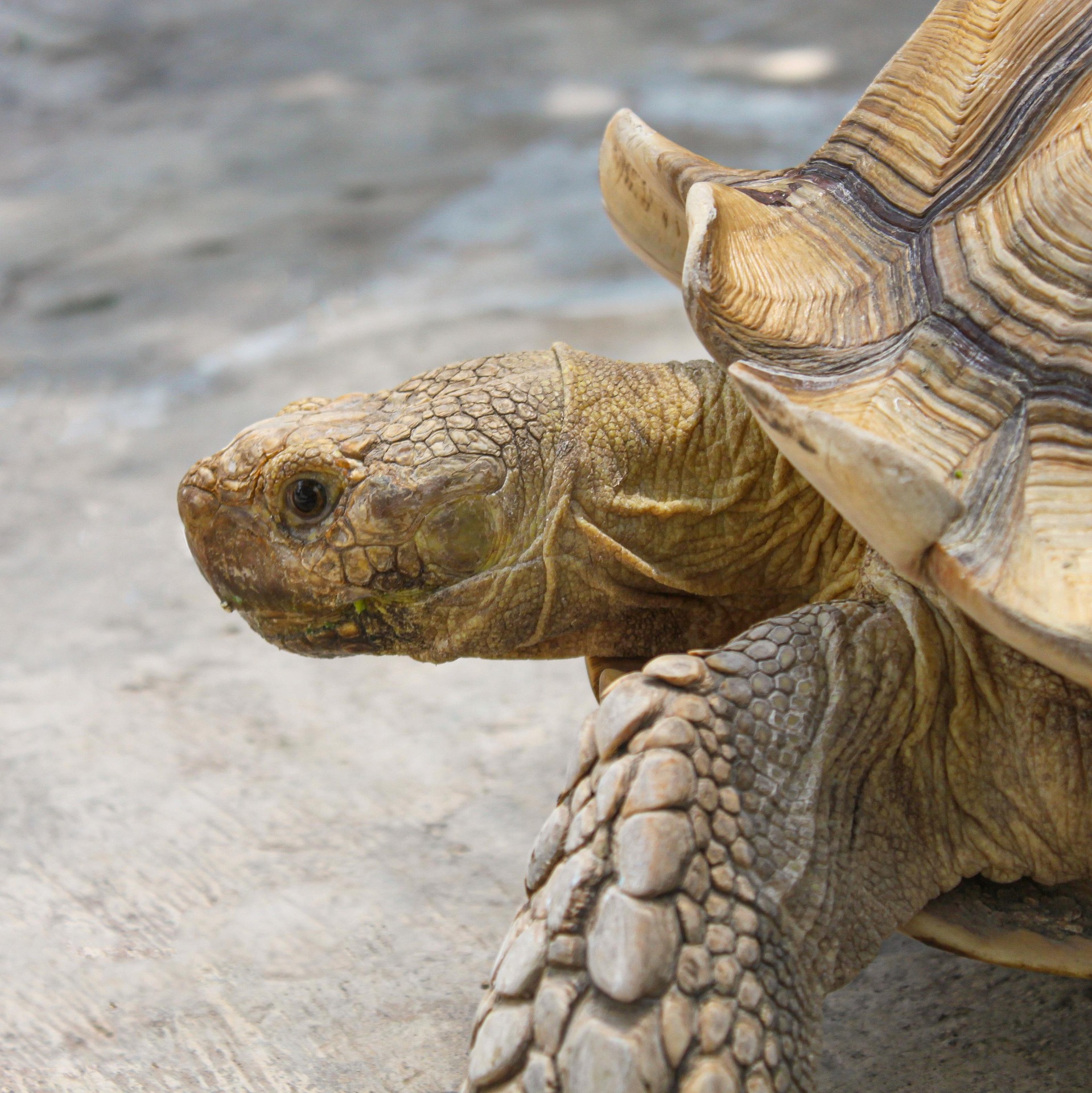
What kind of animal is the Emisuto tortoise? We will explain its characteristics, personality, ecology, and habitat. It is a species of land tortoise endemic to Southeast Asia and has been confirmed to live in a fairly wide area, but it is actually designated as an endangered species.


- What is the Emisutoshogutou? Basic Stats
- What are the roots and origins of the Asian Forest Tortoise (Manouria emys)?
- Habitat
- What are its characteristics? What is it like?
- What is its personality like?
- What is its ecology like?
- About Young Emis Flat-footed Tortoises
- Is the Emis flat-footed tortoise an endangered species?
- Can the Emis flat-footed tortoise be kept as a pet?
- Zoos Housing the Species (Japan & Worldwide)
- Recommended articles
What is the Emisutoshogutou? Basic Stats
The Manouria emys is a turtle classified in the order Testudins, family Testudinidae, and genus Manouria. Its scientific name is Manouria emys, and its English name is Asian forest tortoise/Asian brown tortoise. Its carapace length is 40-60cm and its weight is 20-35kg. The list of information is as follows.
| Japanese(和名) | エミスムツアシガメ |
| English(英名) | Asian forest tortoise / Asian brown tortoise |
| scientific name(学名) | Manouria emys |
| classification(分類) | Reptilia、 Testudines、 Testudinidae、Manouria 爬虫綱、カメ目、リクガメ科、ムツアシガメ属 |
| IUCN Status(保全状況) | CRITICALLY ENDANGERED |
| Length(体長) | 40~60cm |
| Weight(体重) | 20~35kg |
Taxonomy of the Smooth-footed Tortoise
- 界(Kingdom):動物界 (Animalia)
- 門(Phylum):脊索動物門 (Chordata)
- 綱(Class):爬虫綱 (Reptilia)
- 目(Order):カメ目 (Testudines)
- 科(Family):リクガメ科 (Testudinidae)
- 属(Genus):ムツアシガメ属 (Manouria)
- 種(Species):エミスムツアシガメ (Manouria emys)
What are the roots and origins of the Asian Forest Tortoise (Manouria emys)?
Manouria emys—known in English as the Asian Forest Tortoise—is a large tortoise species representative of Southeast Asia.
🌏 Native Range
Its current natural distribution is quite extensive, spanning:
🇮🇳 Northeast India
🇧🇩 Bangladesh
🇲🇲 Myanmar
🇹🇭 Thailand
🇲🇾 Malay Peninsula
🇮🇩 Sumatra
🇮🇩 Borneo
It is primarily adapted to high-rainfall forests and hilly terrain.
🧬 Actually a “Primitive Tortoise”
The most distinctive feature of the Asian Forest Tortoise is its position near the very root of the tortoise family’s (Testudinidae) evolutionary lineage.
Molecular phylogenetic analysis shows the following hierarchy:
Testudinidae (Tortoise family)
↓
Genus Manouria
↓
Asian Forest Tortoise (M. emys)
The genus Manouria occupies a very basal position among extant tortoises. Even more interestingly, research indicates that Manouria is a sister group to the North American genus Gopherus (gopher tortoises).
In short:
It is best understood not as a “relatively new tortoise that evolved to resemble modern tortoises,” but rather as a tortoise that has preserved an ancient evolutionary lineage of the Testudinidae family to the present day.
🦴 A Manouria Relative Once Lived in Japan
This is a particularly fascinating point.
Fossils of an extinct tortoise named Manouria oyamai have been discovered in Late Pleistocene strata on islands such as Okinawa Main Island and Tokunoshima.
Research suggests that:
Manouria emys (extant)
- Manouria impressa (extant)
- Manouria oyamai (extinct)
…form a single monophyletic group (clade). In other words, while the Manouria emys (Asian forest tortoise) we see today did not itself inhabit Japan, a very closely related large Manouria tortoise once lived in the Ryukyu Islands of Okinawa.
🗺️ Evolutionary Overview
To summarize the general picture:
Ancestral Asian tortoise lineage
↓
Divergence of the Manouria lineage
↓
├─ M. impressa (Impressed tortoise)
├─ M. emys (Asian forest tortoise)
└─ M. oyamai (Ryukyu Islands; extinct)
↓
Migration to the forests of present-day Southeast Asia
That is the general evolutionary scenario.
Habitat
The Batagur turtle is found in India, Sri Lanka, Pakistan and parts of Southeast Asia (Thailand, Malaysia and Myanmar). It is now extinct in Singapore.
- Distribution
Distributed throughout Southeast Asia
Thailand, Malaysia, India, Indonesia, Cambodia, Vietnam, Laos, etc.
Found in a wide range of habitats, from low-altitude forests to mountainous areas
- Habitat
Mainly found in humid tropical and subtropical forests
Prefers evergreen and deciduous broadleaf forests and moist forest floors
Semi-terrestrial/mainly terrestrial
Prefers near rivers and wetlands, but is not fully aquatic
Live hidden under fallen leaves and logs on the forest floor
Strong hiding habits
Hide under fallen leaves and logs to protect themselves from predators
Young adults also spend their time camouflaged on the forest floor
- Ecological Characteristics
Active mainly during the cooler hours of the day and evening
Searches for grass, fruit, and insects on the forest floor to feed on
Strong hiding habits make them difficult to spot
What are its characteristics? What is it like?
The Emis mute-footed tortoise is said to be one of the most primitive and largest, with a rather large head and a short snout. The front of its four legs are lined with large scales with spiny tips. The Emis mute-footed tortoise prefers to live in tropical rainforests from lowlands to mountainous areas. It is active at dusk, and is active during the day when the temperature is not too high.
- Appearance and Physical Characteristics
Size
A large species among extant tortoises
Adults reach a carapace length of 40-70 cm, with some individuals weighing around 20-30 kg.
Carapace (Dorsal Shell)
Brown to blackish-brown
Flat, dome-shaped, with a slightly rugged carapace pattern
Juveniles have bright yellow or orange spots on their carapace, which fade as they grow.
Plaston (Ventral Shell)
Yellowish-brown to pale yellow
Small patterning
Head and Limbs
Medium-sized, rounded head
Stiff legs with strong claws on the forelimbs, adapted for digging in forest floors and moist soil
Tail
Short, blunt tip
- Behavior & Ecology
Semi-terrestrial turtle, mainly living on the forest floor
Although they may go near water, they primarily spend their time on land
They live hidden under fallen leaves or fallen logs on the forest floor
Activity Pattern
Active during the day and evening, resting under fallen leaves or logs during hot weather
Diet
Omnivorous
Plants: Leaves, fruits, and grasses
Families: Insects and small invertebrates
Young turtles consume a lot of animal food, and as they grow older, they also consume more plant food
- Personality
Timid and cautious
When threatened, they will hide under fallen leaves or logs
Little aggressive, and gentle
Can coexist with other turtles and small animals
Curious but reserved
They will come out slowly when food is available, but do not easily become accustomed to people

What is its personality like?
The Emis mute-footed tortoise is a gentle type of tortoise, and is very easy to raise because it is docile, but it is also designated as an endangered species, so the selling price is rising and it is becoming difficult to obtain it.
- Basic Personality
Timid and highly cautious
If threatened, they immediately hide under fallen leaves or fallen logs on the forest floor
Gentle and rarely aggressive
Likely poses little problem in the same environment as other turtles or small animals
Curious but reserved
They may slowly emerge when food is available, but are not easily accustomed to people
- Behavioral Characteristics
Strong hiding habit
Hides on the forest floor, fallen logs, or under fallen leaves
Activity Pattern
Active during the day and cooler evening hours
Moves very little during hot weather or when threatened
Cautious and environment-dependent
It is more important for them to get used to safe environments such as the forest floor or fallen logs than to get used to humans
- Personality in Captivity
Very easy to handle but timid
Almost non-aggressive, making them a joy to observe
Juveniles are particularly cautious and often spend their time hiding under fallen leaves or logs
Slow and calm
Preparing the environment and observing quietly is key
What is its ecology like?
The Emis mute-footed tortoise is herbivorous, and lives by eating plants, grasses, leaves, seeds, bamboo shoots, fruits, etc. It is oviparous. It lays eggs by building a nest on the ground, and collects leaves, branches, and soil to create a mound-shaped nest. Females tend to stay in the nest after laying eggs and guard them. In the wild, they are said to live for 100 to 150 years.
- Habitat
Semi-terrestrial, forest-based lifestyle
Inhabits the humid tropical and subtropical forests of Southeast Asia
Includes areas near rivers and wetlands, but is not fully aquatic
Strong hiding habits
Hides under fallen leaves or logs on the forest floor
Young animals also spend their time camouflaged among fallen leaves and moss
- Activity Patterns
Active during the day and evening
Mostly stays hidden during hot weather or when they sense danger
Thermoregulation
May engage in short periods of sunbathing (basking) in open areas of the forest floor
- Diet
Omnivorous
Plants: Leaves, fruits, grass
Animals: Insects, small invertebrates
Young animals consume a large amount of animal-based food
As they grow, they eat more plant-based foods and adapt to the same omnivorous diet as adults
- Reproduction
Spawning: Spring to early summer
2-6 eggs per clutch They lay their young under fallen leaves or damp soil on the forest floor.
Their young also spend their time hiding on the forest floor.
They learn to hide from an early age and adapt to the same ecology as adults.
Do they have any natural predators?
Small-footed tortoises are sometimes preyed upon by tigers, bears, and foxes.

About Young Emis Flat-footed Tortoises
This section provides a detailed overview of young Emis flat-footed tortoises (Manouria emys).
- Appearance and Physical Characteristics (Young Adults)
Size
The carapace length immediately after hatching is approximately 6-8cm.
They grow to be large turtles, measuring approximately 40-70cm.
Shell (Carapace)
Young adults have a brown to dark brown carapace with bright yellow or orange spots.
The pattern fades as they grow, settling into a dark brown color in adults.
The shell is soft and dome-shaped.
Plaston (Ventral Shell)
A light yellowish-brown shell with a subtle pattern.
Head and Limbs
The legs are thick, with strong claws on the forelimbs, adapted for digging in the forest floor and moist soil.
The head is medium-sized and rounded.
Tail
Short, blunt tip.
- Behavior and Personality (Juveniles)
Very timid and cautious
If threatened, they will immediately hide under fallen leaves or fallen logs on the forest floor
Curious but reserved
They will slowly emerge when food is presented, but are not easily accustomed to people
Activity Pattern
Active in the mornings, evenings, and cooler times of the day, hiding during the day
- Diet (Juveniles)
Omnivorous, but consumes a large amount of animal matter
Eats mainly insects and small invertebrates
Consume small amounts of leaves and fruit
As they grow, they consume more plant matter, adapting to the same omnivorous diet as adults
- Ecology and Lifestyle
From the juvenile stage, they live hiding on the forest floor, under fallen leaves, and fallen logs
Avoids high temperatures and dryness, and primarily hides
Adapts to the same behavioral patterns and ecology as adults within a few years
Is the Emis flat-footed tortoise an endangered species?
The Emis flat-footed tortoise is listed in Appendix I of the Convention on International Trade in Endangered Species of Wild Fauna and Flora (CITES), and international trade is restricted. Not only has its habitat been reduced due to recent development, but it has also been over-hunted as a pet, which has become a problem.
- International Conservation Status
IUCN (International Union for Conservation of Nature) Red List
Classification: EN (Endangered) – Critically Endangered
Meaning: Wild populations are declining and at high risk of future extinction
CITES (Convention on International Trade in Endangered Species of Wild Fauna and Flora)
Listed in Appendix II
A permit is required for international trade, and unauthorized import and export are prohibited
- Main Causes of Decline
Pet Trade/Smuggling
Due to their large size and rarity, wild capture is common.
Habitat Destruction
Deforestation and development in Southeast Asia have reduced forest floor habitat.
Environmental Change
Habitat conditions are deteriorating due to deforestation and deterioration of humid environments.
- Conservation Status and Measures
Captive Breeding
Captive-bred in zoos and conservation organizations, and legal captive populations are in circulation.
Habitat Protection
Forest Protection and Illegal Logging Regulations
International Regulations
International trade is governed by CITES Appendix II
Can the Emis flat-footed tortoise be kept as a pet?
The Emis flat-footed tortoise is also designated as an endangered species in Asia, so there is currently little stock and it is difficult to obtain, but there is some information available and it is possible to keep it as a pet.The items needed to keep a turtle are as follows. Small individuals are newly registered and sold, and there are many recruitments for foster parents, so check them out. Pay attention to the type of food and cage. They also have a long lifespan, so take that into consideration.
Cage
Depending on the size of the shell and the growth rate, a wide cage of about 60 cm is required in a shop. It is recommended to use a reptile cage made of glass, acrylic, or plastic.
Flooring
There are various types of flooring categories, from large to small. There are various types, such as Akadama soil, coconut shells, and artificial turf. Sometimes they are sold at a low price during campaigns.
Heater
If necessary, prepare an air conditioner or heating appliance to make sure your turtle is comfortable. There are panel heaters, spot lamps, and basking lights.
Thermo-hygrometer
When raising amphibious turtles, it is very important to control the temperature and humidity. It is best to keep the temperature at around 30 degrees.
Lighting
Turtles are animals that maintain their health by producing vitamin D3 in their bodies, which promotes calcium absorption, by exposing them to strong ultraviolet rays in a day. For this reason, lighting is essential. There are incandescent and fluorescent tube types, and it is best to choose one that suits the cage. Use the sunlight hours as a guide for lighting.
Shelter
Turtles are living creatures, so it is a good idea to have a shelter as a point to create a place where they can escape indoors. Make sure to install it properly so as not to cause them too much stress.
Water dish
A water dish is also essential. Wash the water bowl every day and provide fresh water.
Pet Food
Turtles are herbivorous and their food consists mainly of small vegetables and fruits, with some also eating mustard spinach and mushrooms. Some turtles eat wild plants instead of vegetables. Give them fruits such as bananas, watermelons, apples, strawberries, kiwis, and mangoes as snacks. Some people also give supplements as a reference. It is a good idea to start by offering commercially available products. These contain all the nutrients that living creatures need.
Zoos Housing the Species (Japan & Worldwide)
The Asian Giant Tortoise (Manouria emys) is one of the largest tortoise species in Asia. As it is currently Critically Endangered (CR) in the wild, its husbandry and breeding in zoos are of significant importance for conservation. It is managed under the EAZA EEP program in Europe and the AZA SSP program in North America.
🇯🇵 Japan
Hiroshima City Asa Zoological Park
Records indicate the species is kept here; it is also listed as a current holding facility in international zoo databases.
Yokohama Municipal Nogeyama Zoo
Past annual reports from Yokohama City Zoos confirm the husbandry of the Asian Giant Tortoise (Manouria emys).
🌎 Major Facilities Worldwide
| Country | Zoo/Facility |
|---|---|
| 🇺🇸 USA | Honolulu Zoo |
| 🇺🇸 USA | San Diego Zoo |
| 🇺🇸 USA | Dallas Zoo |
| 🇺🇸 USA | Houston Zoo |
| 🇺🇸 USA | Smithsonian’s National Zoo |
| 🇨🇦 Canada | Toronto Zoo |
| 🇪🇸 Spain | Barcelona Zoo |
| 🇩🇪 Germany | Aquazoo Düsseldorf |
| 🇩🇪 Germany | Leipzig Zoo |
| 🇵🇱 Poland | Wrocław Zoo |
| 🇧🇪 Belgium | Pairi Daiza |
| 🇸🇪 Sweden | Nordens Ark |
| 🇸🇬 Singapore | Singapore Zoo / Mandai Wildlife Group |
| 🇹🇭 Thailand | Nakhon Ratchasima Zoo |
| 🇵🇭 Philippines | Avilon Zoo |
| 🇮🇱 Israel | Ramat Gan Zoological Center |
These are facilities where records of Manouria emys husbandry have been confirmed.
Recommended articles

コメント